Brand guidelines examples from five real brand books: a section-by-section template, contrast checks on real palettes, font licences and IP India's fees.
- Published
- Reading time
- 14 minutes
Drafted with AI tools; researched, edited and approved by Althameem Ali. Our editorial policy
On this page · 14 sections
- What are brand guidelines, and who uses them?
- What should brand guidelines include?
- What do five brand books from our own work do well?
- Tagus Global: one master brand, three businesses
- Damascas: a story that justifies every choice
- Ynad Mount Resort: rules for every guest touchpoint
- Clarix Education: a compact book that covers the essentials
- TBJ: a personal brand with a voice
- How detailed should a small business's guidelines be?
- What digital rules do guidelines need for contrast, fonts and licences?
- How should guidelines cover packaging, signage and social templates?
- How do you protect the logo?
- Frequently asked questions
- Start with what people actually make
Full disclosure: we design identities, and the guidelines that come with them, as part of our branding work for businesses in Kerala, across India and in the Gulf. Every example below comes from a brand book we designed. The signs, vans and packs in those books are presentation mockups, and our case studies label them that way.
Below is a section-by-section template, five real books and what each does well, the digital rules most books forget, and how to protect the logo once it exists.
What are brand guidelines, and who uses them?#
Brand guidelines, also called a brand book, brand manual or style guide, turn an identity into rules other people can follow. The designer won't be in the room when a staff member makes an Onam poster, a sign maker cuts letters for a new branch, a developer builds the website or a Gulf distributor prints a shelf talker. The guidelines are there instead.
Without them, a brand drifts. The signboard shows one version of the logo, Instagram another and the delivery bag a third, which is one of the seven signs in our guide to whether you need a rebrand or a refresh. Each lapse is small; together they make a business look smaller than it is.
Governments have reached the same conclusion. India's Ministry of Electronics and Information Technology launched a Digital Brand Identity Manual (opens in a new tab) on 18 February 2025 to standardise colour palettes, typography and iconography across government websites, apps and social media. In the UAE, every federal government entity must comply with (opens in a new tab) TDRA's UAE Design System (opens in a new tab), now in version 3.0, for its websites. If ministries need a rulebook to stay consistent, a business with three branches and an Instagram page will benefit from a shorter one.
What should brand guidelines include?#
Use this as a template. The right-hand column points to a book of ours that handles each section well.
A good book explains why as well as what. The Damascas book calls its Champagne Gold "the spark against the shadow", the warmth of hospitality, which tells the next designer to keep it for the logo and highlights. A rule with a reason survives a change of designer; a bare rule gets ignored the first time it's inconvenient.
What do five brand books from our own work do well?#
All five are on our brand identity case studies page, with pages from each book. They're very different documents, which is the point: the right book depends on the business.
Tagus Global: one master brand, three businesses#
Tagus Global is a Saudi parent company with freight and logistics, facility management, and travel and holidays businesses, so its guidelines are about architecture. The mark, a globe carved with a T, carries every division under the same lockup with a spaced descriptor, and the group reads as one company. Colour is fixed at 60% Horizon White, 30% Najd Forest and 10% At-Turaif Gold, each with HEX, RGB and CMYK values. Clear space comes from a unit taken from the mark itself, and the misuse rules forbid stretching, recolouring, gradients, shadows and glows. The applications run from truck and container livery to kraft cartons, uniforms and a social grid, all shown as mockups.
Damascas: a story that justifies every choice#
Damascas is a world-cuisine restaurant brand in Kozhikode, and its book leads with the idea: "Global tastes, Kozhikodan soul." The emblem draws the wave of Calicut beach rising into the fire of the dum and the charcoal grill, then settling into a chef's cap. Typography is assigned by job, the most useful page for anyone making a menu: Vonca for the hook, Gotham for what people scan (prices, signs, buttons) and Lora for what they read. Minimum sizes are set, with 355 px recommended for the lockups and 90 px for the emblem, and the mockups run from a teal-and-gold façade to chef jackets and a Malayalam teaser poster.
Ynad Mount Resort: rules for every guest touchpoint#
Ynad Mount Resort is a hill resort in Wayanad whose mark interlocks six Ys, drawn after the Edakkal cave carvings. The book's strength is its kit of devices: the mark tessellated into a lattice pattern, an oversized super-graphic, a circular seal for embossing and stamps, and a thin-line icon set for wayfinding. It sets the colour split too (45% Forest Green, 30% Silver Gray, 20% Burnt Orange, 5% Sand Dollar), with minimum sizes for both lockups. The mockups follow a guest from the business card and the trail sign to door hangers, key tags and restaurant napkins.
Clarix Education: a compact book that covers the essentials#
Clarix Education, an admissions and career-guidance consultancy, covers the fewest touchpoints of the five, which makes it a good model for a small business. One purple (#513392) and white do almost all the work, black is kept for one-colour use, and four colourways are approved. A logo grid sets the clear space, three typefaces each have one job (Ronta for the logo, NewBlack for headlines, Raleway for text), and the applications stop at what the business uses: an app icon, business cards, a letterhead and envelopes.
TBJ: a personal brand with a voice#
TBJ is the brand book for the rapper The Baby Jean, and it shows what guidelines can do for voice and photography. Two manifesto pages in the artist's own words set the tone. A heavy, forward-slanted monogram with a bull cut into the B sits in a three-colour world of cream, deep green and charcoal, and a green duotone turns performance photos into brand images. A star-grid pattern repeats the spark in the logo, and the mockups run from gig posters and tickets to a tote and streaming artwork.
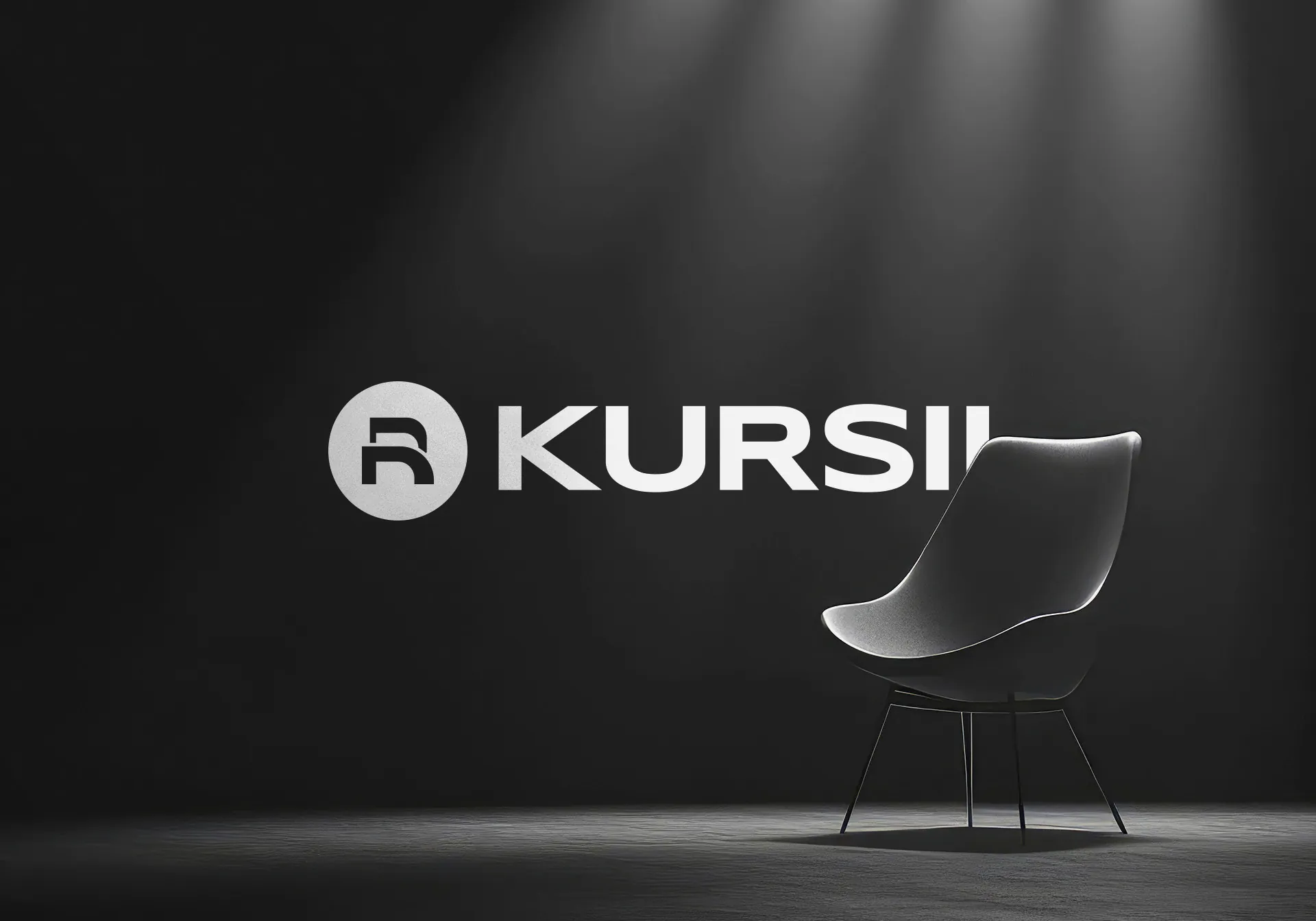
The identity we designed for Kursii, a seating brand, adds one more lesson: its chair-shaped R monogram repeats into a pattern for packaging, uniforms and showroom walls, so the brand still shows when the logo doesn't.
How detailed should a small business's guidelines be?#
Detailed enough for the people who'll use them, and no more. A book nobody opens protects nothing.
For a single café, clinic, shop or consultancy, the core fits in a few pages:
- Logo files in the formats each supplier needs: vector files for print and signs, PNG and SVG for screens, and the icon on its own for profile pictures.
- Two or three colours with HEX, RGB and CMYK values, and a note on which colours text may sit on.
- Two typefaces, with sizes for headlines and body text.
- Clear space and a minimum size, so the logo survives a WhatsApp profile circle and an embroidered shirt.
- A handful of do's and don'ts, shown as pictures.
- Templates for what you make every week: a post, a story, a WhatsApp status, a menu or price list, an invoice and a letterhead.
Clarix's book shows how compact that core can be. A group with several divisions, a franchise or a brand entering new markets needs the fuller version, with brand architecture, misuse pages, language versions and specifications for signs, vehicles and packs, as in Tagus Global's book. What each level of branding work usually includes is set out in our guide to branding costs in India.
What digital rules do guidelines need for contrast, fonts and licences?#
Colours that look rich on a printed swatch can fail on a phone. The Web Content Accessibility Guidelines (WCAG 2.2 (opens in a new tab)) ask for a contrast ratio of at least 4.5:1 for normal text and 3:1 for large text (18 point, or 14 point bold), and 3:1 for interface parts such as buttons and icons. Logos are exempt.
We ran pairs from our own books through the WCAG formula:
Our calculation with the WCAG 2.2 contrast formula, from the colour values in each book.
The lesson isn't that any of these colours is wrong. Burnt orange beside forest green is a fine pairing for a logo or a pattern; it just can't carry words. Good guidelines say so, with a short table of which colour sits on which, so nobody finds out after the flyers are printed.
Fonts need the same care:
- Name a web version and a fallback for each typeface, so the website and emails don't quietly switch to a default font.
- Cover every script you use. If you advertise in Malayalam or Arabic, the guidelines should name a matching typeface for it instead of leaving the choice to whoever types the poster.
- Check the licence. Fonts under the SIL Open Font License (opens in a new tab) can be used in logos, print and websites and embedded in documents; they can't be sold on their own, and a modified version can't use a reserved name. Clarix's text face, Raleway, is one, and its licence (opens in a new tab) reserves the name "Raleway". A commercial typeface needs a licence that covers each use you plan, so record the licences you hold in the book itself.
How should guidelines cover packaging, signage and social templates?#
This is where a book earns its keep, because these pieces are made by other people, often in a hurry.
Packaging. The guidelines set the system: how the logo sits on a pack, how flavours or variants are colour-coded, and what reads from two metres away. They don't replace the law. Food packs sold in India must carry the information FSSAI requires, so leave room for the legal panel from the first sketch. Our checklist of FSSAI labelling rules lists what has to go on it, and our guide to starting a food brand in India puts the pack in the launch order. We design those systems as packaging design projects. Our guide to the packaging design process follows one from brief to print.
Signage, vehicles and uniforms. Specify the lockup for each surface, the materials, the illuminated version and the smallest size that still reads from across the road. Damascas's mockups show gold letters on a teal slatted fascia and a crest on a waistcoat; Tagus Global's scale the mark's rising bands into a super-graphic across a truck; Ynad's route the lockup into a timber trail sign.
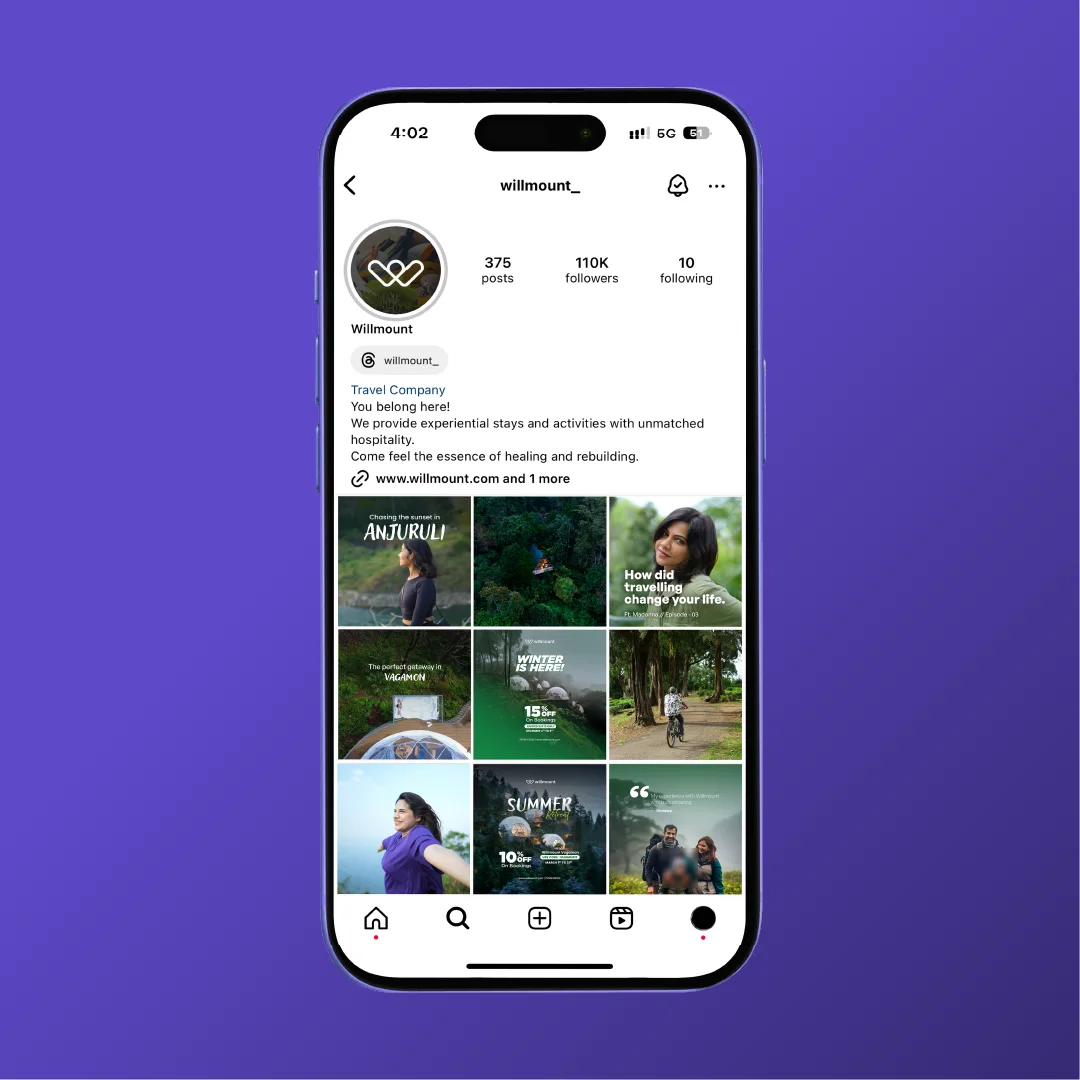
Social templates. Staff will make posts whether or not you give them tools, so give them templates as well as rules. Damascas's book includes social and story templates, Tagus Global's has a colour-block grid of green, white and gold tiles, and TBJ's includes story templates and video thumbnails. A template that already has the right fonts, colours and logo placement does more for consistency than a page of instructions.
How do you protect the logo?#
Guidelines control how the brand is used; a trade mark controls who may use it.
- File early, in every class you trade in. IP India's official fee (opens in a new tab) for a trade mark application (Form TM-A) is ₹4,500 per class filed online, or ₹5,000 on paper, for individuals, start-ups and small enterprises, and ₹9,000 (₹10,000 on paper) for others, before any attorney's fees (fee schedule read on 4 October 2026). Classes follow the international Nice classification: a restaurant, café or resort files in Class 43 (opens in a new tab), which covers food and drink services and temporary accommodation, and needs goods classes as well if it sells packaged products.
- Use ® only after registration. Section 107 of the Trade Marks Act, 1999 (opens in a new tab) forbids representing an unregistered mark as registered. The Jan Vishwas (Amendment of Provisions) Act, 2023 (opens in a new tab) replaced its old jail term with a penalty of 0.5% of the business's total sales or turnover, or ₹5 lakh, whichever is less, in force since 1 August 2024.
- Get the artwork in writing. The logo's copyright should pass to you with the files. Our own branding terms hand over full intellectual property and every source file on final payment, and that's the clause to look for in any designer's contract.
- Plan for the Gulf separately. An Indian registration doesn't cover the UAE or Saudi Arabia, so a Gulf launch needs its own filings there.
Frequently asked questions#
What is the difference between brand guidelines and a brand book?#
Usually nothing: both names describe the document that sets out how a brand is used. Some teams keep "brand book" for a version that tells the brand's story as well as its rules, and "guidelines" for the technical rules alone.
How many pages should brand guidelines have?#
There's no right number. A single-location business can cover the logo, colours, fonts, spacing, do's and don'ts and a few templates in a short document, while a group with several divisions, languages and vehicles needs a full book. Length should follow the number of touchpoints and the number of people who use it.
What format should brand guidelines be in?#
A PDF that anyone can open, plus the master logo files and editable templates. Large organisations sometimes publish their guidelines as a website instead; the UAE Design System is one example.
How often should brand guidelines be updated?#
Whenever something real changes: a new sub-brand, a new market or language, new packaging or a new channel. Put a version date on the cover, so suppliers know which copy is current.
Do brand guidelines need Malayalam or Arabic versions?#
If you communicate in those languages, yes. The guidelines should include lockups drawn to match the Latin logo in weight and rhythm, and name typefaces that support each script, rather than leaving the choice to whoever makes the next poster.
Start with what people actually make#
The real test of a brand book is the next poster, menu or van someone produces without calling the designer. If yours would fail that test, or if you don't have one yet, tell us what you're working with and we'll suggest the smallest book that will hold the brand together. You can see the full range of our brand identity work, or page through the books themselves on our branding case studies.
Related services
Industries
Written by
Co-founder, Marketlube
Althameem Ali researched, edited and approved this post. Marketlube is a growth partner in Calicut building brands, websites, CRMs and campaigns for businesses across Kerala, India and the Gulf.