Food packaging design in India for 2026: formats for spices, snacks and pickles, our audit of 32 Kerala packs, flavour systems and the rules now changing packs.
- Published
- Reading time
- 12 minutes
Drafted with AI tools; researched, edited and approved by Fidal P. Our editorial policy
On this page · 8 sections
- What does a food pack have to do in 2026?
- Which format suits which food?
- What did our audit of Kerala spice and snack packs find?
- How do you design a range so flavours read at a glance?
- How do you design for a kirana shelf and a quick-commerce thumbnail at once?
- What is changing for food packs in 2026?
- Frequently asked questions
- Design the range, not just the pack
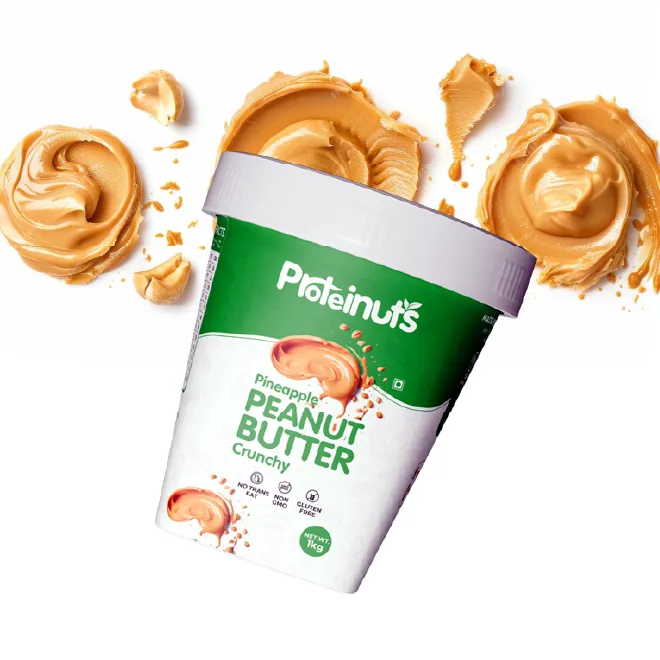
We design packaging for food and FMCG brands, including the peanut butter tub labels we designed for Proteinuts, so this guide is written from the design side. It covers the choices that differ by food: format, front panel, range system and what is changing in 2026. The label's legal content has its own home in our FSSAI labelling checklist, and the law on materials in our guide to FSSAI packaging regulations.
A food pack in India is now judged twice: on a crowded shelf, and as a small image in an app. Our page for FMCG and food brands puts the problem plainly: "Most regional brands design for the pack in hand, not the pack at two metres or at 200 pixels."
What does a food pack have to do in 2026?#
Four jobs, in this order:
- Protect the food until its last day: from light, air, moisture, oil and the trip to the shop or the doorstep.
- Tell the truth the law asks for: the name, ingredients, nutrition, veg or non-veg mark, net quantity, price and the rest, at their minimum sizes.
- Sell on the shelf: what it is, why it's better and which variant, readable from two metres in about three seconds.
- Sell on the screen: the same, at thumbnail size, because quick commerce and marketplaces now sell food too.
The first two are fixed by the product and the rules. The craft is in fitting the last two into what is left without crowding the first two out.
Which format suits which food?#
Start from the food, not the look. The format decides the cost, the shelf life and how the pack sits on a shelf, a hook or a phone screen.
Ask your printer or converter for the barrier film, inks and test reports that match the food; our FSSAI packaging regulations guide covers the standards they should meet.
What did our audit of Kerala spice and snack packs find?#
On 7 October 2026 we looked at the front-of-pack listing image of 32 retail packs from nine Kerala food brands, three of them now owned by larger groups: 11 spices (7 ground, 4 whole), 9 masala blends, 6 pickles and 6 snacks. We found them on the brands' own online stores or catalogues and, for one brand, on Flipkart, and coded what a shopper sees on the front. We read listing images, not packs in hand, so anything printed on the back or added on the packing line isn't counted. We don't name the brands, because the point is the pattern rather than any one pack; none is our client.
Our audit, 7 October 2026. A claim is any promotional line or seal beyond the brand, the product name, the variant and the mandatory marks. A mark printed on another face of the pack isn't counted.
Five things stood out:
- Categories have uniforms. Three of the five chicken masala packs put a rooster on the front; the other two showed the finished curry. A convention helps a shopper find the shelf, and it makes it harder to be the pack they notice.
- Malayalam is the norm, and English carries the name. Twenty-two packs printed the product name in Malayalam as well, usually smaller than the English. A brand selling outside Kerala, or into the Gulf, then adds more scripts; one jar carried ten languages.
- One render can serve every size. Twelve listing images didn't show the net quantity on the front, in some cases because one picture stands in for several pack sizes. Online, that leaves the shopper to find the size in the listing text.
- Claims crowd the front. The 32 fronts carried 57 claims and badges between them: heritage lines, "no added" lines, quality seals. Nine carried none at all, and the busiest carried five.
- Older words linger. Seven fronts still carried "100%" in a claim or a seal, a term FSSAI advised food businesses to drop in May 2025, as our labelling checklist explains. Listing images can trail the packs on the shelf, so check your own artwork before a reprint.
How do you design a range so flavours read at a glance?#
Fix everything except one variable, and make that variable colour. Proteinuts is the example from our own work: as its project page describes it, a white tub carries "a brand-green band for Pineapple Crunchy and a rich brown band for Dark Chocolate, so flavour reads from across the aisle." The logotype, the layout and the product name stay where they are; only the band changes.
The audit shows how rarely ranges hold together across categories. Of the eight brands with packs in more than one category, one kept one layout and changed only the colour across powders, a whole spice and a pickle. Four kept one layout for their powders but switched designs for other categories, so a pickle or a snack could look as if it came from a different company than the masala; one of those four also used the same colour for two different products. Three used a different layout for each pack, held together by the logo.
A range system worth having sets, once:
- The brand block: the same size and place on every pack and format.
- The name position: the product name in the same place and type, English first, with Malayalam or other scripts below it.
- One colour per variant, chosen so neighbours on the shelf don't look alike.
- A legal panel template, so a new flavour changes the numbers, not the layout; our guide to product label design covers it.
- Rules for new formats, so a jar, a pouch and a gift box still look like one brand.
Then test the whole range side by side, not one pack at a time.
How do you design for a kirana shelf and a quick-commerce thumbnail at once?#
The same three decisions win both: a brand block big enough to find, a product name big enough to read, and a colour that does the variant's work. Our packaging work holds every front panel to a two-metre shelf-distance test, because on a crowded shelf a pack gets about three seconds, and the thumbnail test is the same idea at 200 pixels.
What differs is the detail. On a shelf, the shopper can pick the pack up and turn it over; in an app, the listing has to carry what the back of the pack says, in text. Fine print, claim icons and secondary words disappear first at small sizes, as our thumbnail test of our own Proteinuts renders showed: at 80 pixels, only the colour band still told the two flavours apart. So put the reason to buy in large type, and let the colour carry the variant.
Selling online adds a rule of its own. FSSAI's e-commerce advisory of 3 December 2024 (opens in a new tab) (read 7 October 2026) says products must have "a minimum shelf life of 30% or at least 45 days before expiry, at the time of delivery", which makes shelf life, and so the pack's barrier, a sales question as well as a safety one.
What is changing for food packs in 2026?#
Only changes we can source; style "trends" without evidence aren't included.
Plastic packaging also carries duties under India's plastic waste rules, from registration to what the pack must print; our FSSAI packaging regulations guide covers them. If the pack is going to the Gulf, the rules change again: see our guide to packaging for Kerala brands going to the Gulf.
Frequently asked questions#
What is the best packaging for spices?#
It depends on the form. In our audit, 14 of the 16 ground spices and masalas came in printed pouches and two in cartons, while two of the four whole spices came in clear packs that show the product. Whatever the format, ask your converter for a barrier film and food-grade inks suited to the spice, with test reports.
How do you make a snack pack stand out?#
Break the category's uniform where it costs nothing: a colour your neighbours don't use, a product name big enough to read at thumbnail size, and one claim instead of four. Then test the pack beside your real competitors, on a shelf from two metres and on a phone screen.
Should a Kerala food brand use Malayalam on the pack?#
Alongside English, usually yes: 22 of the 32 packs in our audit did. The mandatory details must be in English or in Hindi in Devanagari script, and Malayalam can sit alongside as long as it doesn't contradict them, as our FSSAI labelling checklist explains.
How many SKUs should a new food brand launch with?#
Fewer than you think. As our page for FMCG and food brands puts it, new brands usually start with brand and packaging for two or three hero SKUs, then scale as distribution grows. Two or three are enough to set the range system and test it before you add flavours; our launch checklist for food brands puts that in order with the licence and the store.
Design the range, not just the pack#
A food pack has to protect, inform and sell, on a shelf and on a screen, and the brands that do it well decide the system once. If you're planning a new range or reworking an old one, tell us about your products, or see how we approach packaging design for food brands. For what selling online adds, read our guide to e-commerce packaging design. If you'd like to talk through your brand or your packs, book an hour with Fidal P, our co-founder.
Related services
Industries
Written by
Co-founder, Marketlube
Fidal P researched, edited and approved this post. Marketlube is a growth partner in Calicut building brands, websites, CRMs and campaigns for businesses across Kerala, India and the Gulf.