Websites for colleges and universities
Every programme, every fee, in the open. College website design for Kerala and the Gulf
Colleges and universities in Kerala and the Gulf get their websites from Marketlube's team in Calicut, Kerala; Gulf institutions we serve remotely, as we have no office there. A college site we build puts every programme on its own page with eligibility, fee and approvals, runs the admissions dates from the real calendar, and carries the public self-disclosure pages the UGC expects, edited by the college office in its own CMS. No college has hired us for its own website yet, so the two college sites on this page are concept builds, Ilanchira for a fictional Kochi college and Corvale for a fictional Dubai one, and the closest real work we can show is the website we built for Clarix Education, a college-guidance platform rather than a college.
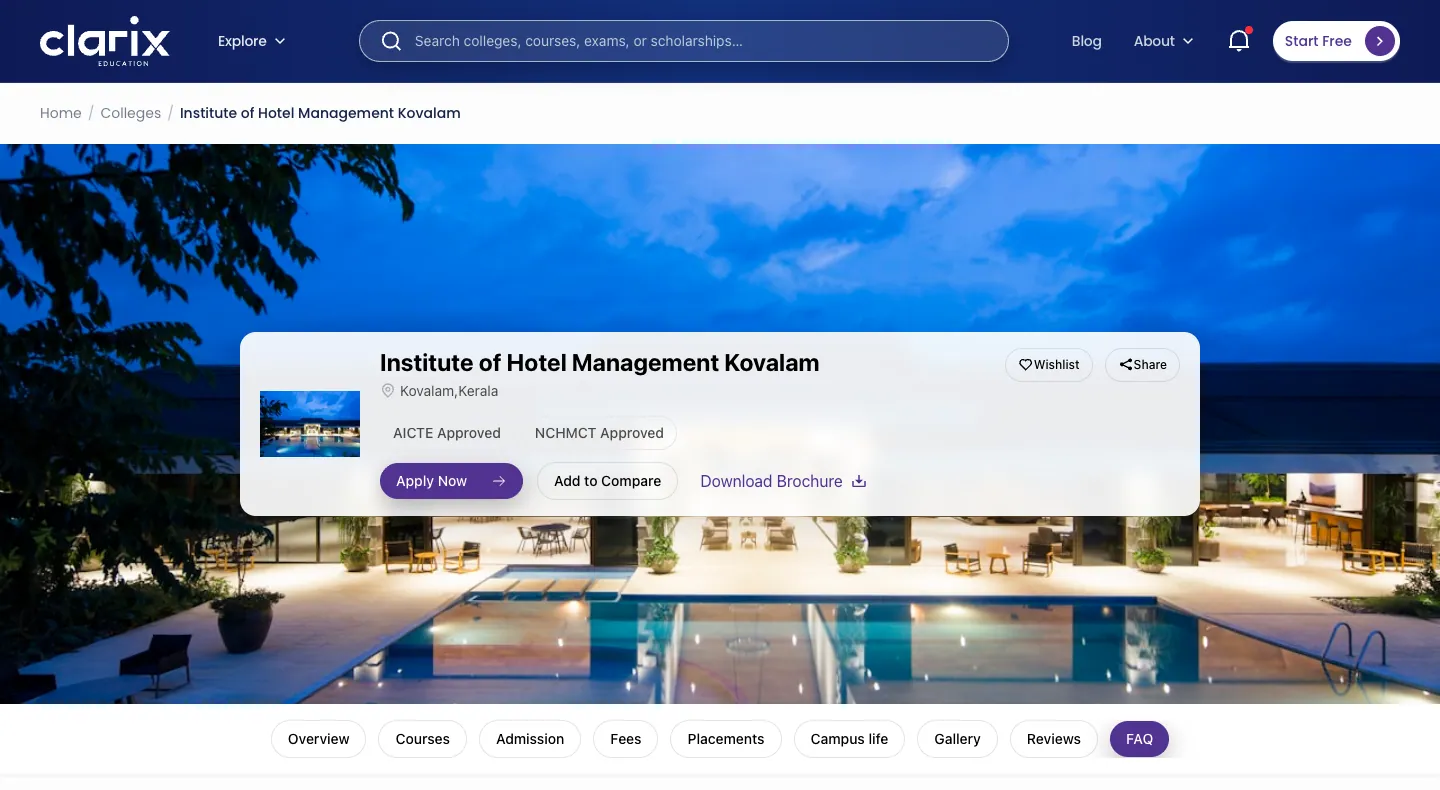
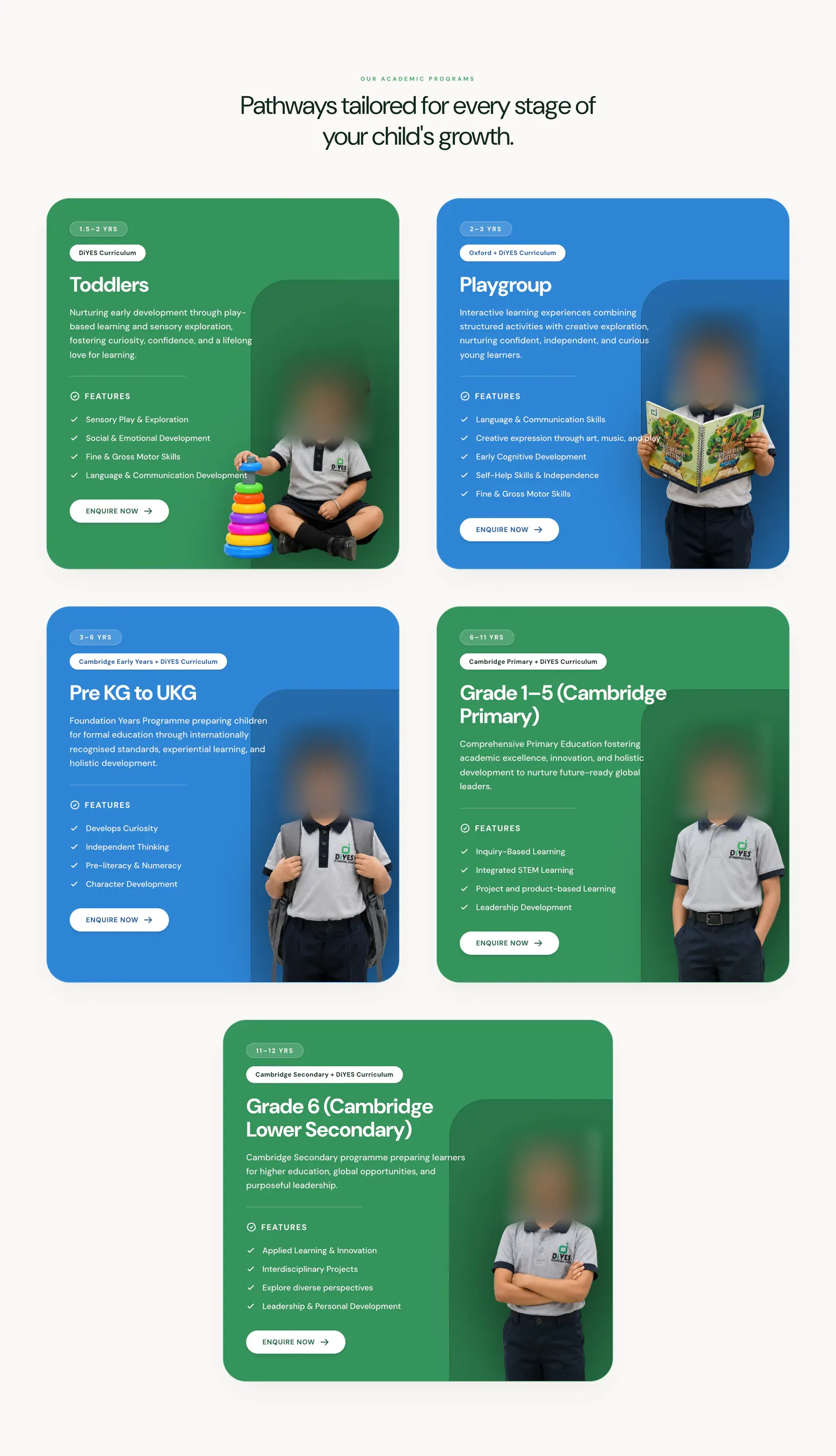
Clarix Education · website we designed and built
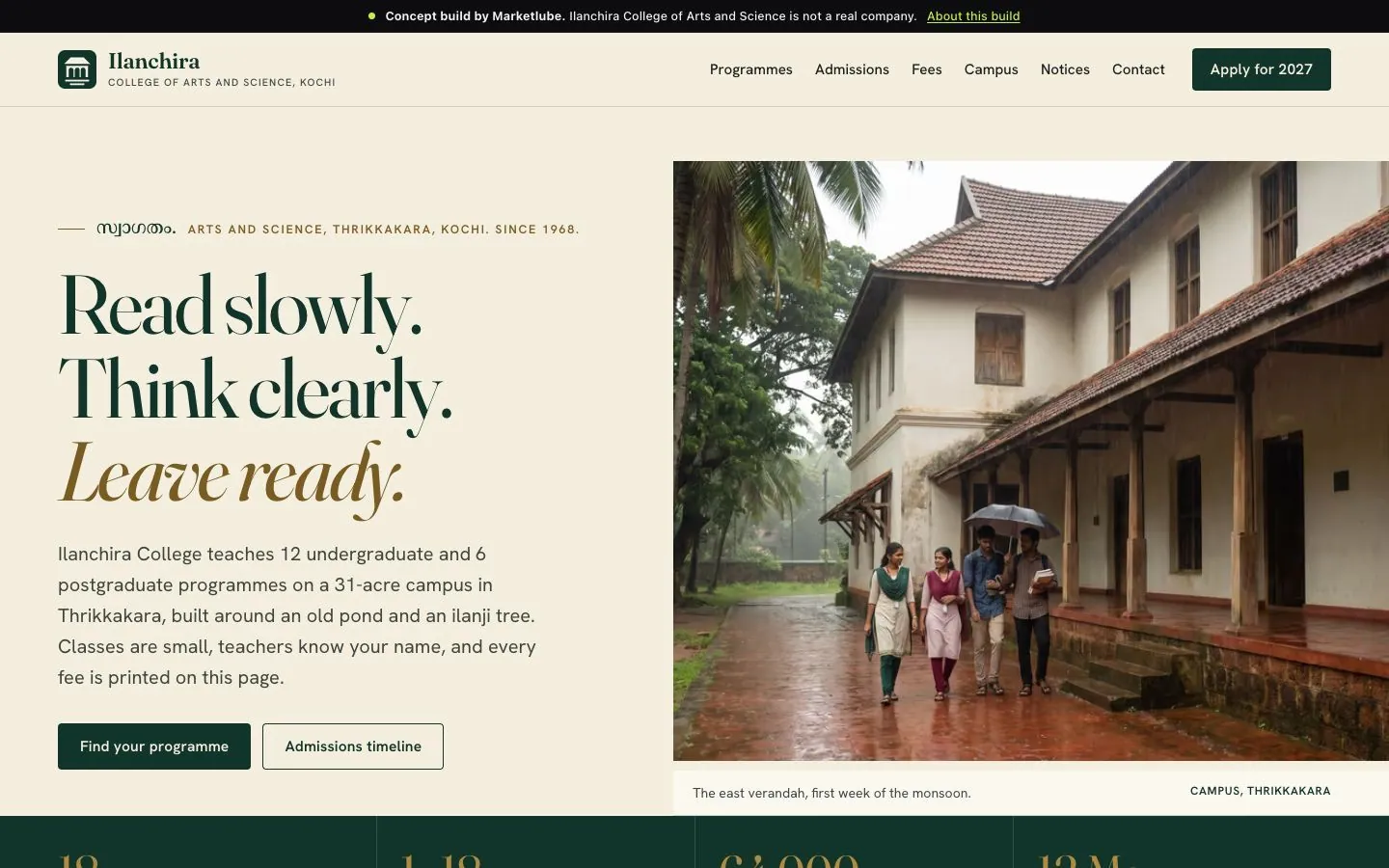
Concept build · Ilanchira College of Arts and Science, a college website for Kochi
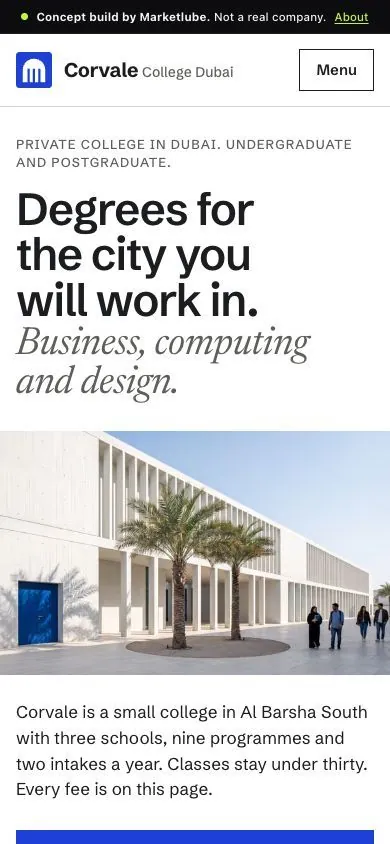
Concept build · Corvale College Dubai on a phone
Client work, then a concept build
A college website is read by four people at once.
The Plus Two student wants to know whether they can get in and what campus life looks like. The parent wants the full fee, the hostel charge and whether the course is approved. The IQAC coordinator needs the NIRF data, the annual reports and the committees published where an inspector can find them. And the admissions office wants every enquiry before the university's allotment closes. Most college sites serve none of them well: a welcome note, a gallery, and a prospectus PDF that no search can read.
We build the other way round. Each programme gets a page that answers eligibility, fee, approvals, admission route and careers in plain text. The disclosures the UGC's 2024 guidelines list become pages with an owner and a last-updated date, not scanned files only the developer can replace. Notices are dated pages you can filter, and the admissions timeline marks what is open today. In the Gulf the same structure carries an Arabic version, the licence and accreditation details a student can check, and a visa section in plain steps.
This page reads the rules from their published sources, each dated. It is not legal advice: how a rule applies to your college is for your management, your affiliating university and your advisers to confirm.
Eight jobs, from the Plus Two results to the IQAC audit.
Disclosures open to anyone, with a search box
The UGC's Guidelines on Public Self-Disclosure by Higher Education Institutions (11 June 2024) say every institution shall keep a functional website whose disclosures open without any login or registration and which has a search facility, then list ten headings, a to j, under which institutions may publish, from About and Administration to Student Life and an Information Corner.
What we build: A disclosure section built on the UGC's ten headings, as text pages the site search can read, with PDFs attached only where the original document matters.
What you get (4)Show less
- One page or sub-page for each of the ten headings, a to j
- Site search across programmes, notices and disclosures
- A named owner and a last-updated date printed on every disclosure page
- Grievance, anti-ragging and equal opportunity pages linked from every footer
Source: UGC, Guidelines on Public Self-Disclosure by Higher Education Institutions, 2024, read 28 Oct 2026
A page for every programme a family can shortlist from
Each course has its own eligibility, seats, fee, approvals, admission route and searches, and an ad for one programme should land on that programme, not on a general admissions page.
What we build: A programme finder that filters by level, stream and department and searches as you type, with each programme opening to its own page.
What you get (4)Show less
- Programme pages with eligibility, duration, seats, fee and the approving body
- The allotment codes students must enter for your college and course
- What graduates go on to do, with placement figures only where you can evidence them
- An enquiry form on each programme page that records which course was asked about
Fees, the refund policy and the prospectus in public
Under heading d, Admissions and Fee, the UGC guidelines list a prospectus including the fee structure for each programme, the admission process and guidelines, and the fee refund policy.
What we build: A fee table as a web page, one row per programme, with a switch between per year and the whole course and every other charge listed beside it.
What you get (4)Show less
- Tuition per year and for the whole course, in rupees or dirhams
- Exam fee, caution deposit, hostel and bus charges listed, not hidden in a PDF
- The refund policy on its own page, in text the site search finds
- Each year's prospectus kept as a dated download, with older years archived
Source: UGC, Guidelines on Public Self-Disclosure by Higher Education Institutions, 2024, read 28 Oct 2026
An admissions calendar that matches the university's
In 2026 the University of Calicut's main window for four-year undergraduate applications ran from 2 to 12 June, with the first allotment on 22 June and classes from 1 July, so a college has a few weeks after the Plus Two results to be on a student's option list.
What we build: An admissions timeline that marks each step as upcoming, open now or closed from today's date, with the documents checklist beside it.
What you get (4)Show less
- A countdown to the date applications open or close
- Each step linked to the university's own portal where the student registers
- A documents checklist students can tick through on a phone
- Separate tracks for merit, management quota and NRI seats where you have them
Source: University of Calicut, Directorate of Admissions, Revised schedule for FYUG-CAP 2026 admission, read 28 Oct 2026
NIRF data and AICTE's mandatory disclosure, kept by year
NIRF's notice of March 2024 said the data institutions submitted for India Rankings 2024 had been hosted on their own websites for public comment, and that responsibility for the data rests with the institution. Colleges running AICTE-approved programmes also have to disclose, at a prominent place on their website, the information set out in Annexure 18 of AICTE's Approval Process Handbook 2024-27, as AICTE's 2026-27 approval letters remind them.
What we build: NIRF and Mandatory Disclosure pages linked from the homepage, each holding one entry per year that the IQAC adds through the CMS.
What you get (4)Show less
- A homepage link labelled NIRF, as inspectors and families expect
- Year-by-year archives for NIRF data, approval letters and audited accounts
- Department-wise infrastructure, approved intake, faculty details, student-faculty and cadre ratios, and three years of audited accounts, as AICTE lists them
- Older years left public instead of overwritten
Source: National Institutional Ranking Framework, Notice of 8 March 2024, read 28 Oct 2026
Notices, circulars and RTI details that stay findable
A government college, and often an aided one, is a public authority under the Right to Information Act, 2005, which asks it to publish a set list of information under Section 4(1)(b), update it every year and keep disclosing proactively, including through the internet.
What we build: A notices section of dated pages filtered by admissions, exams, events and scholarships, and an RTI page naming the Public Information Officer and the appellate authority.
What you get (3)Show less
- Notices as searchable pages, with expired ones moved to an archive
- The Section 4(1)(b) documents with the year each was last updated
- Redirects whenever a page moves, so links in old circulars keep working
Source: Department of Personnel and Training, The Right to Information Act, 2005, read 28 Oct 2026
Enquiry forms that handle applicants under 18
Many Plus Two applicants are minors, and from 13 May 2027 India's Digital Personal Data Protection Act and Rules require verifiable consent from a parent before processing a child's data, and bar targeted advertising directed at children.
What we build: An enquiry form that asks who is filling it in, takes a parent's details and consent for a minor, and says what it collects and why.
What you get (4)Show less
- A short notice beside the form, in plain words
- A parent or guardian route for applicants under 18
- Marketing opt-ins left unticked and separate from the enquiry
- A privacy page and a way to ask for data to be corrected or erased
Source: MeitY, Digital Personal Data Protection Rules, 2025 (G.S.R. 846(E)), read 28 Oct 2026
Affiliation and approvals named exactly
ASCI's guidelines for advertising by educational institutions say an ad must not present an institution or programme as recognised, approved, accredited or affiliated unless that can be substantiated with evidence, and that where an institution is not itself recognised by a mandatory authority but is affiliated to one that is, the affiliating institution's full name and location must be stated. They are written for advertising, and a prospective student reading your programme page deserves no less.
What we build: An approvals panel that names the affiliating university, each approving body and every accreditation as its letter states it, with the validity date and a link to check.
What you get (4)Show less
- The affiliating university's full name and place on every programme page
- NAAC, NBA or AICTE status with its validity, removed when it lapses
- Rankings shown only with the publisher's full name and date
- In the Gulf, the licence and programme accreditation with their reference numbers
Source: ASCI, Guidelines for Advertising of Educational Institutions, Programmes and Platforms, read 28 Oct 2026
Two college concept builds to open, in Kochi and Dubai.
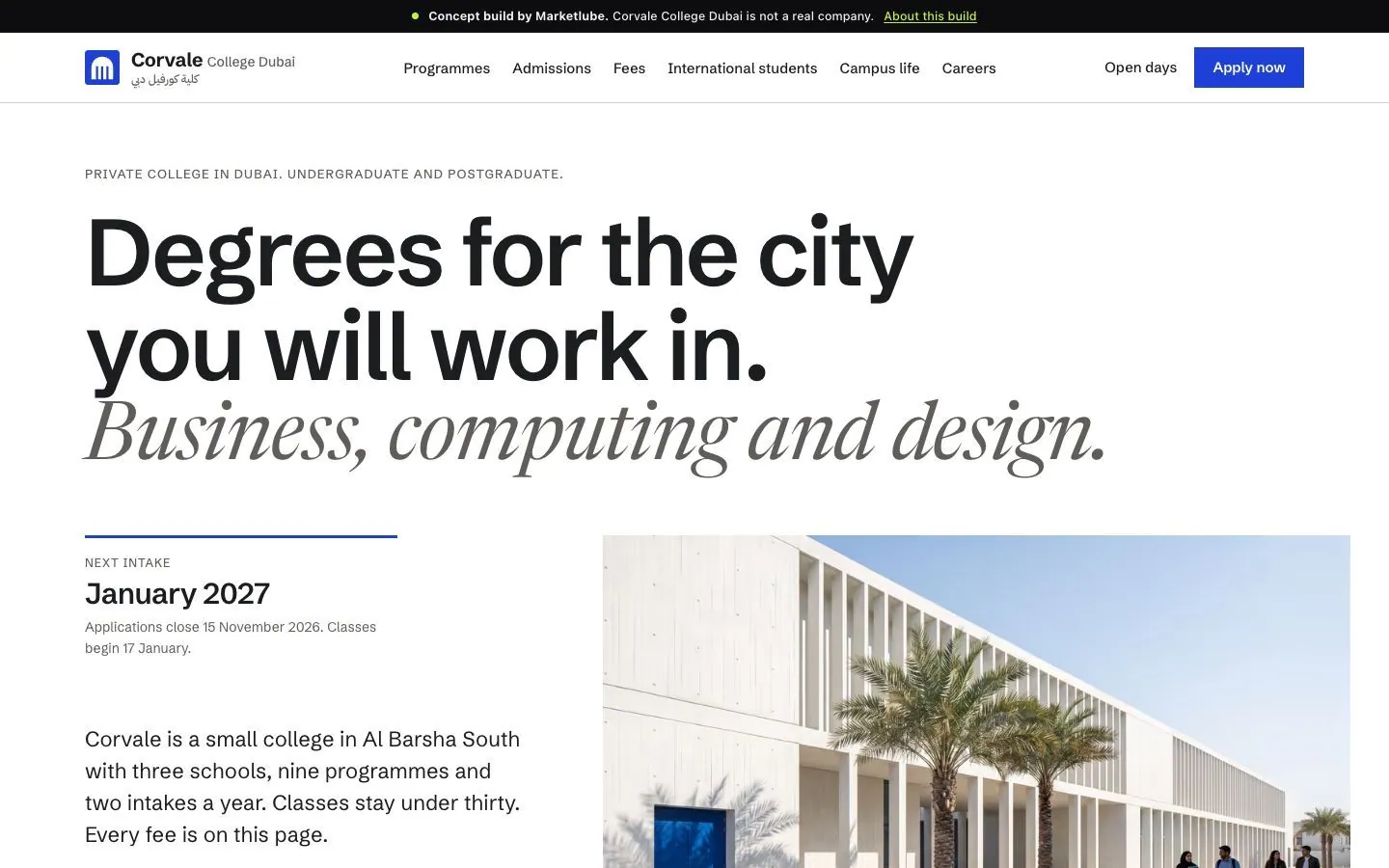
Ilanchira College of Arts and Science and Corvale College Dubai are concept builds: working homepages we designed and built for fictional brands, so you can try the layouts and their tools on your phone before we build yours. Neither is a client. See every concept build.
Concept build · College · Kochi
Ilanchira College of Arts and Science
Concept build · College · Dubai
Corvale College Dubai
Real work: a college-guidance platform, not a college
Clarix Education
Clarix Education, a college-guidance brand rather than a college, helps Class 12 students and their parents choose a college, a course and a career, from offices in Kochi and Calicut. We built its website with its own CMS and admin panel: the front end runs on Next.js at Vercel's Mumbai edge, the content comes from a separate API and CMS, and its team publishes thousands of college profiles and guides without touching code.
From the programme finder to the RTI page: twelve sections.
- HomeKey facts, the admissions status for this year, the latest notices, and links labelled NIRF, Mandatory Disclosure and RTI where they apply.
- ProgrammesThe programme finder, then one page per programme: eligibility, seats, fee, approvals, admission route, allotment codes and careers.
- AdmissionsThe timeline from today's date, eligibility by route, the documents checklist, NRI and management quota seats, and a link to the university's portal; for a Gulf college, the student visa steps in plain order.
- Fees and refund policyThe fee table by programme, every other charge, scholarships, and the refund policy on a page of its own.
- About and approvalsHistory, the sponsoring body, the affiliating university, NAAC, NBA and AICTE status, and annual reports and audited accounts by year.
- Administration and committeesThe principal, the governing body, the finance officer and controller of examinations where you have them, and the Internal Complaint Committee, with profiles, photographs and contacts as the UGC lists.
- Departments and facultyA page per department with its programmes, faculty profiles and photographs, labs and research.
- IQAC, NIRF and disclosuresIQAC reports, NIRF data and AICTE's mandatory disclosure, each kept by year so earlier submissions stay public.
- Student lifeHostel, sports, NCC and NSS, clubs, placement cell, health, and the grievance, anti-ragging and equal opportunity pages.
- Notices and circularsDated pages filtered by admissions, exams, events and scholarships, with an archive and an RSS feed.
- Alumni and careersThe alumni association, where graduates work and study, and placement figures from the latest completed year with the class size beside them.
- Contact and campus visitThe telephone directory by office, the address and map, and a form to book a campus visit or an open day.
Affiliation in Kerala, licensing and Arabic in the Gulf.
Kerala and India
Most arts and science colleges in Kerala are affiliated to a university, so the site names the affiliating university on every programme and links to its admission portal, since students register there, not with you. The season is short: the 2026 Plus Two results came out on 26 May and the University of Calicut's main application window closed on 12 June, with late registration only after the allotments had run. Where a parent works in the Gulf and reads along from there, pages that load fast on a phone abroad and enquiry hours given in IST and Gulf time keep that parent in the conversation. Short Malayalam labels beside the English headings help parents who read Malayalam first.
Source: Kerala Public Relations Department, Plus Two results 2026, read 28 Oct 2026
United Arab Emirates
Gulf News (May 2023) describes the Commission for Academic Accreditation as the federal quality assurance agency that licenses and accredits higher education institutions outside the free zones, with lists of licensed institutions and accredited programmes on its website. Institutions in Dubai's free zones go through KHDA's UQAIB quality assurance, which, Gulf News says, complements the CAA's. So a UAE college site gives its licence and each programme's accreditation a slot with the reference number and a link to the official list. The UAE's personal data law, Federal Decree-Law No. 45 of 2021, is written to reach processing done abroad too, so an applicant form built in Kerala for a Sharjah or Dubai college is covered.
Source: Gulf News, How to find out if your university is accredited in the UAE, read 28 Oct 2026
Saudi Arabia
Institutional accreditation in the Kingdom comes from the National Center for Academic Accreditation and Evaluation (NCAAA), which the Education and Training Evaluation Commission lists among its centres, and universities announce it on their own sites, as Fahad Bin Sultan University did for its full institutional accreditation. A Saudi college site starts Arabic-first, right to left, with English alongside. Saudi Arabia's data protection law, in effect from 14 September 2023, also binds an organisation outside the Kingdom that handles the data of people resident in it, and it asks for a privacy policy to be made available before any data is collected, so it sits beside the application form.
Source: Fahad Bin Sultan University, Full institutional accreditation from the NCAAA, read 28 Oct 2026
Qatar and the other Gulf states
According to a Shura Council note of November 2021, Qatar's Law No. 7 of 2019 on protecting the Arabic language obliges educational and public institutions to use Arabic and names publications and advertisements among the places it must be used, so a Qatari college plans an Arabic-first or fully bilingual site. Where a Qatari college's forms reach applicants who are still children, Qatar's data protection law (Law No. 13 of 2016), as DLA Piper summarises it, requires a notice explaining the use of their data and a parent's approval before it is processed. Domain zones such as .edu.qa and .edu.kw are reserved for recognised educational bodies in each country, so the college registers its own domain and we connect the site to it.
Source: Shura Council of Qatar, News of 15 November 2021 on the Arabic language law, read 28 Oct 2026
What a college website costs.
- Business websiteCustom design, up to 8 pages · 4 to 8 weeksfrom INR 60,000 · AED, QAR or SAR 8,000 · KWD 650 · OMR or BHD 800
- Next.js website with a CMSHeadless CMS, up to 15 pages · 8 to 14 weeksfrom INR 2,00,000 · AED, QAR or SAR 15,000 · KWD 1,250 · OMR 1,550 · BHD 1,500
- Website care planBilled yearly · starts within a weekfrom INR 3,000 · AED, QAR or SAR 500 · KWD 40 · OMR or BHD 50 a month
GST is added to these figures for an Indian college, and VAT for a Gulf one where it applies. A college site with programme pages and the full disclosure section usually runs past the smaller tier's page count and needs the CMS, so your written quote lists the number of programme and department pages, the disclosure and archive pages, the move of old PDFs with redirects, any application fee payment gateway, and a Malayalam or Arabic version with who writes and checks it.
What the build includes
- A sitemap mapped against the UGC's ten headings, with the gaps on your current site marked
- The programme finder and one page per programme, built from your list of courses
- The admissions timeline, documents checklist and fee table, all editable by your office
- Disclosure, NIRF and Mandatory Disclosure pages with year-by-year archives
- A notices section with filters, an archive and dated pages
- Enquiry and campus visit forms with a parent route for applicants under 18
- Programme and organisation structured data, a sitemap and redirects from your old addresses
- A training session for the office and IQAC staff who will keep the pages current
Not included
- Writing your NAAC self-study report or NIRF submission; we publish what your IQAC prepares
- The university's admission portal or allotment, which we link to rather than rebuild
- Legal advice on RTI, DPDP or Gulf licensing; your management and advisers confirm what applies
- Campus photography and video, quoted separately if you need them
- Admission season ads and lead campaigns, which are a separate engagement
Five steps. No surprises.
Every stage has an owner, a deliverable and a sign-off, all agreed with you before it starts.
Book a discovery callAudit what you publish today
We read your current site against the UGC's ten headings, NIRF, AICTE where it applies and the RTI list, and send back a table of what is there, what is missing and what lives only in a scanned PDF.
Agree the sitemap and the owners
We draft the site map with your principal's office, IQAC and admissions team, and give each page an owner: who updates the committees, who updates the fees, who posts notices. That list becomes the CMS permissions.
Design for the student's phone
We design the programme finder, a programme page, the admissions timeline and the fee table first, because that is where students and parents decide. Your admissions team tries the designs on their own phones before a line of the CMS is built.
Build, migrate, redirect
Programme pages, the disclosure section and the CMS go up first; then notices, reports and approval letters move into dated pages, and redirect every old address so links in past circulars and in Google keep working.
Train the office, then launch
We train the staff who will edit the site, then launch well before the Plus Two results so the programme pages are indexed in time. After launch, the care plan covers the yearly rush: new fee tables, the next timeline and the fresh NIRF entry.
College websites, answered.
The team is in Calicut, India
1414, 4th Floor, Phase 1, HiLITE Business ParkKozhikode, Kerala 673014Mon–Sat · 9:30 am to 6:30 pm
What does the UGC require on a college website?
The UGC's Guidelines on Public Self-Disclosure by Higher Education Institutions (June 2024) say every institution shall keep a functional website for self-disclosure, open without any login or registration, with a search facility. They then list information an institution may publish under ten headings: About, Administration, Academics, Admissions and Fee, Research, Student Life, Alumni, an Information Corner with RTI details, a Picture Gallery and Contact. The guidelines cover colleges as well as universities, naming the affiliating university in the case of colleges.
Should a college publish its NIRF data on its own website?
If it takes part in the rankings, yes. NIRF's notice of March 2024 said the data institutions submitted for India Rankings 2024 had been hosted on their own websites, invited stakeholders to comment on it, and said responsibility for the data rests entirely with the institution. The usual pattern is a homepage link labelled NIRF that opens a page holding each year's submission.
What happens to institutions that do not put their disclosures online?
The UGC has started naming them. In September 2025 Careers360 reported that the UGC had identified 54 state private universities that had not submitted information under Section 13 of the UGC Act or had not uploaded their public self-disclosure on their websites, and had asked them to comply immediately with a link on the home page. Colleges were not the subject of that list, but it shows the website is now part of how the regulator checks an institution.
Should a college website show fees, or only in the prospectus?
On the website, as a table, with the prospectus as a download beside it. The UGC guidelines list a prospectus with the fee structure for each programme, the admission process and the fee refund policy among what an institution may publish, and a table on a web page is what both the site search and Google can read. List every charge beside tuition: exam fee, caution deposit, hostel and transport.
How should a college handle enquiries from students under 18?
Ask who is filling in the form and take a parent's details and consent for a minor. India's Digital Personal Data Protection Act requires verifiable parental consent before processing data of anyone under 18 and bans targeted advertising directed at children, with those duties applying from 13 May 2027. The Rules' exemption for educational institutions covers tracking and monitoring for educational activities and the safety of enrolled children, not marketing.
Does a UAE college website need to show its licence and accreditation?
Students are told to check both. Outside the free zones, the Commission for Academic Accreditation licenses institutions and accredits programmes, and publishes lists of each, and Gulf News (May 2023) reports the ministry's advice that students confirm their chosen programme is accredited so the qualification can be attested. A college site that shows its licence and each programme's accreditation, with reference numbers and a link to the CAA's lists, saves the student a search.
How long before the Plus Two results should a new college website go live?
Count back from the Plus Two results, because the site needs to be live and indexed before they come out: in 2026 the University of Calicut's main application window closed 17 days after them. How long the build takes depends mostly on the content, not the design: how many programmes and departments there are, and how much of the disclosure material already exists as editable text rather than scanned PDFs. The quote sets the dates once we have your programme list and the audit of your current site.
Further reading
Sources
- UGC, Guidelines on Public Self-Disclosure by Higher Education Institutions, 2024, read 28 Oct 2026
- University of Calicut, Directorate of Admissions, Revised schedule for FYUG-CAP 2026 admission, read 28 Oct 2026
- National Institutional Ranking Framework, Notice of 8 March 2024, read 28 Oct 2026
- Department of Personnel and Training, The Right to Information Act, 2005, read 28 Oct 2026
- MeitY, Digital Personal Data Protection Rules, 2025 (G.S.R. 846(E)), read 28 Oct 2026
- ASCI, Guidelines for Advertising of Educational Institutions, Programmes and Platforms, read 28 Oct 2026
- Kerala Public Relations Department, Plus Two results 2026, read 28 Oct 2026
- Gulf News, How to find out if your university is accredited in the UAE, read 28 Oct 2026
- Fahad Bin Sultan University, Full institutional accreditation from the NCAAA, read 28 Oct 2026
- Shura Council of Qatar, News of 15 November 2021 on the Arabic language law, read 28 Oct 2026
- UGC, Guidelines page, read 28 Oct 2026
- College of Engineering Trivandrum, AICTE extension of approval corrigendum 2026-27, read 28 Oct 2026
- Careers360, UGC identifies 54 state private universities for non-compliance with public self-disclosure norms, read 28 Oct 2026
- Education and Training Evaluation Commission, NCAAA, read 28 Oct 2026
- DLA Piper, Data protection laws: Saudi Arabia, read 28 Oct 2026
- Clyde & Co, Saudi Arabia issues Personal Data Protection Law (privacy policy before collection), read 28 Oct 2026
- u.ae, Data protection laws (Federal Decree-Law No. 45 of 2021), read 28 Oct 2026
- DLA Piper, Data protection laws: Qatar, read 28 Oct 2026
- CMS, New SDAIA rules and guidelines published as KSA's personal data protection framework is now enforceable, read 28 Oct 2026
- Communications Regulatory Authority (Qatar), Domain registrants, read 28 Oct 2026
- CITRA, Kuwait domain .kw, read 28 Oct 2026
College websites
Let's build your website.
Tell us what the site has to do and who it is for. A strategist replies within one working day, from our team in Calicut.
Every rupee you spend with us has to earn its keep.