Hotel social media marketing strategy for Kerala resorts and homestays: what to post, a content mix, creator rules, DMs to direct bookings and a season plan.
- Published
- Updated
- Reading time
- 13 minutes
Drafted with AI tools; researched, edited and approved by Althameem Ali. Our editorial policy
On this page · 10 sections
- What should a Kerala resort post to win bookings?
- Which platforms matter for domestic, Gulf and European guests?
- How did Willmount's feed sell the place?
- A monthly content mix
- Creators and influencers: the rules and the brief
- How do DMs become direct bookings?
- A season-by-season calendar
- Frequently asked questions
- Sell the stay, then follow it up
- Changelog
We plan and run Instagram for resorts and stays as part of our marketing for hotels, resorts and homestays, so this playbook draws on that work, including the Willmount case study, whose figures appear below with the labels they carry there.
Guests rarely find a Kerala resort by searching for it. They see a reel of mist over a tea estate, a friend's story from a dome in Vagamon, a creator's walk through a forest pool, and only then go looking for the name. Social media is where the trip begins; the job is to make sure it ends with a booking on your own website or WhatsApp.
What should a Kerala resort post to win bookings?#
The place, then the experience, then the room. Travellers book the sunset, the walk and the campfire; the room has to be good, but it is rarely the reason someone stops scrolling.
Demand is there to be won. Kerala Tourism's 2025 statistics (opens in a new tab) (file dated 7 May 2026) count 30,18,598 domestic tourist visits to Munnar alone, the most of any destination in the state, and 14,73,710 to Wayanad district. Idukki district, home to Munnar and Vagamon, drew 46,79,800 domestic visits, more than any other district. Every resort in those hills competes for the same few seconds of a viewer's attention.
What earns those seconds:
- Places with a name. "Chasing the sunset in Anjuruli" beats "Beautiful views at our resort". A named place tells the viewer where they could be, and it is searchable.
- People in the frame. A couple on a viewpoint or a family at a campfire lets the viewer picture themselves there. Get written consent from every guest you film, and keep children out of public posts.
- The real experience, in order. The drive up, the welcome drink, the trail at 6 am, the dinner, the rain on the roof at night.
- Proof of the practical. Road conditions in the monsoon, the distance from Kochi or Kozhikode, whether pets are welcome, what the food is like. These posts answer the questions that stop a booking.
Which platforms matter for domestic, Gulf and European guests?#
Instagram is the centre for most Kerala stays, but not the only screen.
Domestic guests plan on video. In a Google and Kantar survey of 1,000 online adults in India in 2025, published by Think with Google in November 2025 (opens in a new tab), 68% of travellers used YouTube for inspiration, two in five used YouTube Shorts, 85% preferred to book online and 41% said they relied heavily on influencers when planning. Kerala's own residents made up 68.33% of domestic visits in 2025, so Malayalam captions and reels reach your biggest market; Bengaluru and Chennai weekenders want English and a drive time from their city.
Gulf guests are a growing market. Oman sent 65,132 visitors to Kerala in 2025, up from 38,387 in 2024, making it the third-largest source of foreign tourists after the UK and the USA; Saudi Arabia (31,593) and the UAE (26,255) were ninth and tenth. Gulf families often travel for the monsoon, so show rain-view rooms, family suites and halal food where you offer it, with Arabic subtitles if Arab families are your audience.
European and American guests made up the two biggest foreign markets in 2025, the UK with 14.86% of foreign visits and the USA with 13.09%. Make sure they can check you in English: walkthroughs on YouTube, reviews they can read and clear prices on your website do more work for them than another reel. Our guide to winning direct bookings covers the website, the booking engine and Google's hotel listings.
How did Willmount's feed sell the place?#
Willmount runs experiential stays in Kerala's hills: wooden cabins near Munnar, Willmount Geodesic Domes in Vagamon, billed as Kerala's first geodesic dome stay, and a villa in Wayanad. Guests book directly on its website or on WhatsApp, where direct bookings get exclusive offers, or through travel sites such as MakeMyTrip and Goibibo.
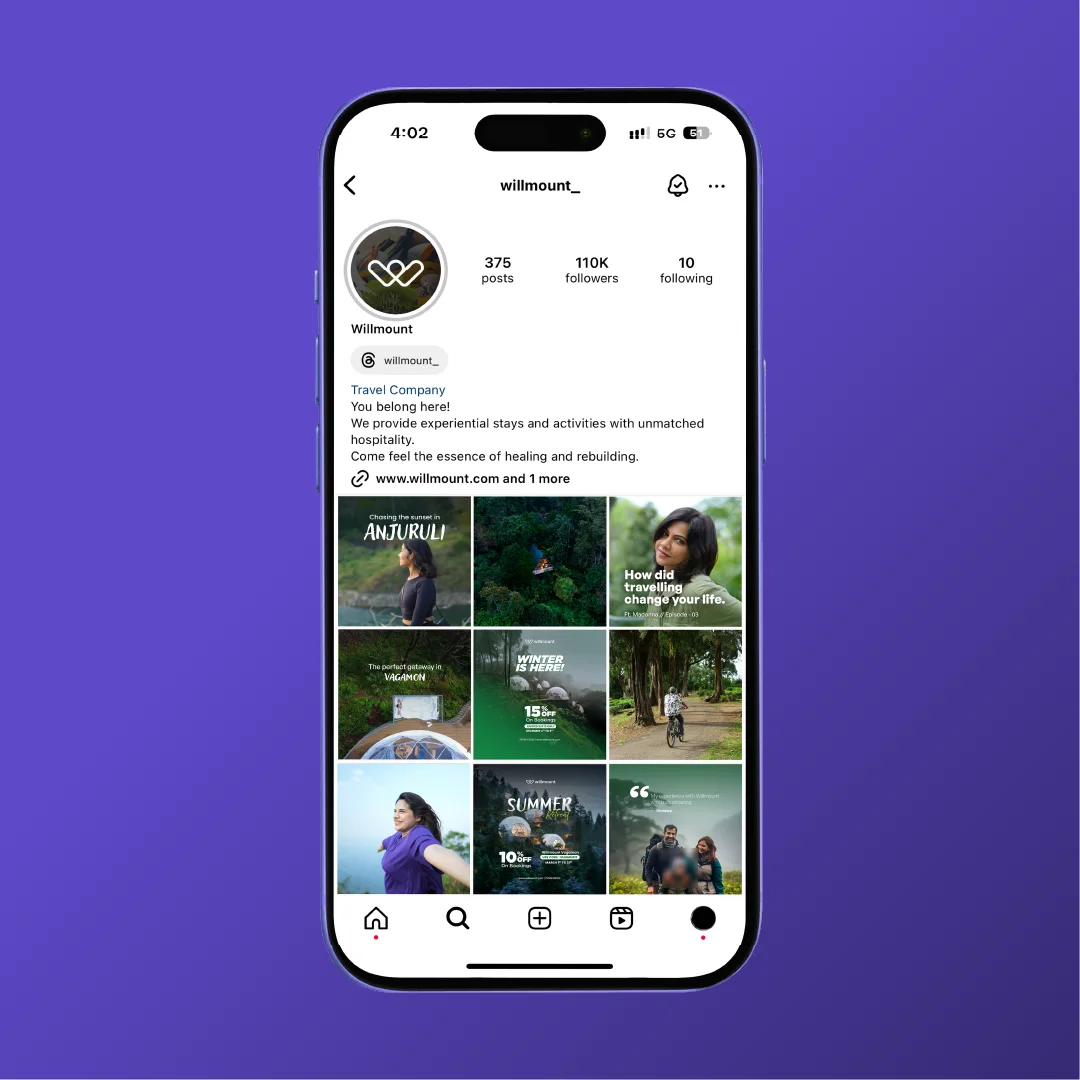
We shaped its Instagram around the places and the feeling of being there. As the Willmount case study sets out, the strategy was:
- Places first, with destination hooks such as "Chasing the sunset in Anjuruli" and "The perfect getaway in Vagamon", and drone shots of the domes in the forest.
- Travellers in the frame, so viewers could see themselves there.
- Questions that invited replies, such as a quote series asking "How did travelling change your life?".
- Offers in the same forest-green look, from "Winter is here!" with 15% off bookings to a summer retreat at 10% off, so a discount read like an invitation, not a sale board.
On 29 September 2026, Instagram's public profile data showed 119,416 followers for @willmount_. Our team reports that the work grew the account by more than 50,000 followers organically and that bookings for the properties rose alongside; archived copies of the profile show only a login page, so both carry our team's label, and we don't publish Willmount's booking figures.
Two other stays show the same thinking in different looks. For Kuruva Island Resort & Spa, a forest resort and spa, the feed took a cinematic forest-and-gold style, with series for couples ("Nature & Love"), adventure seekers ("Wild Curves") and pet owners ("Paws"), and offers in the same premium style. For Ynad Mount Resort in Wayanad, we designed an identity built from six interlocking Ys in forest green, mist grey and burnt orange, with the line "Lost in the Mist": the kind of palette that makes a feed recognisable before anyone reads the caption.
A monthly content mix#
Here is the mix we plan from for a resort posting about three or four times a week. It is a planning guide, not a rule; your best-performing posts should change the shares.
Two rules hold the mix together. Every post should look like the same place, so a guest who sees three of your reels remembers one brand. And every post should have a next step: a booking link in the bio, a WhatsApp number, or a question that invites a reply. For the food side, our Instagram plan for Kerala restaurants covers dish shots, reels and food creators in more depth.
When you film, film for the ads too. A good drone pass and a room walkthrough can run for months as reels and paid placements; our guide to what changed in Meta ads covers how to run them in 2026. If you use AI-made films, show only what exists: ASCI's guidelines on synthetic content in ads (opens in a new tab), released on 29 September 2026 (opens in a new tab) and in effect from late December 2026, give "a travel agency depicting a hotel in a non-existent location or having non-existent facilities" as an example of content prohibited even with a label. Our AI film for Ynad Mount Resort, a family's escape from a desk piled with files to the hills, is presented as AI-made, and our guide to AI video or a real shoot covers when each makes sense.
Creators and influencers: the rules and the brief#
Creators can fill a resort's weekends, and they come with rules. ASCI's guidelines for influencer advertising (opens in a new tab) (revised on 6 March 2025) treat any material connection as advertising, and they list "trips or hotel stays" as an example. A free night is enough.
The label. It must be upfront and hard to miss: "Ad", "Advertisement", "Sponsored", "Collaboration", "Partnership", "Free gift" or Instagram's "Paid Partnership" tag, not buried in hashtags. On a video with no caption, the label goes on screen:
In live streams, the label is announced at the start and the end. The guidelines make the brand and the creator jointly responsible, so check the post before it goes up. ASCI's annual complaints report (opens in a new tab) of 28 May 2026 says 97.3% of the 1,609 influencer ads it processed in 2025-26 needed changes.
Wellness claims. If a creator explains the health benefits of an Ayurveda programme, ASCI's 2025 addendum for health and finance influencers requires relevant qualifications for technical health advice, as Storyboard18 reported in April 2025 (opens in a new tab). A travel creator showing the treatment room doesn't need one; a creator explaining what the treatment does for your health does.
Gulf creators. Since 1 February 2026, anyone publishing advertising content on social media from the UAE needs a UAE Media Council Advertiser Permit, and visiting creators go through accredited agencies, Gulf News reported (opens in a new tab). If a Dubai-based Malayali creator posts about your stay, ask to see the permit.
The brief. Put it in writing: the dates and what's included, the deliverables (reels, stories, collab posts), the label, whether you may run the content as ads and for how long, the guests and staff who have agreed to appear, and the facts that must be right, such as prices and road access. Choose creators for where their audience lives, not follower count; our restaurant guide's section on vetting food creators applies to travel creators too.
How do DMs become direct bookings?#
By answering fast, in the guest's language, and handing over a booking link before the conversation cools. Most Instagram enquiries are the same ten questions: price for these dates, extra bed, food for children, pets, the road, the distance from the airport. Save the answers, and move the chat to WhatsApp, where you can send photos, the location pin and a payment link.
- One booking path everywhere. Your own booking engine in the bio link, the same link in every WhatsApp reply. Willmount's route is a good model: direct on the website or WhatsApp, with offers kept for direct bookings.
- Tag where each booking came from. A different WhatsApp link or code per campaign, and a "How did you hear about us?" question at checkout. On our own site, every WhatsApp link opens a chat with a first message saying it came from marketlube.in and, where known, from which page, so we know what started each conversation.
- Keep the OTAs honest. Rate parity, Google's free booking links and the booking engine itself are covered in our direct bookings guide; social media should feed that system, not compete with it.
Homestays have one extra trust signal. Kerala Tourism classifies homestays (opens in a new tab) where the owner's family lives on the premises and lets out up to six rooms, for an application fee of ₹3,750, and the certificate, valid for three years, must be displayed for guests. Show it in a highlight; it answers the question "is this a real home?" before it's asked.
A season-by-season calendar#
Plan content four to eight weeks before each window, because that's when guests are deciding. These are typical patterns; your own booking data is the better guide.
Frequently asked questions#
How often should a resort post on Instagram?#
There is no official number. Three or four posts a week, with stories most days, is a pace most small teams can keep up while maintaining quality. A steady rhythm matters more than volume.
Do resorts need to label posts by creators who stayed for free?#
Yes. ASCI's influencer guidelines count a free hotel stay as a material connection, so the post needs an upfront label such as "Ad", "Collaboration" or "Free gift", or Instagram's "Paid Partnership" tag. On videos, the label must stay on screen for a set share of the video.
Which social platforms do Indian travellers use to plan trips?#
YouTube and Instagram lead. A Google and Kantar survey published in November 2025 found that 68% of Indian travellers used YouTube for travel inspiration and two in five used YouTube Shorts, while 85% preferred to book online.
What should a homestay post on social media?#
The family behind it, the house, the food and the place around it, plus practical answers on rooms, meals and directions. Kerala Tourism's homestay classification requires the owner's family to live on the premises, so showing the hosts is both honest and a reason to book.
Sell the stay, then follow it up#
A resort's feed should make someone want to be there, and then make it easy to book. If you'd like a content plan built around your place, your seasons and your direct-booking path, tell us about your property, see how we plan a hotel's social media, or book a consultation with Fidal P.
Changelog#
- 2026-10-10: Linked our social media and video production pages, and the closing paragraph now offers a consultation with Fidal P.
Related services
Industries
Written by
Co-founder, Marketlube
Althameem Ali researched, edited and approved this post. Marketlube is a growth partner in Calicut building brands, websites, CRMs and campaigns for businesses across Kerala, India and the Gulf.