Concept build · Dubai
Lintel Real estate website design for Dubai, a concept build
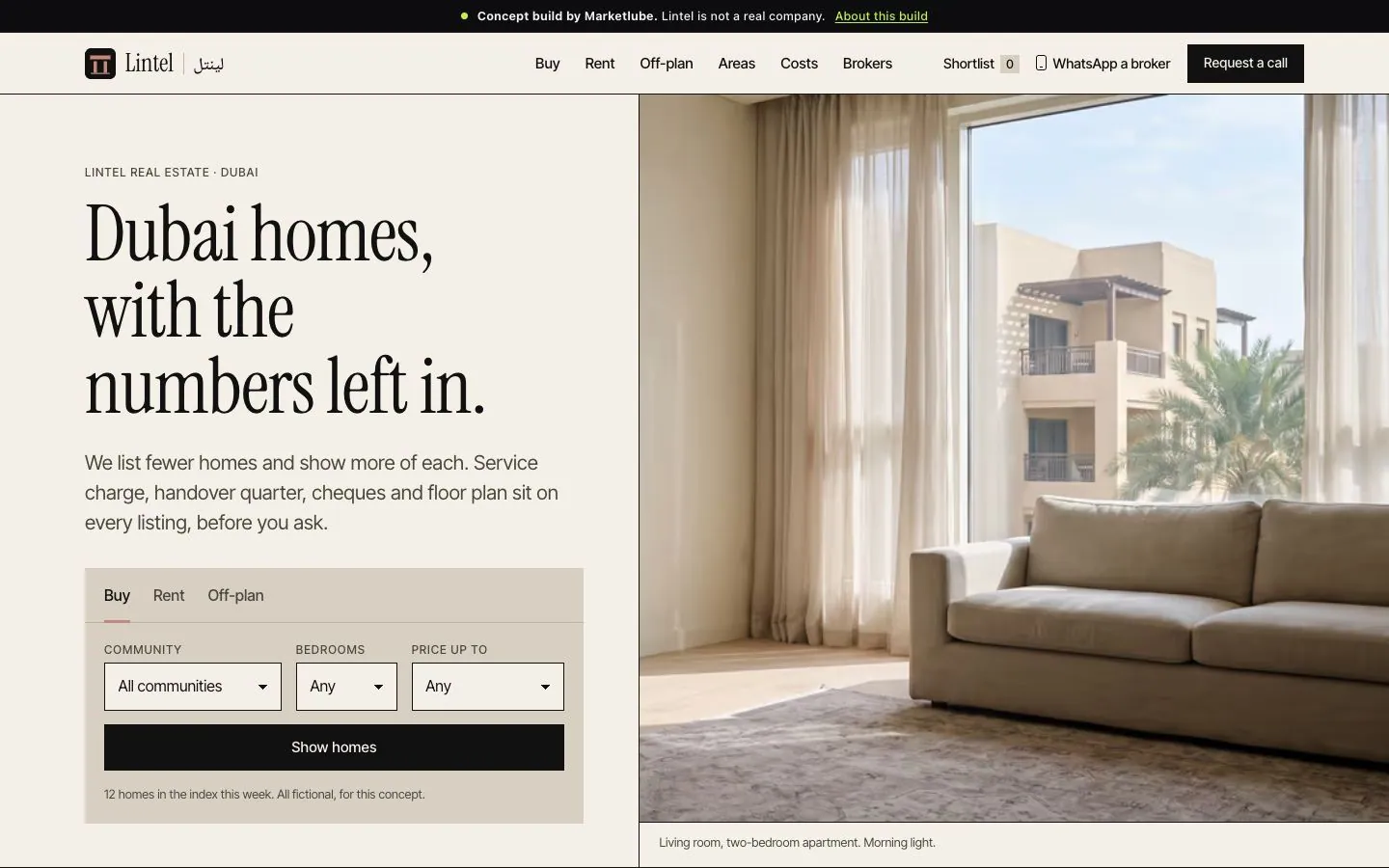
Lintel is a Dubai brokerage that exists only on this page: four brokers and twelve homes for sale, to let and off-plan across six communities, all of them made up. We designed and coded its homepage around one idea, that a listing should answer the money questions before anyone asks, so every home shows its service charge, handover quarter or cheque terms beside the price. The cost panels, fee calculator, cheque splitter and floor plans respond to every change.
A concept build: Lintel is a fictional brand we created to show how we design and build a real estate website for Dubai. It is not a client and not a real company; our client work is on the work page.
The complete homepage, live
Both frames run the real site. Scroll inside them, try the index of twelve homes in buy, rent and off-plan tabs, with community, bedroom and price filters and four sort orders, the rows sliding into their new order, or open it in a new tab.
How we designed a real estate website for Dubai
The numbers on every listing
Buyers and tenants in Dubai usually have to ask for the service charge, the handover date and how many cheques the landlord takes. So each home in the index carries them in a spec strip beside the photo, with beds, baths, size and price. A marked gap on every listing shows where the Dubai Land Department advertising permit number and QR code would go on a live site.
The fees behind the price
The listed price is not what leaves a buyer's account, so the cost section adds the DLD transfer fee, title deed, map, knowledge and innovation fees, the trustee fee, Lintel's own fee on resales and, for a mortgage, the registration fee. Each official fee links to the DLD page it came from, with the date it was read. Where the 4% fee can be split either way, the calculator assumes the buyer pays all of it, so the total is never smaller than it turns out.
Rent paid by cheque
Dubai rents are quoted by the year and paid with post-dated cheques, which tenants from elsewhere often find confusing. The cheque splitter dates every cheque from the chosen start and adds the first cheque, deposit, agency fee and Ejari into the cash needed at move-in. If a tenant picks more cheques than a listed landlord accepts, the page says so.
Read like a property magazine
Big portals already show thousands of homes in card grids, so a small brokerage wins on depth instead. The page reads like a property magazine: an ivory ground, ink hairlines, Instrument Serif headlines with community names in italic, and solid olive, stone and desert-rose blocks. Twelve homes are read in a line, one row each, and the wordmark pairs Lintel with لينتل in Arabic script.
What the homepage includes
- Hero and home search
- The index of twelve homes
- Floor plans
- Off-plan payment plans
- Costs of buying
- Renting and cheques
- Areas
- Brokers
- Before you call
- Enquiry and callback
- Call to action
Features and interactions
- Index of twelve homes in Buy, Rent and Off-plan tabs, with community, bedroom and price filters and four sort orders, the rows sliding into their new order
- Cost panel on every listing that draws a payment timeline and lists each fee line by line, with a cash or mortgage switch for sales and every rent cheque dated for rentals
- Cost of buying calculator for ready or off-plan homes, paid in cash or with a mortgage, that totals every DLD fee and links each one to its source page
- Cheque splitter that takes a yearly rent, a start date, furnishing and one to twelve cheques, dates each cheque and adds up the cash needed at move-in
- Drawn floor plans for three homes with a sq ft and m² switch, ground and first floors for the townhouse, and a room list that highlights each room on the plan
- Off-plan payment schedules for three homes, with every instalment in dirhams, the quarter it falls due and a stage bar that grows as you switch homes
- Stylised SVG map of six communities linked to their area notes, and a shortlist kept in the browser that fills in the WhatsApp message and the callback form
The whole page, top to bottom


Palette and type
- Ivory #F4F0E8
- Ink #111111
- Desert rose #C4877A
- Olive #5B6150
- Stone #D6CFC2
Type: Instrument Serif, Inter Tight, Noto Naskh Arabic.
Languages: English.
How it is built
- Hand-built HTML, CSS and JavaScript, no framework
- GSAP 3.15.0 with ScrollTrigger, SplitText and Flip
- Lenis 1.3.26 smooth scrolling
- Photographs generated with Higgsfield (Nano Banana Pro), served as WebP, with AVIF for the hero
- Instrument Serif, Inter Tight and Noto Naskh Arabic from Google Fonts
- Homepage weight about 570 KB on desktop and about 510 KB on a phone, measured on our machine on 28 Oct 2026
Need a real estate website like this?
We design and build sites like this one for real businesses, with your brand, your photographs, your prices and the forms wired to your team. See what goes into real estate websites, our web development service, our website prices and how we work with businesses in the UAE, or browse every concept build.
Questions
What should a real estate website in Dubai include?
Each listing should show the price, size, bedrooms, the service charge per sq ft, whether the home is ready or off-plan and, for rentals, how many cheques the landlord accepts. Every property advert in Dubai needs a Dubai Land Department permit, with its number and QR code shown on the listing, and the broker and brokerage registration numbers should be easy to find. Floor plans and plain notes on each community help buyers compare homes before a viewing.
Should a Dubai property website show the full cost of buying?
Yes. Buyers know the listed price is not the final figure, and a site that adds the DLD transfer fee, title deed, trustee fee and any mortgage registration fee saves them working it out elsewhere. Link each official fee to the Dubai Land Department page it comes from and say when it was checked, because fees change. For off-plan homes, show the payment plan as a schedule of instalments, not just a price.
How should enquiries work on a real estate website in Dubai?
Most buyers and tenants in Dubai would rather send a WhatsApp message than fill in a long form, so a WhatsApp button that carries the listing reference is the quickest route. A short callback form with a name, a mobile number and a preferred time suits people who would rather talk. Letting visitors save a shortlist and send it in one message means a broker knows exactly which homes they mean.
More concept builds
Websites
Want yours built like this?
Tell us about your business. We'll plan the pages, the bookings or enquiries, and the launch.
Every rupee you spend with us has to earn its keep.