Websites for jewellers
Every gram accounted for. Jewellery website design for gold, diamond and pearl jewellers
Marketlube builds jewellery websites for gold, diamond and pearl showrooms in Kerala and across the Gulf. Our team sits in Calicut, Kerala, and works with Gulf clients over WhatsApp and video calls; we have no Gulf office. The site is built around how gold is actually sold: a rate per gram set each morning, every piece priced line by line from karat and weight to making charge and tax, bridal viewings booked by piece code, and plain pages on hallmarks, stones and old-gold exchange. No real jeweller's website of ours exists yet; the sample here is our Dayyin concept build, a jewellery website for a fictional gold and pearl shop in Manama.
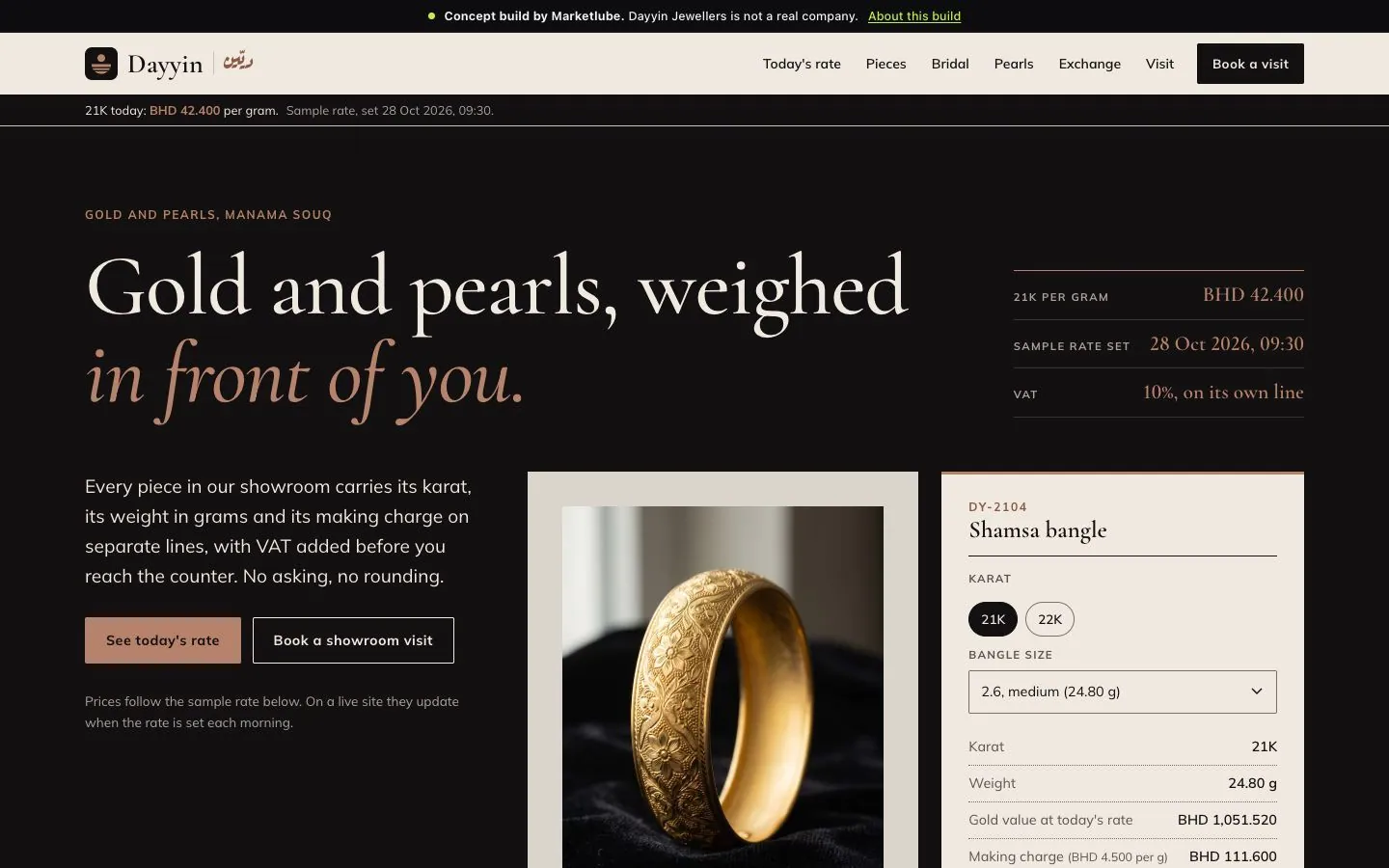
Concept build · Dayyin Jewellers, a jewellery website for Manama

Concept build · Dayyin Jewellers, further down the homepage
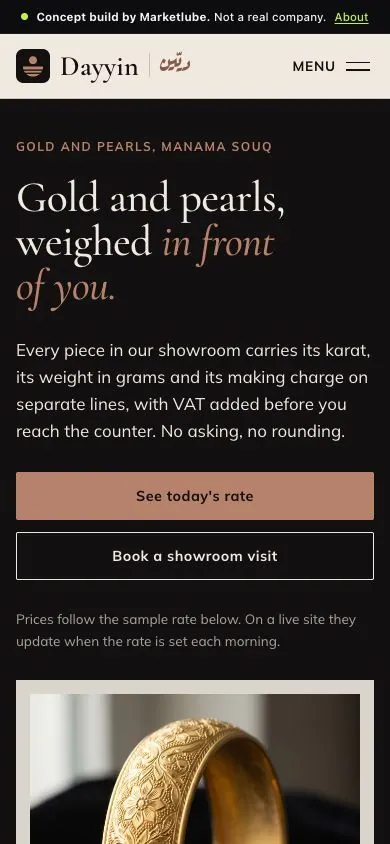
Concept build · Dayyin Jewellers on a phone
Dayyin Jewellers, a concept build
A jeweller's price list moves every morning.
Most jewellery websites are a gallery: a hundred necklace photos, a phone number and "price on request". That suits a fashion label. It does not suit gold, where the buyer already knows the day's rate and is really asking two questions: how many grams, and what are you charging for the work. A family choosing a bridal set compares three or four showrooms on exactly those lines before anyone leaves the house, and a relative paying from Riyadh or Doha wants them in writing.
So we start from the arithmetic. One rate table, set by your staff each morning and printed with the time, drives every price on the site. Each piece shows its karat, weight, gold value at that rate, making charge, stones on their own line and the tax that applies where you trade, and the total moves the moment the rate does. Around that sit the pages families actually use: bridal sets priced piece by piece, a booking form that holds named pieces for a visit or a video call, exchange and buy-back terms, and what a hallmark or a pearl report does and does not prove.
Dayyin, the sample below, is a concept build: a working jewellery website we made for a fictional shop in Manama Souq, not a client. Change the karat or the size and every receipt, the calculator and the bridal set rework themselves, which is the quickest way to judge whether line-by-line pricing suits your counter.
Eight things a jeweller's website must get right.
The day's rate, with the time it was set
What we build: A rate board for each karat you sell (24K, 22K, 21K, 18K), set once in the admin by whoever fixes the rate in the morning, stamped with the date and time and shown in the header, on its own page and on every piece. Optional rate alerts go only to people who opted in, with an opt-out that works; Bahrain's data protection law, for example, gives a jeweller 10 working days to stop direct marketing once someone asks.
What you get (4)Show less
- A rate strip in the header and a full rate page with a buying rate beside the selling rate
- One place in the admin to change the rate, which reprices the whole catalogue
- A printed time on every price, so nobody argues about an old screenshot
- An opt-in list for daily rate messages, with an unsubscribe link
Source: Bahrain Business Laws, Personal Data Protection Law (Law No. 30 of 2018), Article 20, read 28 Oct 2026
Prices broken into lines, not a single figure
What we build: A price slip on every piece: code, karat, weight in grams, gold value at today's rate, making charge per gram and as a total, stones or pearls separately, then tax and the total. In Kuwait a 2021 commerce ministry decision, in force from 9 May 2021 as Kuwait Times reported, requires each piece's label to state its karat, weight, making charge and the type of gems, so the website simply matches the tag in the case.
What you get (4)Show less
- Slips that rework every line when the buyer changes karat, size or chain length
- A compare drawer that sets two or three pieces side by side by all-in price per gram
- A calculator for buyers to price a piece they already own
- Three-decimal totals for dinar markets, two for rupees and dirhams
Source: Kuwait Times, How new sale regulations will affect buying gold in Kuwait, read 28 Oct 2026
Proof of purity that a buyer can check
What we build: A hallmark page and a line on each piece that says what is marked and how to check it. In India the BIS hallmark carries three marks, the BIS logo, the purity grade and a six-character HUID, and a buyer can look the HUID up with "Verify HUID" in the BIS Care app. Because a HUID belongs to one physical piece, not to a design, we print it on the invoice and the order page rather than on a catalogue photo shared by several pieces.
What you get (3)Show less
- A plain explainer of the hallmark and how to verify it on a phone
- A HUID field on each order, carried to the invoice email
- Purity shown as both karat and fineness (22K and 916)
Source: Bureau of Indian Standards, Hallmarking of Gold Jewellery and Artefacts, read 28 Oct 2026
Stones, diamonds and pearls set apart from the gold
What we build: Stone weight and stone value on their own lines, so gold is never charged at the gold rate on the weight of the stones. Saudi Arabia's guidance for precious metals shops says the shop must disclose the weight percentage of stones set in a gold piece. For pearls, a short natural-versus-cultured page and a label on every pearl piece.
What you get (3)Show less
- Separate gold weight, stone weight and stone value on each slip
- Diamond details as your certificate states them (carat, colour, clarity) where you hold one
- A natural and cultured pearl explainer that promises nothing a photograph cannot show
Source: Monsha'at, Store Operation Manual (precious metals and gemstones shops), read 28 Oct 2026
Bridal viewings, in the showroom or on a video call
What we build: A booking flow built for a family decision: choose the purpose (bridal set, engagement ring, exchange, custom order), the branch, a slot inside your opening hours and the piece codes to hold. A second option books a video-call viewing at an hour that suits a relative in Dubai, Doha or Riyadh.
What you get (4)Show less
- Bridal sets priced piece by piece, with tick boxes to drop the ring or the earrings
- Time slots generated from each branch's hours, including split shifts and Friday evenings
- "Ask about this piece" buttons that open WhatsApp with the piece code already typed
- A booking email to the branch with the held pieces listed
Old gold exchange and buy-back, written down
What we build: A terms page in plain words: how you test and weigh old gold, which rate you credit it at, what happens to making charge and tax on a buy-back, how long an unworn exchange stays open and what ID you ask a seller for. An estimate tool lets a family weigh a bangle at home and see roughly what it is worth against a new piece.
What you get (3)Show less
- Exchange, buy-back and custom-order terms that match the counter
- An old-gold estimate calculator using the day's buying rate
- A booking purpose for exchange visits, so the tester is free when they arrive
One page per showroom
What we build: A page for each branch with its own address, hours, phone, WhatsApp number, map link and the collections it carries, so a search for your name plus the town lands on the right counter. Chains with branches in Kerala and the Gulf get a branch switcher that also switches currency and tax.
What you get (3)Show less
- Branch pages with structured data for the address and hours
- Opening hours that handle Ramadan and festival changes from the admin
- Currency and tax that follow the branch the visitor picks
Selling online only where it makes sense
What we build: A store for what buyers will order unseen: coins, lightweight gifting, daily wear and silver, with insured shipping rules and the rate locked at checkout. Payment is the country's question: Shopify Payments and Stripe list the UAE but not Saudi Arabia, Qatar, Kuwait, Bahrain or Oman, where the store connects a local gateway instead.
What you get (4)Show less
- A Shopify or custom store limited to the lines you choose to sell online
- The price fixed at the moment of payment, so a rate change mid-checkout cannot alter it
- The local gateway you contract with, tested with local cards (BENEFIT, mada, KNET where supported)
- Order emails that carry karat, weight and making charge, not just a product name
Source: Shopify Help Center, Shopify Payments supported countries, read 28 Oct 2026
Price a bangle yourself on Dayyin, our concept build.
Dayyin Jewellers is a concept build: a working homepage we designed and built for a fictional brand, so you can try the layout and its tools on your phone before we build yours. It is not a client. See every concept build.
Concept build · Jewellery · Manama
Dayyin Jewellers
We placed Dayyin Jewellers, an invented gold and pearl shop, in Manama Souq, and wrote its pieces, weights and morning gold rate as samples for the demo. The site is for families buying wedding gold, people weighing up pearls and anyone who wants to check a price before walking into the souk, so every piece carries a printed receipt with its karat, weight, gold value, making charge, VAT and total in Bahraini dinars. The receipts, the calculator, the compare drawer and the booking times all respond as you use them.
From the rate board to the showroom: eleven pages.
- HomeThe day's rate, one hero piece with its price slip, the bridal collection and the nearest branch.
- Today's rateSelling and buying rates per gram for each karat, the time they were set and a calculator.
- CollectionsBridal, daily wear, men's, kids', diamonds, pearls and coins, filtered by karat, weight and price.
- Piece pagesPhotographs at true colour, the full price slip, size options and buttons to hold the piece or ask on WhatsApp.
- BridalSets priced piece by piece, a private viewing booking and a video-call option for relatives abroad.
- How we priceGold value, making charge, stones and tax explained with one worked example.
- Hallmark and purityWhat the marks on your pieces mean and how a buyer checks them.
- Pearls and stonesNatural and cultured pearls, diamond grading and what a lab report proves.
- Exchange and buy-backYour terms for old gold, exchange windows and buy-back, with the estimate tool.
- Custom ordersSketch to collection in steps, with a request form for piece type, karat and budget.
- ShowroomsOne page per branch with hours, map link, phone, WhatsApp and the booking form.
Hallmarks, VAT and labels differ by country.
Kerala and India
BIS made hallmarking mandatory in phases: 256 districts from 23 June 2021, 288 from 1 June 2022, and more in later phases, so check that your district is on BIS's current list before the site makes the claim. Pieces under two grams are among the exemptions, so a site should not promise a HUID on a pair of small studs. Showroom sites here lead with the rate in rupees per gram and per pavan, branch pages and bridal bookings, with Malayalam where your customers read it.
Source: Bureau of Indian Standards, Mandatory hallmarking FAQs, read 28 Oct 2026
United Arab Emirates
Gold jewellery bought by shoppers carries the standard 5% VAT, while investment gold of at least 99% purity in bars, ingots or bullion coins is zero-rated, and trade between VAT-registered dealers runs on a reverse charge. UAE law also wants prices advertised to consumers to include VAT, so a UAE site shows VAT-inclusive dirham prices on jewellery and treats coins and bars as their own tax case, which your accountant confirms.
Source: Gulf News, UAE gold VAT and trading rules, read 28 Oct 2026
Saudi Arabia
Saudi guidance for precious metals shops asks for a karat marking and the maker's or importer's hallmark on each piece, a precise scale, a stamped invoice, the stones' weight percentage disclosed, and all information in Arabic with another language allowed alongside. The website follows suit: Arabic first, stone weights shown, and VAT at 15% in the price.
Source: Monsha'at, Store Operation Manual (precious metals and gemstones shops), read 28 Oct 2026
Bahrain, Qatar and Kuwait
Bahrain charges VAT at 10% and its VAT law wants displayed prices to include it; how it falls on gold, making charge and pearls is one for your accountant, and the slip shows it however they advise. Qatar and Kuwait have no VAT. Qatar's commerce ministry tells buyers to check the karat marking, the scale and an invoice with the karat and a full description of the piece. Bahrain and Kuwait price in dinars of 1,000 fils, so their slips and carts work to three decimals.
Source: The Peninsula, MoCI shares advice for buying and selling gold, read 28 Oct 2026
Prices for a showroom site or a gold store.
- Business websiteCustom design, up to 8 pages · 4 to 8 weeksfrom INR 60,000 · AED, QAR or SAR 8,000 · KWD 650 · OMR or BHD 800
- Next.js website with a CMSHeadless CMS, up to 15 pages · 8 to 14 weeksfrom INR 2,00,000 · AED, QAR or SAR 15,000 · KWD 1,250 · OMR 1,550 · BHD 1,500
- Shopify storeUp to 50 products set up · 6 to 10 weeksfrom INR 1,20,000 · AED, QAR or SAR 12,000
- Custom online storeOn WooCommerce or a headless build · 8 to 12 weeksfrom INR 1,50,000 · AED, QAR or SAR 15,000
- Website care planBilled yearly · starts within a weekfrom INR 3,000 · AED, QAR or SAR 500 · KWD 40 · OMR or BHD 50 a month
Rows without a KWD, OMR or BHD figure are quoted in AED for Kuwait, Bahrain and Oman.
These starting figures exclude GST in India and exclude VAT in the Gulf countries that charge it. A jeweller's written quote lists the rate engine and who sets the rate, how many pieces we load, the bridal booking and video-call flow, any payment gateway and local card network, the Arabic or Malayalam copy and its translator, and any link to your billing or stock software.
What the build includes
- A rate table for each karat that reprices the whole site from one admin screen
- Price slips on every piece with gold value, making charge, stones and tax on separate lines
- Bridal sets priced piece by piece, with tick boxes for the pieces a family keeps
- Booking for showroom and video-call viewings that holds named pieces
- Hallmark, pearl and stone explainers written for your stock
- Exchange, buy-back and custom-order pages, with an old-gold estimate tool
- One page per showroom with hours, map link and WhatsApp
- Photographs prepared for true colour and fast loading on phones
- Training for the staff member who sets the rate each morning
Not included
- Product photography and films, quoted separately if you want a shoot
- A live market price feed subscription; the rate is set by your staff
- Hallmarking, assay, gem or pearl certification, which come from the lab or authority
- Payment gateway and app fees, paid to the providers in your business's name
- Writing your exchange, buy-back or savings scheme terms, which are your business's and its advisers'
Five steps. No surprises.
Every stage has an owner, a deliverable and a sign-off, all agreed with you before it starts.
Book a discovery callHow you price today
A video call with whoever fixes the rate and the making charges. We note which karats you sell, whether making is per gram, a percentage or a flat figure per piece, how stones are weighed and what your counter invoice already prints, because the website has to match it line for line.
Catalogue and photographs
We agree which pieces go online at launch and the fields each needs: code, karat, gross and net weight, stone weight, size options. If you photograph in-house, we send a short guide for true-colour gold on a phone; if you want a shoot, it is quoted separately.
Design around the slip
We design the price slip first, then the rate board, the bridal set and the branch pages around it, in English and in Arabic or Malayalam where you need them. You check every design on your own phone, under the same light a customer would scroll it in, because gold colour is judged there.
Build, load and test the sums
Next the catalogue goes in, and we test every slip against prices worked out on your counter software for the same rate, so a fils or a rupee of rounding never differs. Any gateway is tested in its sandbox with a local card before launch.
Launch and the first mornings
We launch on a quiet weekday, then watch the first mornings as your staff set the rate, and adjust the admin until it takes a minute. After launch, the care plan covers updates and backups, and we load each new collection before the wedding season it is made for.
Jewellery websites, answered.
The team is in Calicut, India
1414, 4th Floor, Phase 1, HiLITE Business ParkKozhikode, Kerala 673014Mon–Sat · 9:30 am to 6:30 pm
Should a jewellery website show the gold rate every day?
If it shows prices, yes, with the date and time the rate was set. Buyers check the rate per gram before anything else, and a price built on yesterday's rate either loses the sale or causes an argument at the counter. Set the rate once each morning, print the time beside it and let it reprice the catalogue, rather than updating pieces by hand.
Should we show making charges on the website?
Showing them builds trust. The buyer can check the gold value for themselves but not the work, so making charge, stones and tax on separate lines let a family compare showrooms fairly. In Kuwait, the commerce ministry's 2021 decree, as reported by Kuwait Times, already requires shop labels to show the making charge with karat and weight.
What should a jewellery website say about BIS hallmarks and HUID?
Explain the three marks (the BIS logo, the purity grade and the six-character HUID) and how to check a HUID with "Verify HUID" in the BIS Care app. Print the HUID on the invoice of the piece sold, since each code belongs to one physical item. BIS lists items under two grams among the exemptions, so avoid blanket claims that every piece carries a HUID.
Can a jewellery website in the Gulf take card payments?
Yes, through a gateway your business contracts with. Shopify Payments and Stripe list the UAE but not Saudi Arabia, Qatar, Kuwait, Bahrain or Oman, so stores there connect a local gateway that takes the local cards: mada in Saudi Arabia, KNET in Kuwait, BENEFIT in Bahrain. Many jewellers sell only coins and lightweight pieces online and book visits for the rest.
How does VAT show on a Gulf jewellery website?
Inside the price: the UAE and Bahrain both want consumer prices shown with VAT included. Shoppers in the UAE pay the standard 5% on jewellery, Bahrain's rate is 10% and Saudi Arabia's 15%, while Qatar and Kuwait have no VAT. Investment gold of 99% purity is often treated differently from jewellery, so let your accountant set the rules and have the slip show tax on its own line. This is not tax advice.
How many pieces should a jewellery website launch with?
Enough to show each collection properly, not the whole safe. Many showrooms launch with their bridal sets, a few dozen daily-wear pieces and coins, each fully weighed and photographed, and add a collection before each wedding season. A smaller catalogue with exact weights and prices does more than a large one marked "price on request".
What photographs does a jewellery website need?
One clear photograph of each piece at true colour on a plain background, one showing it worn or in a hand for scale, and close-ups of the detail buyers ask about, such as filigree, stone setting or the clasp. Gold that looks right under showroom lights often turns orange or grey on a phone, so check every image on a phone screen before it goes live.
Further reading
Sources
- Bahrain Business Laws, Personal Data Protection Law (Law No. 30 of 2018), Article 20, read 28 Oct 2026
- Kuwait Times, How new sale regulations will affect buying gold in Kuwait, read 28 Oct 2026
- Bureau of Indian Standards, Hallmarking of Gold Jewellery and Artefacts, read 28 Oct 2026
- Monsha'at, Store Operation Manual (precious metals and gemstones shops), read 28 Oct 2026
- Shopify Help Center, Shopify Payments supported countries, read 28 Oct 2026
- Bureau of Indian Standards, Mandatory hallmarking FAQs, read 28 Oct 2026
- Gulf News, UAE gold VAT and trading rules, read 28 Oct 2026
- The Peninsula, MoCI shares advice for buying and selling gold, read 28 Oct 2026
- PwC Tax Summaries, Bahrain: other taxes, read 28 Oct 2026
- Bahrain Business Laws, Value Added Tax Law, Article 3 (displayed prices include VAT; the 5% rate shown there was raised to 10% from 1 Jan 2022), read 28 Oct 2026
- PwC Tax Summaries, Saudi Arabia: other taxes, read 28 Oct 2026
- PwC Tax Summaries, Qatar: other taxes, read 28 Oct 2026
- PwC Tax Summaries, Kuwait: other taxes, read 28 Oct 2026
- Stripe, Global availability, read 28 Oct 2026
- Habib Al Mulla and Partners, VAT-inclusive displayed prices in the UAE, read 28 Oct 2026
- Bureau of Indian Standards, Hallmarking overview, read 28 Oct 2026
- Bureau of Indian Standards, Phase-wise coverage of districts under gold mandatory hallmarking, read 28 Oct 2026
Jewellery websites
Let's build your website.
Tell us what the site has to do and who it is for. A strategist replies within one working day, from our team in Calicut.
Every rupee you spend with us has to earn its keep.