Concept build · Thiruvananthapuram
Pathila Ayurveda House Ayurveda centre website design for Thiruvananthapuram, a concept build
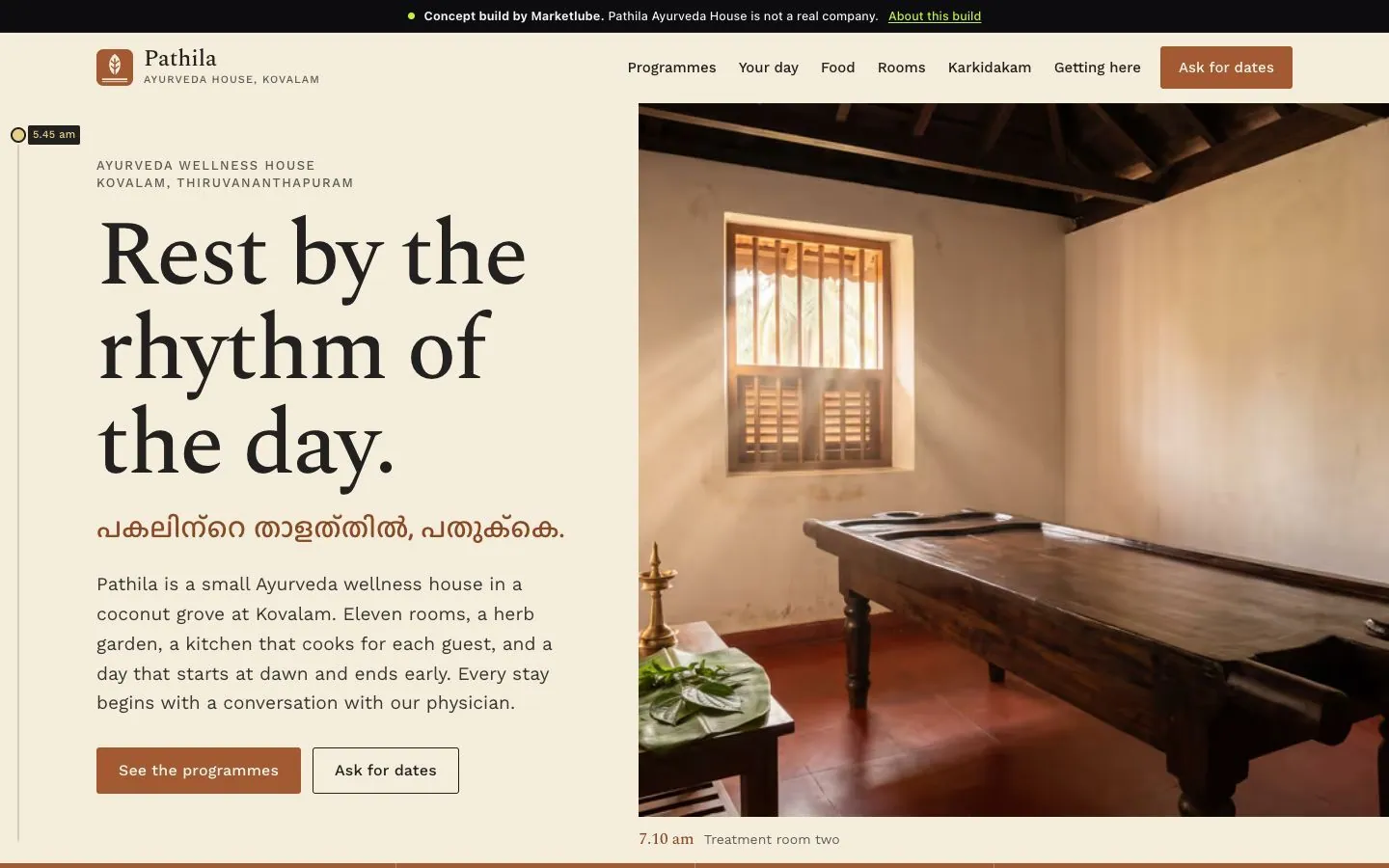
Pathila Ayurveda House is a concept, not a place you can stay: an eleven-room wellness house in a coconut grove at Kovalam, Thiruvananthapuram, offering stays of 7, 14 or 21 nights, with staff and prices that are equally fictional. On its homepage you can plan a stay, open any day of it hour by hour, slide your arrival across the seasons and price it in rupees or US dollars; the enquiry form then sums up the plan, though it sends nothing.
A concept build: Pathila Ayurveda House is a fictional brand we created to show how we design and build an Ayurveda centre website for Thiruvananthapuram. It is not a client and not a real company; our client work is on the work page.
The complete homepage, live
Both frames run the real site. Scroll inside them, try the stay planner: choose 7, 14 or 21 nights and a focus (rest, yoga or seasonal routine), and a calendar strip redraws with one square per day, coloured by phase, with an animated reshuffle as the length changes, or open it in a new tab.
How we designed an Ayurveda centre website for Thiruvananthapuram
The page is one day
Guests choosing an Ayurveda stay want to know what their days will actually look like, so the page runs from the dawn bell in the hero to lights out in the footer. On wide screens a small sun moves down the left margin and shows the time of each section, from 5.45 am to 10 pm. The hour-by-hour timeline in the middle shifts from cream through oil yellow and copper to indigo as the day goes on.
Wellness, never a cure
Indian advertising law bars promising a cure for the diseases it names, and guests are wary of centres that do. So this page makes no health claim at all: a notice just under the hero says plainly that the house does not diagnose, treat or cure any disease, and every stay starts with a physician's consultation. Physicians appear by role only, beside a clearly marked slot where a real centre would list its names, registrations and approvals.
Rupees, dollars and the monsoon
Kovalam sells to Indian guests who pay in rupees and to foreign guests who plan months ahead in dollars, so every price is shown in both, with rupees grouped the Indian way. The planner lets a guest drag their arrival along the year and see where the stay falls against the dry season, the monsoon, the June upkeep closure and Karkidakam, the monsoon month many Malayalis keep for rest.
Kasavu as the only ornament
The palette comes from things in an old Kerala house: kasavu cream, copper vessels, oil-lamp yellow and a monsoon indigo, set as solid blocks. A woven kasavu border is the only ornament, used between the parts of the day. Malayalam sits beside the English headings in Baloo Chettan 2, so Malayali guests feel at home and foreign guests see a real Kerala house.
What the homepage includes
- Hero and fact strip
- Wellness notice
- First, a conversation
- Programmes and stay planner
- Your day, hour by hour
- Food and the kitchen garden
- Rooms
- Karkidakam and the year
- What to bring, what to expect
- Physicians and approvals
- Getting here and map
- Questions and enquiry form
Features and interactions
- Stay planner: choose 7, 14 or 21 nights and a focus (rest, yoga or seasonal routine), and a calendar strip redraws with one square per day, coloured by phase, with an animated reshuffle as the length changes
- Open any day of the stay, by tap or arrow keys, to see it from dawn to night as a coloured time track and a list of what happens when, with its date
- Arrival slider along the year that shows your arrival and leaving dates, the season your stay mostly falls in, and a note when it touches the June upkeep closure or Karkidakam; 'Ask for these dates' carries the plan into the enquiry form
- Price estimator for room, guests and currency, in rupees with Indian digit grouping or in US dollars, with the room supplements, the sharing discount and airport transfers set out line by line
- Enquiry form with a live summary that works out the leaving date and estimated total, and flags past dates, the closure and Karkidakam (nothing is sent)
- A day line on wide screens whose sun follows the page, a time chip on phones in the hour-by-hour section, a year strip that outlines the current month, and a packing checklist that remembers your ticks in this browser
- A masked line reveal on the headline, photographs that open behind a curtain and smooth scrolling, with the motion left out entirely under a reduced-motion setting
The whole page, top to bottom


Palette and type
- Kasavu cream #F4EDDC
- Copper #A35A32
- Oil yellow #E7CF8A
- Monsoon indigo #2E3555
- Charcoal #232120
Type: Spectral, Work Sans, Baloo Chettan 2.
Languages: English, Malayalam (headings and short lines).
How it is built
- Hand-built HTML, CSS and JavaScript, no framework
- GSAP 3.15.0 with ScrollTrigger, SplitText and Flip (the calendar strip)
- Lenis 1.3.26 smooth scrolling
- Photographs generated with Higgsfield (Nano Banana Pro), served as WebP, with AVIF for the hero
- Spectral and Work Sans from Google Fonts, with Baloo Chettan 2 loaded only for the Malayalam letters on the page, and an inline SVG map of the coast
- Homepage weight about 680 KB on desktop and about 520 KB on a phone, measured on our machine on 28 Oct 2026
Need an Ayurveda centre website like this?
We design and build sites like this one for real businesses, with your brand, your photographs, your prices and the forms wired to your team. See what goes into Ayurveda centre websites, our web development service, our website prices and how we work with businesses in Calicut and Kerala, or browse every concept build.
Questions
What should an Ayurveda centre website in Kerala include?
Guests want to see what a day of the stay looks like, hour by hour, and what each programme includes: the room, meals, consultations, therapies and yoga. Give the prices, the rooms, the food and how guests get from the airport. Say plainly what a stay will and will not do, and list the physicians' qualifications, registrations and the centre's approvals where guests can check them.
Can an Ayurveda centre website say its treatments cure diseases?
No. In India, advertising that suggests a cure for the diseases named in the Drugs and Magic Remedies (Objectionable Advertisements) Act, 1954 is barred, and consumer law covers misleading claims. A safer website describes the routine, the food and the consultation, and says clearly that the centre does not diagnose, treat or cure disease. Guests trust a plain answer more than a promise.
Should an Ayurveda centre website in Kerala show prices in rupees and dollars?
If it takes both Indian and foreign guests, yes. Indian guests expect rupee prices grouped the Indian way, and foreign guests comparing centres from abroad want a figure in a currency they know. A simple switch between the two, with the same inclusions shown in each, spares guests an exchange of emails before they book.
More concept builds
Websites
Want yours built like this?
Tell us about your business. We'll plan the pages, the bookings or enquiries, and the launch.
Every rupee you spend with us has to earn its keep.