Websites for coaching and training
The batch, the fee, the teacher. On a phone. Coaching centre website design for Kerala and the Gulf
Marketlube designs and builds websites for entrance coaching centres, tuition brands and professional training institutes in Kerala and the Gulf, from Calicut, with no office in the Gulf. Each site is built around what a student, a parent or an HR manager checks before paying: which batch fits, what every instalment costs, what happens to the fee if the student leaves, and who teaches. Our two samples are concept builds for fictional brands, one entrance academy in Calicut and one training institute in Manama.
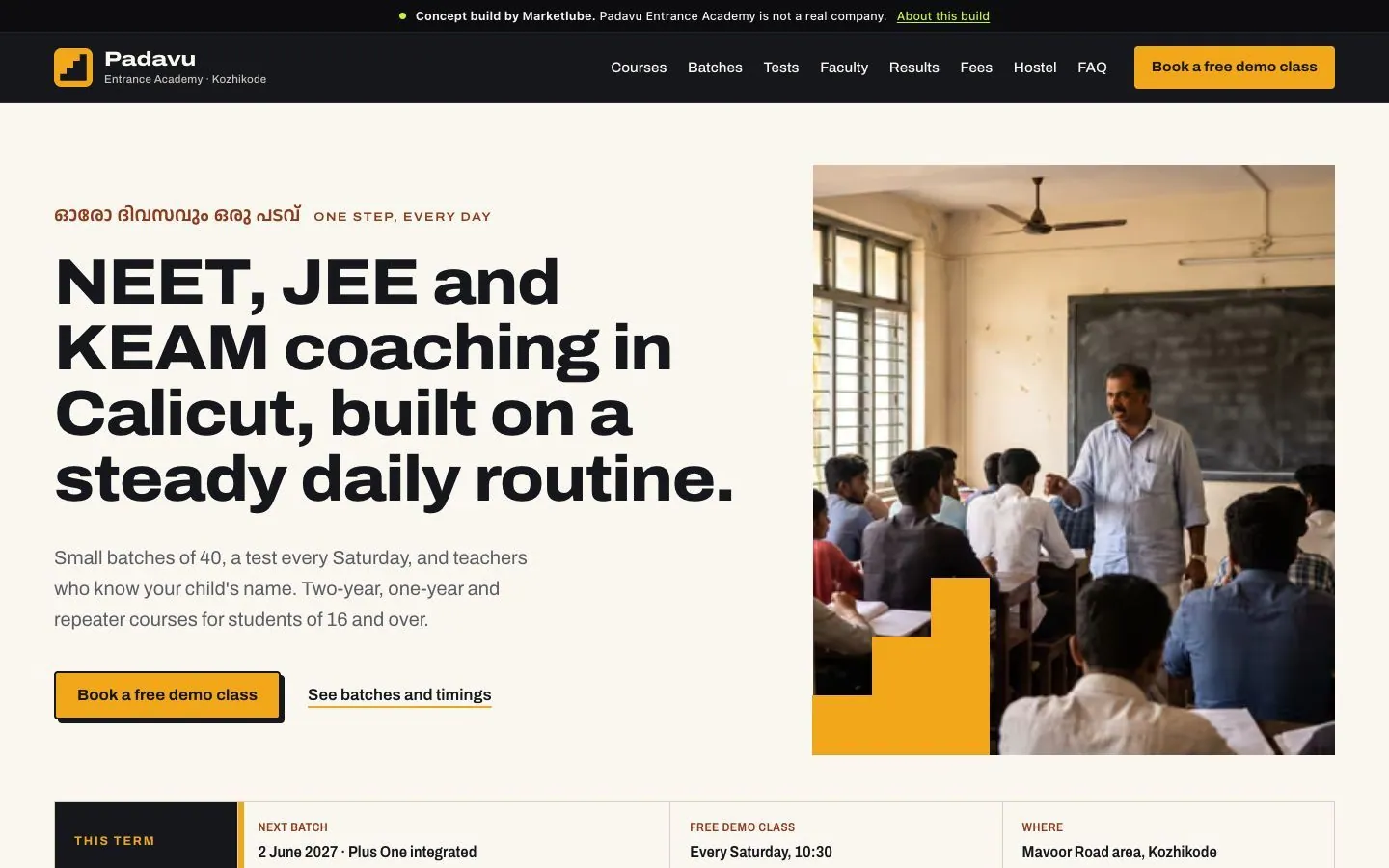
Concept build · Padavu Entrance Academy, a coaching centre website for Calicut
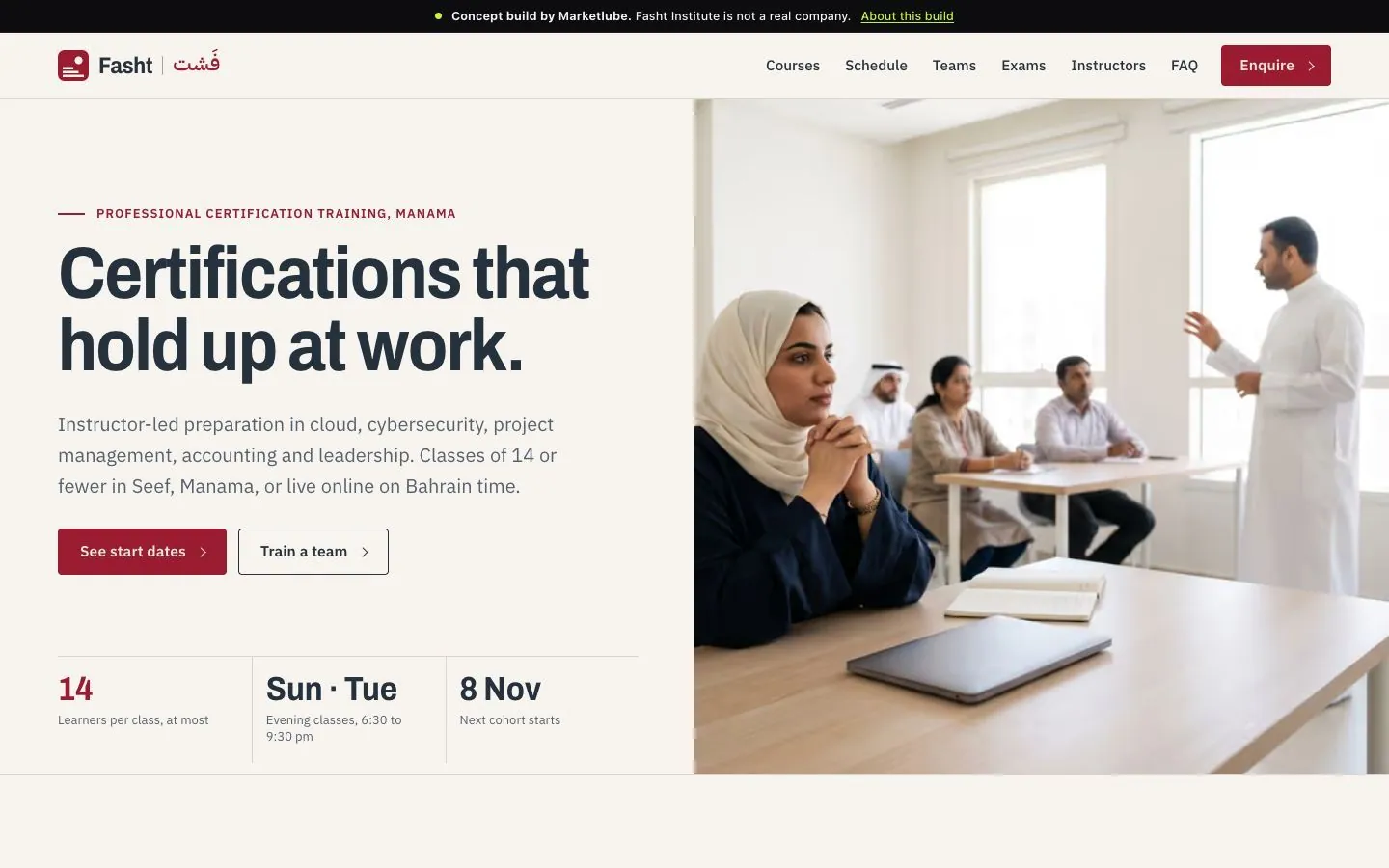
Concept build · Fasht Institute, a training institute website for Manama
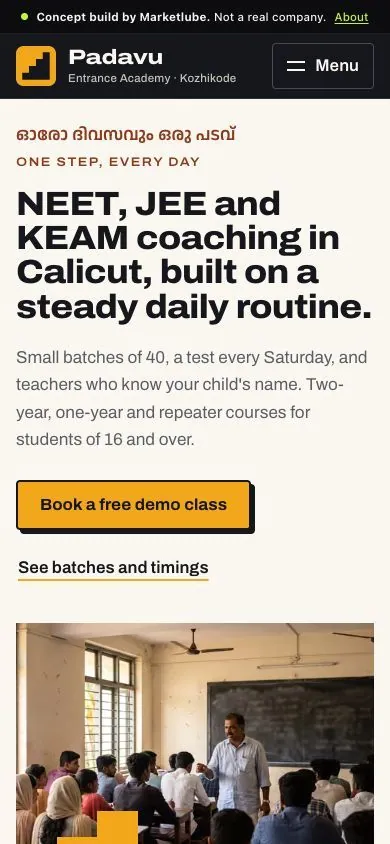
Concept build · Padavu Entrance Academy on a phone
Two concept builds for fictional brands
A coaching website is checked before it is admired.
A parent comparing three entrance academies on Mavoor Road, or an HR manager in Seef choosing where to send six accountants, is not looking for a slogan. They want the batch that fits, the full fee with every instalment, the refund rule, the teachers' names and qualifications, and a way to try a class or hold a seat. Most coaching sites we read bury those behind a topper poster and a "call for fees" button, so the enquiry comes in but the decision is still unmade.
The rules now point the same way. India's Ministry of Education asked in 2024 for coaching centres to keep a website listing tutors' qualifications, courses, duration, hostel facilities and fees, and the Central Consumer Protection Authority's guidelines on coaching adverts the same year banned unverified success claims and false urgency. In Dubai, the KHDA authorises each training institute's programmes and may approve the content of its promotional material, and in Saudi Arabia TVTC accredits each programme an institute may run. We build the site so those answers are on it from the first day.
We have not yet built a website for a coaching centre or training institute client, so the samples here are concept builds for fictional brands. We do market two businesses in this field: we make Malayalam reels and run Meta ads for Drillshore Academy, which trains young people in Kochi for oil and gas careers, and for Zealous Learning, which gives one-to-one tuition to students in classes 5 to 12. Their websites are not our work. Nothing on this page is legal advice.
What a student, a parent and an HR buyer check before paying.
Show whether a batch fits the student's week
What we build: A batch finder built from one schedule per batch: pick the exam or course and the batch, and the whole week appears, as a grid on a desktop and a day-by-day list on a phone.
What you get (4)Show less
- One timetable record per batch, edited once and shown everywhere it appears
- Filters by exam, class year, repeater or weekend batch, and classroom or online
- Start dates and the time zone stated plainly, so a family abroad reads the right hours
- A timetable readable by screen readers, not an image of a printed sheet
Print every fee, instalment and the refund rule together
The Ministry of Education's 2024 guidelines say the fee a student enrolled on may not be raised during the course, and a student who leaves part-way is refunded for the remaining period pro rata within 10 days, hostel and mess fees included.
What we build: A fee table that lists each course's total, its instalments and their months, with the refund rule printed beside it and the batch year on the table.
What you get (5)Show less
- A switch that opens each course's full instalment plan
- The refund rule on the fee page itself, not in a PDF
- A dated line such as "Fees for the batch starting June 2027" and a short change log
- Each course card linking to its own row in the fee table
- Tax stated, included or added, beside every total
Source: Careers360 (PTI), MoE guidelines for coaching centres, read 28 Oct 2026
Name the teachers and what they are qualified in
The CCPA guidelines ask that adverts accurately reflect a course's duration, faculty qualifications and fees, and the website is where a parent checks the advert against the facts.
What we build: A faculty section with one card per teacher: the subject, the degree, the years of teaching and the batches they take.
What you get (4)Show less
- Faculty cards your office can add, edit or retire in minutes
- Each course page listing the teachers who take it
- Qualifications written out, never "expert faculty" with no names
- A termly reminder to remove anyone who has left
Source: MediaNama, CCPA guidelines to curb misleading ads in the coaching sector, read 28 Oct 2026
Report results without rank posters
Under the CCPA guidelines a student's name, photo or testimonial needs their written consent, taken only after their success, and unverified claims about success rates are banned.
What we build: A results page that counts every enrolled student: the cohort size, how many sat the exam, how many cleared the cut-off and how many left and were refunded, published once a year with the method.
What you get (4)Show less
- A yearly report layout with an honest denominator, old years kept online
- Named students only with a dated consent record on file
- Which course each featured student took, and for how long
- No countdown timers or "last few seats" banners on any page
Source: MediaNama, CCPA guidelines to curb misleading ads in the coaching sector, read 28 Oct 2026
Book demo classes for 16 and 17 year olds through a parent
The Ministry of Education's 2024 guidelines say a coaching centre may not enrol students below 16 and should enrol only after the secondary school examination, so most entrance applicants are 16 or 17: still children under India's Digital Personal Data Protection Act, which needs a parent's verifiable consent. AZB & Partners reports that the children's data provisions apply from 13 May 2027.
What we build: A short demo class form that asks the student's class first, the parent's name and number second, and carries a notice of what is collected and why.
What you get (5)Show less
- Next available demo dates offered from the calendar, not typed in each week
- The age and class rule stated above the form, so a class 9 enquiry is answered politely, not booked
- Parent fields and nothing a booking does not need, such as a home address
- A consent notice beside the button and the consent kept with the enquiry
- Each booking tagged with the exam and batch, so the first call starts in the right place
Source: AZB & Partners, India's DPDP framework comes into effect, read 28 Oct 2026
Let a company buy seats for a team
What we build: A team route beside the single-learner one: a fee estimate where the HR buyer picks a course and a headcount and sees the per-person fee, any group rate and the total, then sends it as a proposal request with the course and numbers filled in.
What you get (4)Show less
- A headcount slider and number field kept in step
- Group rates you set, shown before tax with the tax named
- An enquiry form that asks for the number of learners only when a team is chosen
- A page for in-house cohorts run at the client's premises
Keep the institute's course and the exam body's exam apart
What we build: An exam path section that explains, in plain steps, who sets and marks each certification exam, what the entry rules are, and that the exam fee goes to the awarding body rather than to the institute.
What you get (4)Show less
- Course pages that name the awarding body for each certification
- The exam fee listed as a separate line from the course fee
- A slot for your licence and approvals, with links to the documents
- Wording that never implies the institute itself awards the qualification
Admit students whose parents live in the Gulf
What we build: An admissions-from-abroad page for Kerala centres: how a video call with the class teacher works, which documents go by email, how instalments are paid online, and whether the hostel is run by the centre or found with its help.
What you get (4)Show less
- Instalments payable through your payment gateway's hosted page or payment links
- A WhatsApp button that opens with the course already named
- A hostel section that says plainly what the centre runs and what it only recommends
- Malayalam headings and menu labels beside the English detail, where the families want them
An entrance academy and an institute, both concept builds.
Padavu Entrance Academy and Fasht Institute are concept builds: working homepages we designed and built for fictional brands, so you can try the layouts and their tools on your phone before we build yours. Neither is a client. See every concept build.
Courses, batches, fees, faculty: the pages behind an enquiry.
- HomeThe exams or certifications you teach, the next start dates, the batch size and two ways in: book a demo class, or see the fees.
- Courses, a page per exam or trackNEET, JEE Main and KEAM for an entrance academy; accounting, project management or IT tracks for an institute. Each gives the length, the syllabus outline, the test pattern and the teachers.
- Batches and timetableThe batch finder: every batch's week, its start date, its class hours and its holiday, classroom or online.
- Fees and refundsOne table for every course, every instalment and every charge, with the refund rule and the batch year beside it.
- FacultyA card per teacher with subject, qualification and years of teaching, linked from each course they take.
- Results reportFor a coaching centre: the yearly count across every enrolled student, with the method and the date, and students named only with consent.
- How certification exams workFor a training institute: the path from entry rules to exam booking to keeping a certification current, and who charges what.
- Hostel and stayWhether you run a hostel or help families choose one, what you check for, and what it costs, kept separate from the course fee.
- Corporate and team trainingThe team fee estimate, in-house cohorts and a proposal form for HR buyers.
- Demo class or hold a seatThe short booking form, the demo format and length, and when your office replies.
- Questions families askAge of admission, what happens if a student leaves, how progress is reported and how admission works from abroad.
- Contact and branchesEach centre's address, map, phone and hours, with a separate entry for every branch.
What changes between Kerala, Dubai, Riyadh and Manama.
Kerala and the rest of India
The Ministry of Education's 2024 guidelines leave monitoring to state and union territory governments, and PRS Legislative Research's state bill tracker, searched for "coaching" on 28 Oct 2026, listed bills from Rajasthan, Assam, Jharkhand, Haryana and Bihar but none from Kerala. That is not a complete register, so check your position with a lawyer. The CCPA's advertising guidelines are national and reach a centre in Kozhikode whatever the state does, so the results page, the adverts and every landing page follow them. Many parents decide from the Gulf on a phone, so the fee table and demo form are designed for a small screen first.
Source: PRS Legislative Research, State bills search: coaching, read 28 Oct 2026
Dubai and the UAE
Executive Council Resolution No. 50 of 2015 says no one may offer training in Dubai without a KHDA authorisation and a licence from the licensing authority. The KHDA may approve the content of promotional material institutes use to advertise, an institute may not offer a programme its authorisation does not cover, and misleading advertising carries a fine of AED 25,000. So the course list on the site matches the authorised programmes, and we leave time in the plan for KHDA to see the copy if you treat the site as promotional material. Outside Dubai we ask which authority licenses you before we write the licence line. The fee table states whether the UAE's 5% VAT is included or added.
Source: Dubai Legislation Portal, Executive Council Resolution No. (50) of 2015 Regulating Training Institutes, read 28 Oct 2026
Saudi Arabia
TVTC licenses private training facilities, the licence is valid for five years, and training starts only after TVTC activates and accredits each programme. Its FAQs set the programme types by length, from development courses of up to a month and 60 hours to two- and three-year diplomas, allow online delivery of accredited development courses only with prior approval, say e-training also needs a licence from the National Center for E-Learning, and say TVTC does not license training given over WhatsApp or Telegram. The site lists each course under its accredited type, marks which can be taken online, and keeps the classes themselves off messaging apps. Fees shown to consumers say whether the 15% VAT is in the figure.
Source: Technical and Vocational Training Corporation (TVTC), FAQs, read 28 Oct 2026
Bahrain
The Ministry of Labour licenses private training institutions under Decree Law No. 25 of 1998, and its service page asks a newly licensed institution to complete its listing in the National Qualifications Framework with the Education and Training Quality Authority (BQA) within six months. BQA also publishes vocational review reports. A Bahrain institute's site has a place for its licence, its framework listing and, where it has one, a link to its latest review. The working week runs Sunday to Thursday, so evening and Saturday slots are what a working learner looks for, and fees are shown in dinars to three decimals, with the 10% VAT named.
Source: Bahrain Ministry of Labour, Issuance of a Licence to Establish a Private Training Institution, read 28 Oct 2026
What a coaching centre or institute website costs.
- Business websiteCustom design, up to 8 pages · 4 to 8 weeksfrom INR 60,000 · AED, QAR or SAR 8,000 · KWD 650 · OMR or BHD 800
- Next.js website with a CMSHeadless CMS, up to 15 pages · 8 to 14 weeksfrom INR 2,00,000 · AED, QAR or SAR 15,000 · KWD 1,250 · OMR 1,550 · BHD 1,500
- Website care planBilled yearly · starts within a weekfrom INR 3,000 · AED, QAR or SAR 500 · KWD 40 · OMR or BHD 50 a month
Figures are before GST in India and before VAT where it applies in the Gulf. For a coaching centre or institute, the written quote lists the batch timetable and fee table set-up, the payment gateway for fees and instalments, any Malayalam or Arabic pages and who writes them, the team fee estimate, and any connection to the admissions software your office already uses.
What the build includes
- The batch finder, drawn from one editable schedule per batch
- A fee table your office edits, with instalments, the refund rule and the batch year
- Faculty and course pages linked to each other
- A demo class or seat booking form with parent-first fields and a consent notice
- Course pages set up for searches such as "NEET coaching in Kozhikode", with course structured data
- Analytics that count demo bookings by course and batch, so you see which exam page fills seats
- A results report layout and a consent log template for named students
- A walk-through for the office staff who roll fees, batches and teachers each year
Not included
- Deciding your refund rule or how you count results; we publish what you settle with your adviser
- Applications for a KHDA, TVTC, Ministry of Labour or state registration
- A learning platform for live classes, mock tests or recorded lessons
- Study material, question banks or test series content
- Arabic course descriptions, unless the quote names a native writer
- Admission season reels and Meta lead ads, quoted on their own
Five steps. No surprises.
Every stage has an owner, a deliverable and a sign-off, all agreed with you before it starts.
Book a discovery callRead your prospectus and fee sheet
We start with what you already print: the brochure, the fee sheet, the timetable and the last season's adverts. Where they disagree, we settle one master version with you before any design, because the website will be the copy parents hold you to.
Batches, fees and teachers
Every batch, course, instalment and teacher becomes a record your office can edit, so the timetable, the fee table and the course pages all read from the same place. We agree the site map and which pages carry the licence, the refund rule and the results method.
Design around a real week
The design is drawn with your actual timetable and fee table in it, on a phone first, with Malayalam or Arabic where it is scoped. You see the batch finder and the fee table working before the rest of the pages are built.
Build, then fact-check
We build the site, connect the forms and the payment gateway, and go through every page and advert line against the rules that apply to you, from the CCPA points in India to the KHDA or TVTC course lists in the Gulf. The coaching centre guidelines post sets out the Indian checks we use.
Launch before the main batch fills
We time the launch for the weeks before your main batch starts taking seats, not while the office is fielding calls, then show your staff how to add a crash batch, change a teacher or close a full one. On the care plan we roll the fee table to the next batch year each season.
Coaching centre websites, answered.
The team is in Calicut, India
1414, 4th Floor, Phase 1, HiLITE Business ParkKozhikode, Kerala 673014Mon–Sat · 9:30 am to 6:30 pm
What does the Ministry of Education ask a coaching centre to put on its website?
As Careers360 reported the Ministry of Education's 2024 guidelines, a coaching centre should keep a website with up-to-date details of its tutors' qualifications, courses and curriculum, the duration of each course, its hostel facilities and its fees. Families also look for batch timings, the refund rule, how results are counted and a way to book a demo class, all readable on a phone.
Can a coaching centre website show toppers and their ranks?
Only with care. MediaNama reports that the CCPA's 2024 guidelines require a student's written consent before their name, photo or testimonial is used, and that the consent may be taken only after the student's success, never at admission. Unverified success-rate claims and false urgency, such as "only a few seats left", are banned. A results report that counts every enrolled student is a safer and more convincing alternative.
How should a coaching centre show fees and refunds online?
Put every course's total, its instalments and any other charges in one table, with the refund rule printed beside it and the batch year on the table. Under the Ministry of Education's 2024 guidelines the fee a student enrolled on may not be raised during the course, and a student who leaves is refunded for the remaining period pro rata within 10 days, hostel and mess fees included.
Does a training institute in Dubai need approval for its advertising?
Executive Council Resolution No. 50 of 2015 lets the KHDA approve the content of promotional material that training institutes use to advertise, and sets a fine of AED 25,000 for advertising an institute or its programmes in a misleading manner. Institutes also may not offer a programme their KHDA authorisation does not cover. Ask the KHDA how it treats your website's course pages before launch.
Can a Saudi training centre list online courses on its website?
TVTC's FAQs say online training is allowed for accredited development courses at licensed facilities with prior approval, and that e-training also needs a licence from the National Center for E-Learning. They also say a licence cannot be for e-training alone, and that TVTC does not license training delivered through apps such as WhatsApp or Telegram. A Saudi institute's site should mark online only the courses approved for it, and it should check with TVTC and the National Center for E-Learning which approvals apply.
At what point in the batch year should a coaching centre launch a new website?
Count back from the date your main batch starts taking seats. A business website usually takes 4 to 8 weeks and a larger site with a content system 8 to 14 weeks, and the slowest part is rarely the build: it is agreeing one fee sheet, one timetable and one faculty list across branches. Starting straight after a batch has filled gives the office time to check every figure before the next round of enquiries.
From what age can a coaching centre enrol students?
As Careers360 reported the Ministry of Education's 2024 guidelines, coaching centres cannot enrol students below 16 years of age, and enrolment should be only after the secondary school examination. Those 16 and 17 year olds are still children under India's Digital Personal Data Protection Act, which requires a parent's verifiable consent; AZB & Partners reports that this applies from 13 May 2027. How the guidelines apply to a tuition service for younger classes is a question for your lawyer.
Further reading
Sources
- Careers360 (PTI), MoE guidelines for coaching centres, read 28 Oct 2026
- MediaNama, CCPA guidelines to curb misleading ads in the coaching sector, read 28 Oct 2026
- AZB & Partners, India's DPDP framework comes into effect, read 28 Oct 2026
- PRS Legislative Research, State bills search: coaching, read 28 Oct 2026
- Dubai Legislation Portal, Executive Council Resolution No. (50) of 2015 Regulating Training Institutes, read 28 Oct 2026
- Technical and Vocational Training Corporation (TVTC), FAQs, read 28 Oct 2026
- Bahrain Ministry of Labour, Issuance of a Licence to Establish a Private Training Institution, read 28 Oct 2026
- PRS Legislative Research, The Digital Personal Data Protection Bill, 2023, read 28 Oct 2026
- BQA, Education and Training Quality Authority (vocational review reports), read 28 Oct 2026
- Federal Tax Authority, VAT, read 28 Oct 2026
- PwC Tax Summaries, Saudi Arabia: other taxes, read 28 Oct 2026
- PwC Tax Summaries, Bahrain: other taxes, read 28 Oct 2026
- Wikipedia, Workweek and weekend, read 28 Oct 2026
Coaching centre websites
Let's build your website.
Tell us what the site has to do and who it is for. A strategist replies within one working day, from our team in Calicut.
Every rupee you spend with us has to earn its keep.