Website design for schools
Fees, dates and tours, answered before the call. School website design for Gulf and Kerala schools
Marketlube's team in Calicut, Kerala designs and builds websites for private schools and nurseries in the UAE, the wider Gulf and Kerala; we work with Gulf schools remotely and have no office there. A school site we build puts the full fee table, the admissions timeline, tour booking, bus routes and the regulator's documents where a parent looks for them, in English with Arabic or Malayalam as the school needs. Our real school work is the 2026–27 admissions landing page we built for DiYES International School in Trivandrum; the school homepage you can click through is Lanternfield, a concept build for a fictional Abu Dhabi school.
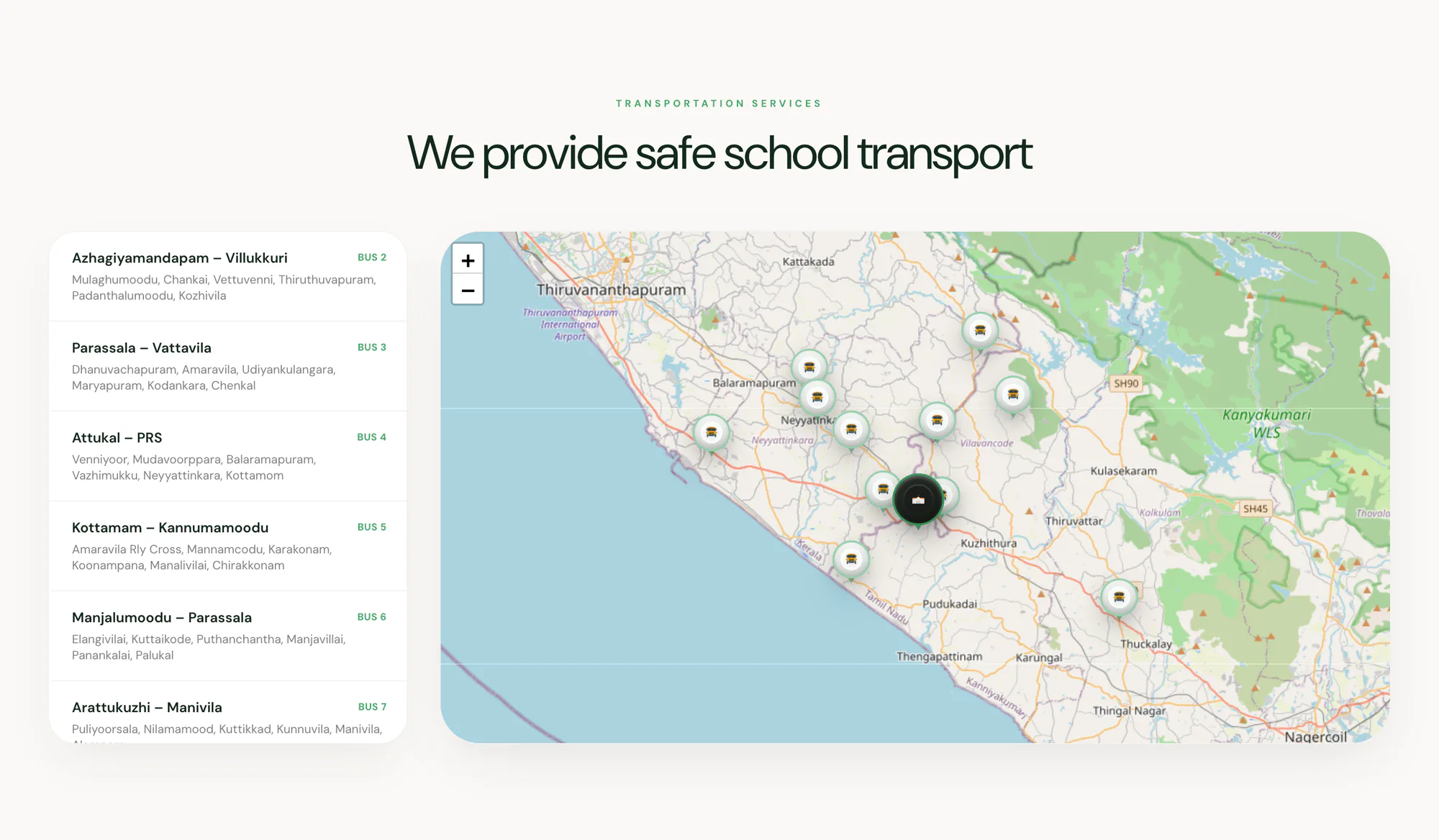
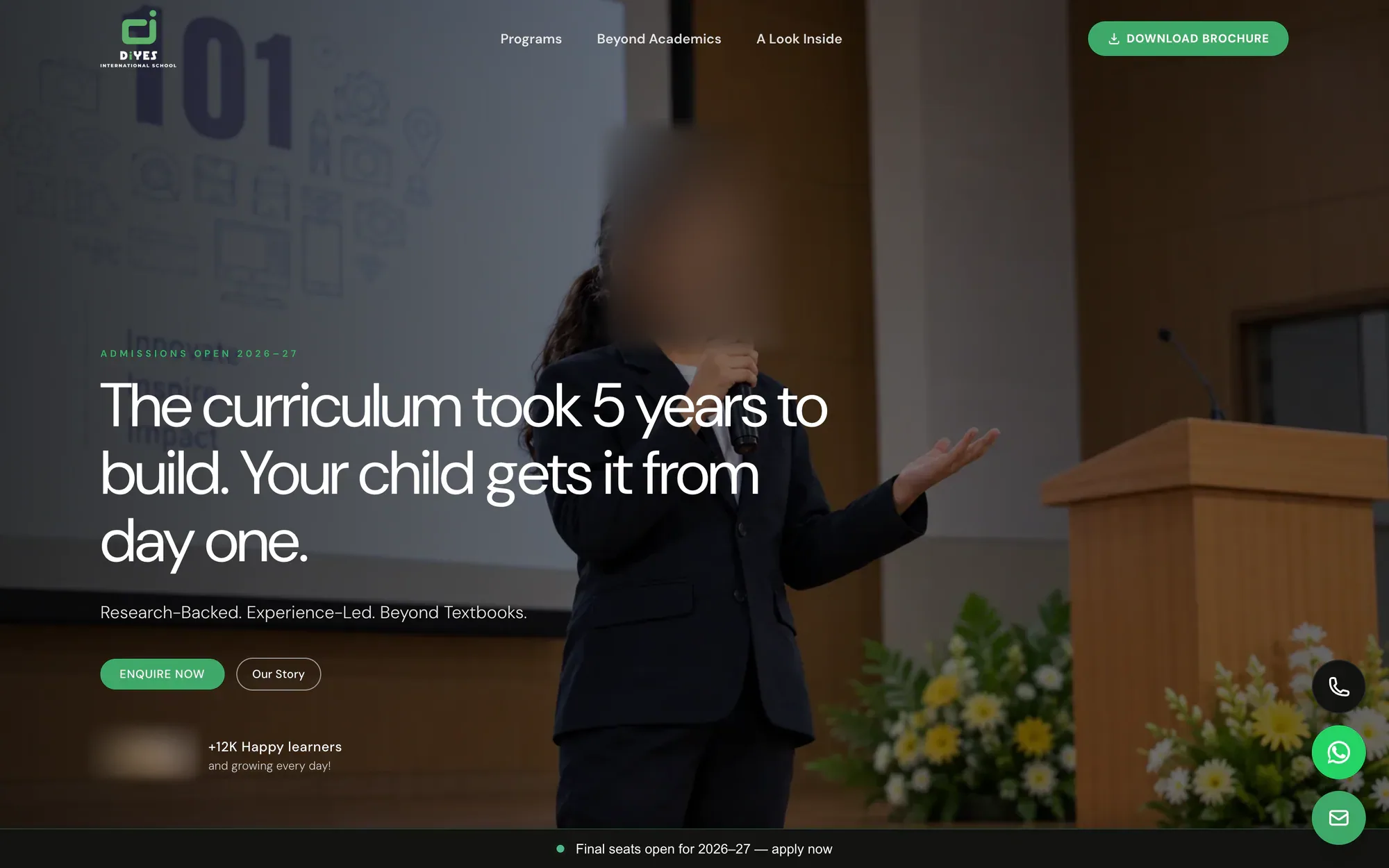
DiYES International · website we designed and built
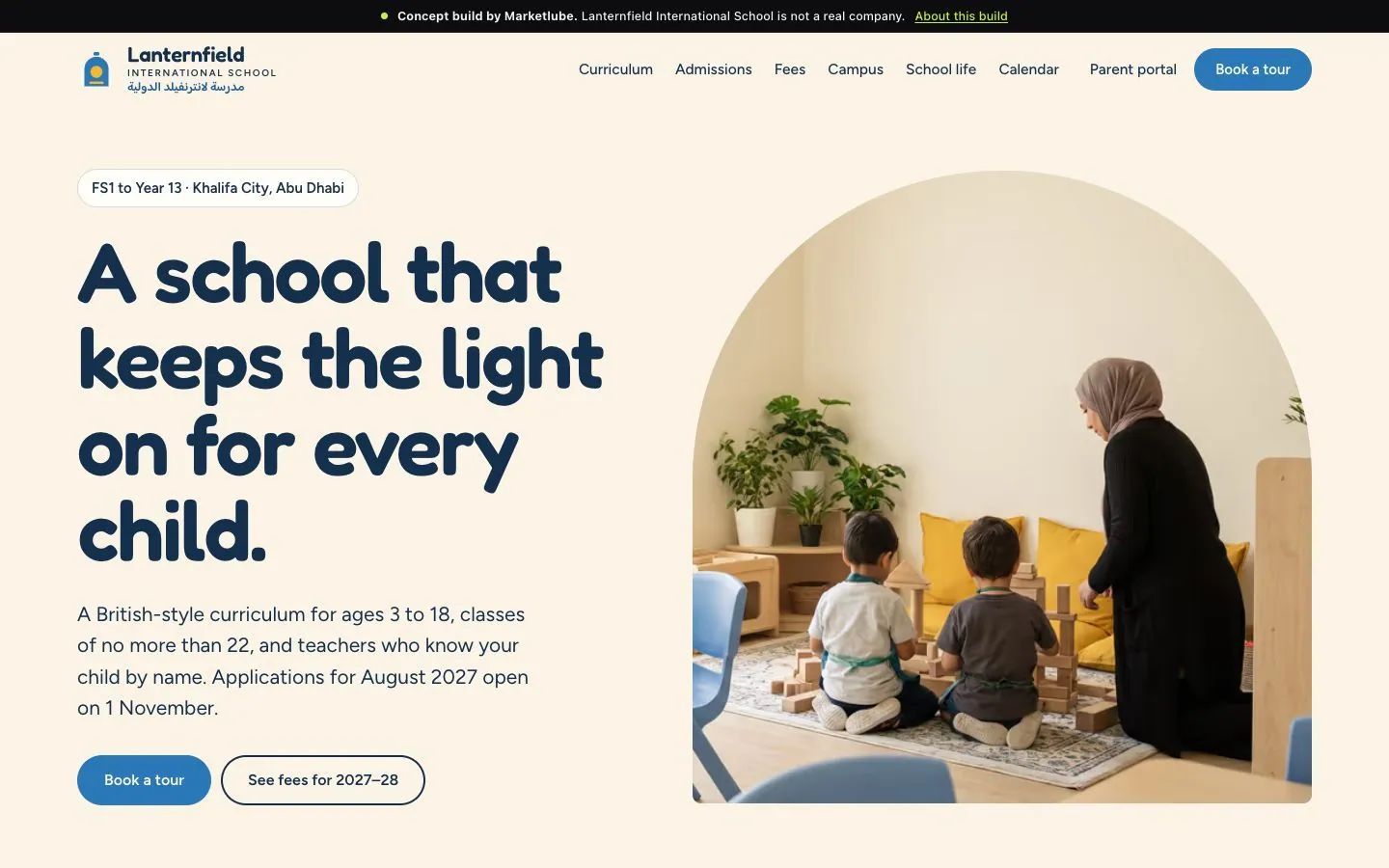
Concept build · Lanternfield International School, a school website for Abu Dhabi
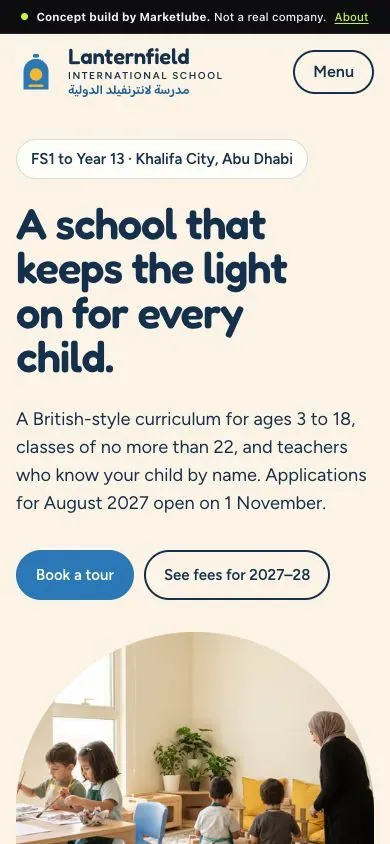
Concept build · Lanternfield International School on a phone
Client work, then a concept build
A parent compares five schools on a phone, late at night.
Most school websites are written for the prospectus: a principal's message, a mission statement, a gallery of sports day. The family choosing a school is usually reading on a phone after the children are asleep, with four or five tabs open, and it wants five answers: what will my child learn at this age, when do we apply, what does it cost in full, how does the bus work and when can we visit. The school that answers those on the page gets the tour request; the one that says "contact admissions for fees" gets closed.
The regulators now ask for much of the same. In Abu Dhabi, ADEK's policies treat the website as marketing material and list what it must carry, from every fee to the inspection reports. In Dubai, KHDA asks each private school to post its School Fees Fact Sheet. In India, a CBSE school's website carries the Mandatory Public Disclosure. So a school site has two readers, a parent and an inspector, and we plan it for both.
Our real school work so far is an admissions landing page for DiYES International School, which we designed and built, and we run the marketing around it. The school homepage on this page is Lanternfield, a concept build: a working homepage for a fictional British-style school in Abu Dhabi, not a client. What we describe below is how we read the rules into pages, not legal advice; your governing board signs off the content and your adviser confirms the current rules.
What parents and inspectors look for on a school site.
Fees shown in full, matching the approved schedule
ADEK's Fees Policy asks Abu Dhabi schools to publish the approved fees and payment schedules and, from AY 2025/26, the stamped approved fee schedule itself, with board exam fees shown separately by grade.
What we build: A fees page by year group, built from the regulator-approved figures, with every component a parent pays listed beside the tuition and an instalment table under it.
What you get (5)Show less
- A fee table per year group that a parent can read on a phone
- Tuition, resources, uniform, transport and activities as separate lines
- The stamped fee schedule as a download beside the table
- A sibling and bus-zone calculator that adds it up
- Board exam fees in their own rows, by grade
Source: ADEK, School Fees Policy (version 1.1, September 2024), read 28 Oct 2026
Dubai's School Fees Fact Sheet, current every year
What we build: A fixed place on the fees page for the KHDA School Fees Fact Sheet, the one-page list of mandatory and optional fees that every Dubai private school receives before each academic year and, in KHDA's words, posts to its own website. The sheet is valid for one year, so the slot names the academic year and is swapped the day the new sheet arrives.
What you get (3)Show less
- The current fact sheet, named with its academic year
- A fee table that matches the sheet line for line
- A yearly reminder in the care plan to replace it
Source: KHDA, School Fees Fact Sheet FAQs, read 28 Oct 2026
An admissions route a family can follow by date
In Abu Dhabi, the Fees Policy (section 5.2.1) says schools shall not request or accept deposits, application fees or first-time enrolment fees before a student is enrolled, so the application form there takes no payment on submit.
What we build: A dated admissions timeline from applications opening to the first day, which reads today's date and marks where the intake has got, with the documents list folded under it.
What you get (4)Show less
- Steps with real dates for your intake, not "rolling admissions"
- A documents checklist, including attestation for transfers from abroad
- A mid-year seats line for relocating families
- An application form set up for your emirate's payment rules
Source: ADEK, School Fees Policy (version 1.1, September 2024), read 28 Oct 2026
Tour requests that turn into a visit
What we build: A short tour form that offers the actual tour mornings to choose from, instead of a free date box, and asks only what the first call needs: the parent's name, email, phone with a country code and the child's year group. Each campaign link can arrive with the year group already chosen.
What you get (4)Show less
- The next tour slots listed from your timetable
- A phone field that accepts Gulf and Indian numbers
- A confirmation that names the tour morning, the meeting point and parking
- Each request reaching the admissions inbox with the year group and the advert that brought it
Children's data handled with a parent's consent
India's Digital Personal Data Protection Rules, 2025 (Rule 10) require a parent's verifiable consent before a child's data is processed, from 13 May 2027, and the Rules' exemption for schools covers tracking and safety, not marketing. ADEK's Digital Policy asks for written parental consent before a school publishes content involving students, and the UAE's federal data protection law, as the government portal u.ae summarises it, prohibits processing personal data without its owner's consent, with some exceptions.
What we build: Enquiry and application forms that collect the least a step needs, with an unticked consent box and a plain privacy notice.
What you get (4)Show less
- Forms that ask for the child's name and date of birth only at the application stage
- A consent record kept with each submission
- A privacy notice written for parents, linked from every form
- Gallery and news templates built around rooms, teachers and work, not children's faces
Source: MeitY, Digital Personal Data Protection Rules, 2025, read 28 Oct 2026
A policies and inspection library parents and inspectors can find
ADEK's Digital Policy (section 8.5) sets the minimum website content, including fees with transport and optional activities, inspection reports and the policies relevant to parents and students, and section 1.1 asks for seven digital documents, from the digital strategy to the data protection policy, in Arabic and English or the language of instruction.
What we build: One library page with a stable address and a publication date for each document.
What you get (4)Show less
- The latest inspection report, linked to the original with its date
- Policies in two languages, side by side
- A dated archive, so last year's version never sits on the live page
- The school's name and registration number in every footer
Source: ADEK, School Policy on Digital (version 1.1, September 2024), read 28 Oct 2026
CBSE's Mandatory Public Disclosure, readable by search engines
CBSE's Circular No. 03 of 5 March 2021 asks for it at a prominent place on the website, and it holds the fee structure, the academic calendar, three years of board results and the building and fire safety certificates.
What we build: For a CBSE-affiliated school, the Appendix IX Mandatory Public Disclosure built as a web page, linked from the homepage and every admissions page, rather than a scanned PDF.
What you get (3)Show less
- A disclosure page in CBSE's order, with each certificate linked
- A homepage link that stays visible on phones
- Teacher and results tables you can update each year without us
Source: CBSE, Circular No. 03/2021 on the Mandatory Public Disclosure, read 28 Oct 2026
A daily site for the families already enrolled
What we build: The pages current parents open every week: a term calendar that filters by stage, bus zones or routes with pick-up times, the uniform list and where to buy it, the lunch menu and a clear link to the parent portal your school already uses.
What you get (4)Show less
- A calendar filtered by Early Years, primary, secondary and admissions
- Bus routes on a map, also described in words
- Uniform items by stage, with the supplier and its opening hours
- A visible sign-in link to your existing parent app or portal
A school homepage to try, and an admissions page we built.
Lanternfield International School is a concept build: a working homepage we designed and built for a fictional brand, so you can try the layout and its tools on your phone before we build yours. It is not a client. See every concept build.
Concept build · School · Abu Dhabi
Lanternfield International School
Lanternfield International School is a fictional British-style school for ages 3 to 18 in Khalifa City, Abu Dhabi, and we designed and built its full homepage to show what a school website for the emirate can do. Lanternfield is invented, and nothing on the page claims otherwise. Curriculum by stage, an admissions timeline, fees in full with a calculator, bus zones, a filterable calendar and a tour request form with the next tour mornings all run in the browser.
Curriculum, admissions, fees, transport: the school site map.
- HomeThe five answers in order: curriculum by stage, admissions dates, fees, transport and a tour slot, with the school's key facts in one strip.
- Curriculum by stageEarly Years, primary, secondary and sixth form or Plus Two, each with ages, year groups, subjects and the languages taught.
- AdmissionsThe dated timeline, the documents list, age cut-offs per grade and the mid-year seats line.
- FeesThe fee table by year group, every extra cost, instalments, the stamped schedule or KHDA fact sheet, and the calculator.
- Book a tourTour mornings to choose from, who shows families round, how long it takes and the short form.
- TransportZones or routes, pick-up times, supervision on the bus and how to register, with the fare per zone.
- Inspection, policies and disclosureThe inspection report, licence or affiliation details, policies in each required language and, for CBSE schools, the Mandatory Public Disclosure.
- Wellbeing and inclusionWho checks in with each child, the counsellors and nurse, and how support for additional needs is planned with parents.
- School calendarTerm dates, open mornings, exams and events, filterable by stage and addable to a phone calendar.
- News and school lifePosts written for parents and search, illustrated with rooms, work and teachers rather than identifiable children.
- CareersTeaching vacancies with the role, curriculum, start date and how to apply, for staff recruited from abroad.
- Contact and parent portalOffice hours by weekday, the map, admissions contacts and the sign-in link for enrolled families.
What changes in Abu Dhabi, Dubai, the wider Gulf and Kerala.
Abu Dhabi
ADEK's School Policy on Marketing counts the school website as marketing material. It asks every piece to show the school's name and registration number, bars disclaimers and footnotes that contradict the headline message, rules out pictures of facilities and results that mislead, and needs ADEK's approval before its logo is used. So a fee table carries no asterisked "estimate only" line, and campus photos are the school's own. Our Lanternfield concept build is set in Khalifa City; its fictional timeline shows an application fee and a seat deposit with the offer, both of which a live Abu Dhabi build would remove, because the Fees Policy (section 5.2.1) bars deposits and application fees before a student is enrolled.
Source: ADEK, School Policy on Marketing (version 1.1, September 2024), read 28 Oct 2026
Dubai
Besides the fee fact sheet, KHDA runs an approval service for private schools' specific advertising and marketing materials: fees of AED 120 in all (an AED 100 application fee and the AED 20 knowledge and innovation fee), a stated three working days and an approval that lasts three months. The service page does not say whether website pages count, so we leave room in the admissions calendar for KHDA's review of campaign pages and adverts, and for a fresh approval when three months run out.
Source: KHDA, Approve Advertising for a Private School, read 28 Oct 2026
Qatar and Oman
Qatar's Law No. 7 of 2019 on protecting the Arabic language requires educational bodies to use Arabic in their publications and adverts, so a Doha school site is planned Arabic-first or fully bilingual, with right-to-left layouts designed alongside the English. Both countries put children's data behind a parent: Qatar's personal data law (Law No. 13 of 2016, as DLA Piper summarises it) asks websites aimed at children for a notice on how their data is used and a parent's express approval, and Oman's Personal Data Protection Law (Article 6) needs a guardian's approval to process a child's data. Admissions forms in both carry that consent step.
Source: Shura Council of Qatar, Law No. 7 of 2019 on protecting the Arabic language, read 28 Oct 2026
Kerala and India
A Kerala family is usually choosing between boards as much as schools: CBSE, ICSE, state syllabus, Cambridge or IB, in its own town. So we give each board and stage its own page, named the way parents search, with the fee or a fee range on it. Some families apply while working in the Gulf, so forms take a +971 or +966 number and campaign pages run in Malayalam and English. ASCI's guidelines for education advertising bar a false sense of urgency among students or parents, and require campus pictures to be real and results to come from the latest completed academic year, which shapes the admissions pages as much as the ads.
Source: ASCI, Guidelines for Advertising of Educational Institutions, Programmes and Platforms, read 28 Oct 2026
What a school website costs.
- Business websiteCustom design, up to 8 pages · 4 to 8 weeksfrom INR 60,000 · AED, QAR or SAR 8,000 · KWD 650 · OMR or BHD 800
- Next.js website with a CMSHeadless CMS, up to 15 pages · 8 to 14 weeksfrom INR 2,00,000 · AED, QAR or SAR 15,000 · KWD 1,250 · OMR 1,550 · BHD 1,500
- Website care planBilled yearly · starts within a weekfrom INR 3,000 · AED, QAR or SAR 500 · KWD 40 · OMR or BHD 50 a month
The figures exclude GST in India, and VAT where it applies in the Gulf. A school's written quote lists the page count, the fee calculator and tour booking, the Arabic or Malayalam version and who writes and checks it, the policies and disclosure library, and any link to your parent portal or admissions software; a bilingual site with a full policies library usually sits on the Next.js tier.
What the build includes
- A page plan built around your intake dates and your regulator's list
- Layouts drawn for a parent reading at night on a phone, in English and Arabic or Malayalam where agreed
- A fees page with a sibling and transport calculator
- A dated admissions timeline and documents checklist
- A tour booking form with your real tour slots and a consent box
- A policies, inspection and disclosure library you can update yourselves
- A filterable school calendar and transport page
- Search set-up: titles per board and stage, school structured data and a sitemap
- Training for the admissions office on changing fees, dates and documents
Not included
- Writing or approving the school's policies, fee schedule or disclosure content
- Regulator approvals, such as KHDA advertising approval or ADEK logo use
- A student information system, timetabling or online fee collection
- Photography and filming of the campus, quoted separately
- Arabic translation where the school has no writer, quoted separately
Five steps. No surprises.
Every stage has an owner, a deliverable and a sign-off, all agreed with you before it starts.
Book a discovery callStart from your intake calendar
On a video call we take your intake month, the date applications open, your board or emirate and the grades you most need to fill, then work backwards so the new site is live before parents start comparing schools.
Audit the documents
We list every document the site must carry, from the fee schedule or KHDA fact sheet to the inspection report, policies and CBSE disclosure, and mark which version is current and who in the school owns each one.
A parent's five questions first
We design the homepage, fees, admissions and tour pages first, as links you open on a phone, and lay out the Arabic or Malayalam version alongside the English rather than adding it later.
Load the fees, test the forms
We build the site, load the approved fees and documents, set the tour slots and form routing to your admissions inbox, and test every form with a Gulf and an Indian phone number before your board signs off the content.
Launch before applications open
We go live in the weeks before your intake opens, not in the middle of it, and spend a session with the admissions office on changing fees, dates and documents. After that, the care plan handles the yearly jobs: the new fee sheet, the new inspection report and the next academic year's calendar.
School websites, answered.
The team is in Calicut, India
1414, 4th Floor, Phase 1, HiLITE Business ParkKozhikode, Kerala 673014Mon–Sat · 9:30 am to 6:30 pm
What must an Abu Dhabi private school show on its website?
ADEK's School Policy on Digital (section 8.5) sets a minimum: contact information, the school's services, fees including transport and optional activities, inspection reports, aggregate achievement data or individual awards shared with consent, public versions of the annual report and the policies relevant to parents and students. The Fees Policy adds the approved fees, payment schedules and, from AY 2025/26, the stamped approved fee schedule. The post on school website requirements in the UAE goes through each line.
Does a Dubai school have to post its KHDA fee fact sheet online?
Yes. KHDA describes the School Fees Fact Sheet as a one-page reference listing all mandatory and optional fees a school may charge in an academic year, and says each school will post its own fact sheet to its website. It is valid for one academic year and carries a QR code to verify it, so replace the file when the new year's sheet arrives and keep any fee table on the site identical to it.
What does a CBSE school have to publish on its website?
CBSE's Circular No. 03 of 5 March 2021 asks affiliated schools to keep a website with their affiliation status, buildings and facilities, teachers and qualifications, student numbers, contact details and fees, and to place the Appendix IX Mandatory Public Disclosure prominently on it. That disclosure includes the fee structure, the academic calendar, three years of board results and building and fire safety certificates. Check CBSE's latest circulars, because the format has been revised since.
Can a school website show photos of students?
With care. In Abu Dhabi, ADEK's Digital Policy asks for written parental consent before a school publishes content involving students. In India, a recognisable photo is personal data, and from 13 May 2027 Rule 10 of the DPDP Rules needs a parent's verifiable consent before a child's data is processed. The simpler course for admissions pages is to show rooms, teachers and children's work, and keep faces out of frame unless consent is on file.
Which school web pages need Arabic, in Abu Dhabi, Qatar and elsewhere?
It depends on the place and the page. ADEK asks Abu Dhabi schools to publish seven digital policy documents in Arabic and English or their language of instruction. Qatar's Law No. 7 of 2019 requires educational bodies to use Arabic in publications and adverts, so a Doha school plans Arabic-first or fully bilingual. Elsewhere, Arabic for the admissions and fees pages helps Arabic-speaking families compare schools. A guide to Arabic and English website design covers right-to-left layouts.
When should a school's new website go live for the next intake?
Count back from the day applications open. A school site of up to 8 pages usually needs 4 to 8 weeks, and a bilingual site with a policies library and a content system 8 to 14 weeks; the wait is usually for the approved fee schedule, the signed-off policies and campus photos, not for the build. In Kerala, the education marketing calendar puts the decisions of families choosing CBSE and international schools between December and March, so a June intake wants the site live by late November.
Can a UAE school use a .sch.ae domain?
Possibly. sch.ae is one of the UAE's restricted zones, with extra eligibility rules, and registration goes through an accredited registrar based in the UAE. Ask the registrar what proof it needs before planning a launch around the name, and register any domain in the school's own name, not the agency's.
Further reading
Sources
- ADEK, School Fees Policy (version 1.1, September 2024), read 28 Oct 2026
- KHDA, School Fees Fact Sheet FAQs, read 28 Oct 2026
- MeitY, Digital Personal Data Protection Rules, 2025, read 28 Oct 2026
- ADEK, School Policy on Digital (version 1.1, September 2024), read 28 Oct 2026
- CBSE, Circular No. 03/2021 on the Mandatory Public Disclosure, read 28 Oct 2026
- ADEK, School Policy on Marketing (version 1.1, September 2024), read 28 Oct 2026
- KHDA, Approve Advertising for a Private School, read 28 Oct 2026
- Shura Council of Qatar, Law No. 7 of 2019 on protecting the Arabic language, read 28 Oct 2026
- ASCI, Guidelines for Advertising of Educational Institutions, Programmes and Platforms, read 28 Oct 2026
- Gulf News, KHDA school fees fact sheet (Zainab Husain, updated 11 August 2025), read 28 Oct 2026
- Morgan Lewis, Guide to UAE domains and domain names, read 28 Oct 2026
- u.ae, Data protection laws, read 28 Oct 2026
- MeitY, Digital Personal Data Protection Act, 2023, read 28 Oct 2026
- PIB, DPDP Rules notified, with an eighteen-month phase for compliance, read 28 Oct 2026
- DLA Piper, Data protection laws: Qatar, read 28 Oct 2026
- Royal Decree 6/2022, Oman Personal Data Protection Law, read 28 Oct 2026
School websites
Let's build your website.
Tell us what the site has to do and who it is for. A strategist replies within one working day, from our team in Calicut.
Every rupee you spend with us has to earn its keep.