Websites for restaurants and cafés
The menu first, the order next. Restaurant website design for Gulf and Kerala kitchens
Marketlube designs and builds websites for restaurants, cafés, cloud kitchens and small restaurant groups in the UAE, Saudi Arabia, the wider Gulf and Kerala, working from Calicut; we have no office in the Gulf. A restaurant site we build puts the menu on the page as real text, with photos, prices that include tax where the law asks, allergens and the nutrition fields each market needs, then lets the diner order delivery or pickup from the right branch, book a table or ask for catering. We have not yet built a website for a real restaurant, so the sample here is a concept build for a fictional brand.
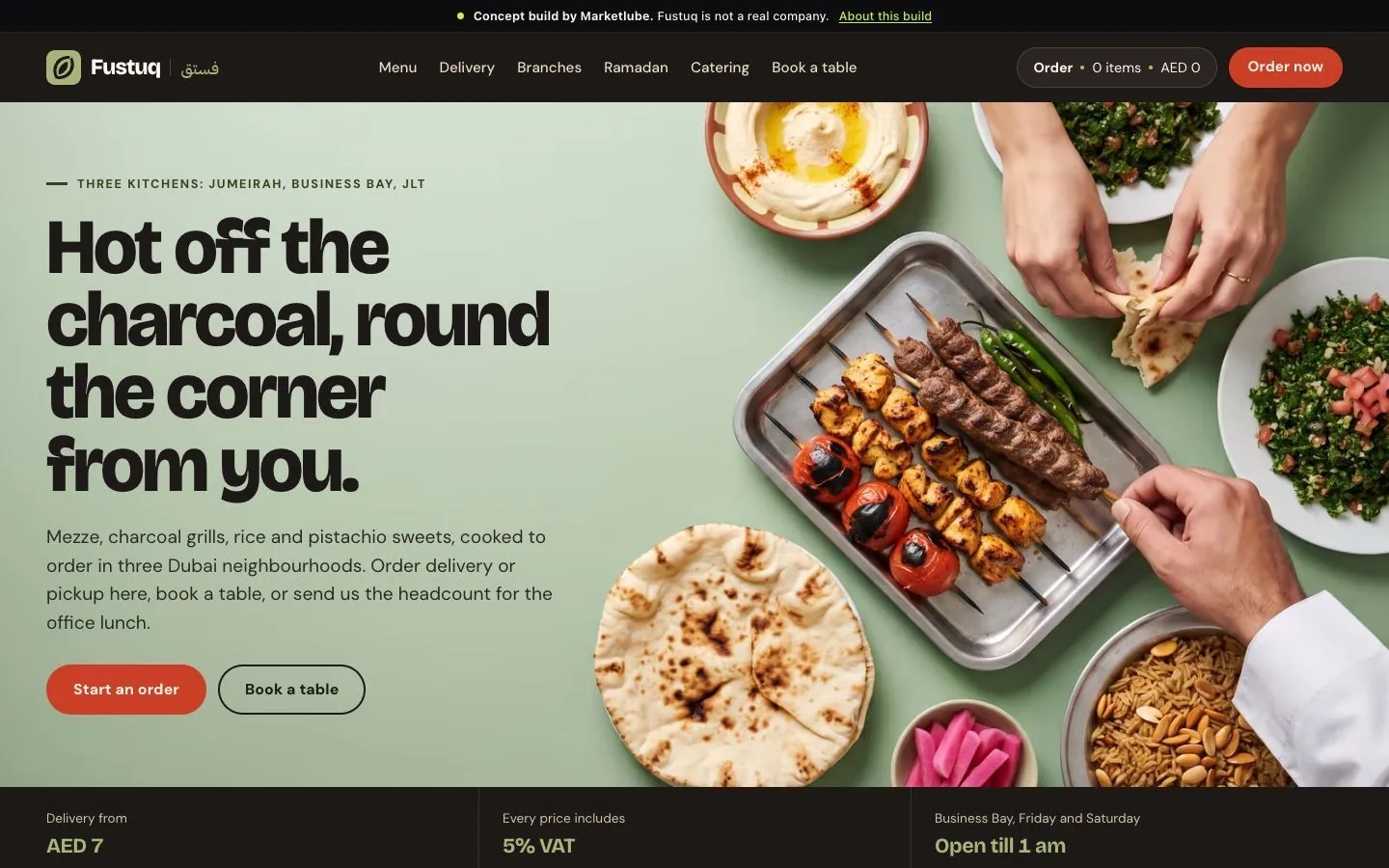
Concept build · Fustuq, a restaurant website for Dubai

Concept build · Fustuq, further down the homepage
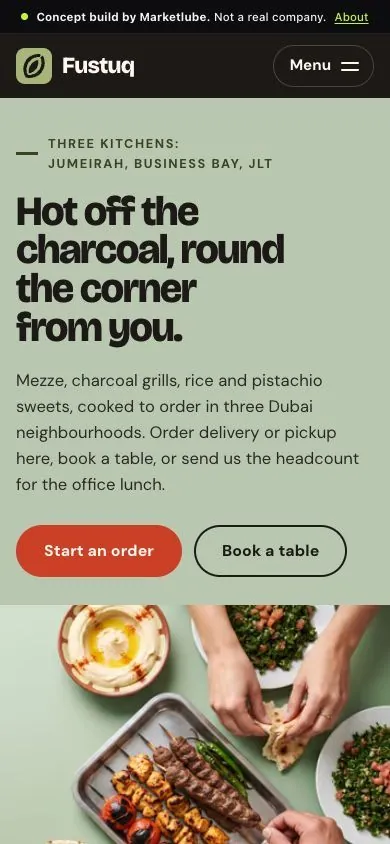
Concept build · Fustuq on a phone
Fustuq, a concept build
Diners pick where to eat on a phone.
Most people meet a restaurant on a phone: a reel, a Maps pin, a link in a WhatsApp group. They tap through wanting four things fast: what is on the menu and what it costs, whether you deliver to them or how far the drive is, whether there is a table on Thursday night, and whether a dish is safe for the child with the nut allergy. A menu posted as a PDF or a photo of the printed card answers none of that well. It has to be pinched and zoomed, a photo of a card gives search engines no text to read, and either one is out of date the day a price changes.
So we build a restaurant site around the menu as data. Each dish is one record, with its name in English and in Arabic or Malayalam where you use them, a photo, a price, allergens, the veg or non-veg mark in India and the nutrition fields your market asks for. The menu page, the order ticket, the branch pages and the structured data Google reads all draw from that one list, so a price you change on Monday is right everywhere by Monday lunch.
About the sample below: Marketlube has not built a website for a real restaurant or café. Our real food work so far is brand and packaging, such as the bilingual English and Arabic identity and the takeaway range we designed for Tea Today, a tea café brand in the GCC. Fustuq, shown below, is a concept build: a working homepage we coded for a fictional group of three grill kitchens in Dubai, with a menu and prices we made up. It shows how the features behave on your phone, and nothing about orders or results. Nothing on this page is legal, tax or food safety advice.
From the menu to the kitchen ticket.
A menu people can read on a phone
The menu is a page, with prices that include tax where the market requires it.
What we build: A menu board built from one dish list: category tabs, a photo and short line for each dish, the price with tax inside it and the tax share shown on the order.
What you get (4)Show less
- Categories that filter in place without reloading the page
- Dish names in English, with Arabic or Malayalam beside them where your regulars use them
- Prices edited once in the dish list and repeated everywhere they appear
- A printable version of the same menu for the counter, made from the same list
Source: Gulf News, Is VAT already included in UAE prices or added at checkout?, read 28 Oct 2026
Allergens and nutrition, market by market
Carry the allergen and nutrition details each market asks for, on the website menu as well as the printed one.
What we build: Dish records with allergen tags, a veg or non-veg mark for India, and nutrition fields that switch on by market: calories, a salt icon, caffeine and the time to burn the calories off for Saudi menus.
What you get (4)Show less
- Allergen chips on every dish, with a cross-contact note your kitchen writes
- Calorie and serving size fields filled from your own recipe calculation, never estimated by us
- The Saudi fields shown only on Saudi branches' menus, so one group can run both
- An allergy note box on the order that prints first on the kitchen ticket
Source: Gulf News, Saudi Arabia enforces new menu rules to flag salt, caffeine and calorie burn, read 28 Oct 2026
Delivery and pickup orders, taken directly
The area's fee, minimum order and timing are clear before the diner pays.
What we build: A branch-aware order ticket: the diner picks an area or a branch, the site finds the kitchen that cooks for it, and the ticket adds the dishes, the delivery fee, the minimum and the earliest time.
What you get (4)Show less
- Delivery areas grouped by the branch that serves them, each with its own fee and minimum
- Dishes a branch does not make greyed out once that branch is chosen
- Today and tomorrow time slots that follow each kitchen's hours
- A WhatsApp route that sends the same order, line by line, if the diner prefers it
Source: BDO Legal, E-commerce in the UAE (Decree-Law No. 14 of 2023), read 28 Oct 2026
Orders in the kitchen the moment they are paid
No one should have to copy an order from an inbox.
What we build: Order hand-off to the kitchen by the route you already use: a WhatsApp message to the branch, an email to a kitchen printer, or your POS where it accepts online orders.
What you get (4)Show less
- One order format the cooks can read at a glance: items, notes, allergy flags, delivery or pickup time
- Each order routed to the branch that will cook it, not to one shared number
- A confirmation to the diner with the order number and the expected time
- In Kerala, the preparation time on the ticket so the parcel sticker can be filled from it
Payment the way diners already pay
Cash on delivery, cards and wallets, mada in Saudi Arabia, KNET in Kuwait, UPI in India.
What we build: A checkout that hands the card step to your licensed gateway, with cash on delivery and pay at the counter kept as options where you allow them.
What you get (4)Show less
- Card numbers entered with the gateway, so the order site only ever stores the order and its paid status
- mada, KNET or UPI placed first on the branches that need them, cards and wallets after
- Cash on delivery limits by area or order size, if you set them
- A paid test order on every method, refunded, before the first real diner pays
Source: Tap Payments developer docs, KNET, read 28 Oct 2026
Tables filled on the nights that need it
A booking should not need a phone ringing through service.
What we build: A table booking form whose time slots follow the chosen branch's hours, with a party size limit that sends larger groups to the catering form.
What you get (4)Show less
- Slots in your own steps, such as every 30 minutes, closed where you are full or closed
- Seating notes for a high chair, a birthday or the family section
- Your hold policy stated beside the form, so a late arrival knows the rule
- Requests delivered to the branch by message, with your confirmation going back the same way
Catering, group trays and the festive seasons
The seasons that make a restaurant's year: iftar and suhoor, Onam sadya, Christmas and Eid.
What we build: A catering page with a live per-person estimate and lead times, and seasonal sections you switch on and off by date.
What you get (4)Show less
- Packages with what each includes and a guest count that updates the estimate
- Lead times by party size, so a request for tomorrow knows if it is possible
- A Ramadan section for iftar, suhoor and delivery hours, or a sadya pre-order with a closing date
- Enquiries that arrive with the date, headcount, area and dietary notes filled in
Found in search and maps, with one set of details
The same hours, menu and address everywhere a diner looks.
What we build: Restaurant structured data on every branch page, with the menu link, cuisine and opening hours, kept in step with what you show on Maps and the delivery apps.
What you get (4)Show less
- One page per branch with its own address, hours, parking and phone
- Restaurant markup with the menu URL, the cuisine served and opening hours
- Holiday and Ramadan hours entered once and shown on every page that lists times
- A checklist to match your Google Business Profile and app listings to the site
Source: Google Search Central, Local business structured data, read 28 Oct 2026
Try the Fustuq menu, a concept build.
Fustuq is a concept build: a working homepage we designed and built for a fictional brand, so you can try the layout and its tools on your phone before we build yours. It is not a client. See every concept build.
Concept build · Restaurant · Dubai
Fustuq
Fustuq is our invention: three grill and mezze kitchens in Jumeirah, Business Bay and JLT, Dubai, cooking for delivery, pickup, dine-in and catering, with a menu and prices we wrote for the demo. Its homepage runs as real code. Pick an area and the ticket recalculates for the kitchen that would cook; the branch map, the catering estimate and the table booking respond as well. Checkout stops at a clear demo message rather than taking payment.
Twelve pages around one dish list.
- HomeThe food in the first screen, then the three things people came for: order, book, find the nearest branch. Opening hours for today sit under the buttons.
- MenuEvery dish by category, with photo, price, allergens and the nutrition fields your market needs, written as text a search engine can read and a diner can zoom.
- Order onlineDelivery or pickup, the area or the branch, the order ticket with fees and the minimum, a time slot and the checkout, all usable with one thumb.
- Branch pagesOne for each location: address, hours, parking, the areas it delivers to, the phone and a map, so a search for your name plus a neighbourhood lands on the right kitchen.
- Book a tableBranch, date, time from that branch's hours, party size and notes, with the hold policy and what to do for a group larger than the form takes.
- Catering and private diningPackages for offices, weddings, majlis gatherings and family events, the per-person estimate, lead times and an enquiry form your events lead receives.
- Seasonal menuRamadan hours and the iftar tray, an Onam sadya pre-order, a Christmas or Eid set menu. Switched on when the season starts and off when it ends.
- Allergens and nutritionHow allergens are marked, the cross-contact note, where the calorie figures come from and what to do if you have an allergy, written once and linked from every dish.
- Our kitchenWho cooks, where the meat, fish and spices come from, and what is made in-house. Real photos of the team and the kitchen, not stock pictures of chefs.
- Gift cards and offersWeeknight offers with their days, times and terms in plain words, and gift cards if you sell them, each kept to its own page so an expired offer can be taken down cleanly.
- JobsOpen roles by branch with shifts and how to apply. Restaurants hire all year, and a jobs page keeps those messages out of the order line.
- FAQ and contactAnswers to what your floor staff hear every day, each branch's phone and WhatsApp, and your trade licence and food safety documents in the footer.
Menus follow different rules in each market.
United Arab Emirates
Prices shown to diners include the 5% VAT; Gulf News, explaining the Federal Tax Authority's rule, notes that the amount on a menu is the total you pay. For online orders, the 2023 e-commerce law, as BDO Legal summarises it, needs terms and charges disclosed before payment, and a delivery or payment fee not set out upfront cannot be added later, so the area's fee and minimum belong on the ticket before checkout. Many Dubai diners read the menu in English, but the Consumer Protection Executive Regulations (Cabinet Resolution No. 66 of 2023), as Pinsent Masons summarises them, require information on websites run by e-commerce providers to be in Arabic at a minimum, with other languages allowed alongside, so a site that takes orders is planned with an Arabic version; your adviser confirms how this applies to you. Our Fustuq concept build, a restaurant website for a fictional Dubai brand, shows the branch-aware ticket, the delivery table and the Ramadan section together.
Source: BDO Legal, E-commerce in the UAE (Decree-Law No. 14 of 2023), read 28 Oct 2026
Saudi Arabia
The Saudi Food and Drug Authority's menu rules, in force from 1 July 2025 as Gulf News reported, ask for detailed nutrition on menus, a salt shaker icon on high-sodium meals, the caffeine in drinks and the time needed to burn off each item's calories, on physical and digital menus including delivery apps. A Saudi restaurant website is a digital menu, so we build those fields in and fill them from your own figures. Prices carry 15% VAT, mada sits first at checkout, and diners expect a proper right-to-left Arabic menu, not English with Arabic headings.
Source: Gulf News, Saudi Arabia enforces new menu rules to flag salt, caffeine and calorie burn, read 28 Oct 2026
Kuwait, Qatar, Bahrain and Oman
The tax line on a menu differs in each: Kuwait and Qatar have no VAT in force, Bahrain's standard rate is 10% and Oman's is 5%. A Times of Oman summary of Oman's consumer protection rules says restaurant and café price lists must include any applicable tax and display Arabic, though it does not say how that applies online. In Kuwait, Bahrain and Oman a delivery fee such as 0.750 dinar or rial has three decimals, so the order ticket must add fils and baisa without rounding them away. Diners there pay with KNET in Kuwait, BENEFIT in Bahrain and OmanNet in Oman, alongside cards and Apple Pay through your gateway.
Source: Times of Oman, How Oman's consumer protection law regulates price display, read 28 Oct 2026
Kerala and India
Under FSSAI's labelling and display rules, as S.S. Rana summarises them, food service businesses with a central licence or outlets in ten or more locations must show calories per serving and the serving size on menus, with allergens, the veg or non-veg logo and a line on an adult's daily energy needs, and online platforms selling their food are expected to show those details on their own pages where they apply. Below that threshold the calorie rule does not apply. In Kerala, since a state order announced in January 2023, food sent out as a parcel has had to carry a sticker with the date and time it was prepared and the time within which it should be eaten, as Onmanorama reported, so an ordering site should pass the preparation time to the kitchen. Most Kerala diners also check Swiggy, Zomato and Google Maps, so the site's menu and hours must match those listings.
Source: S.S. Rana and Co., Display calorie values on menu cards: FSSAI, read 28 Oct 2026
What a menu and ordering site costs.
- Business websiteCustom design, up to 8 pages · 4 to 8 weeksfrom INR 60,000 · AED, QAR or SAR 8,000 · KWD 650 · OMR or BHD 800
- Next.js website with a CMSHeadless CMS, up to 15 pages · 8 to 14 weeksfrom INR 2,00,000 · AED, QAR or SAR 15,000 · KWD 1,250 · OMR 1,550 · BHD 1,500
- Custom online storeOn WooCommerce or a headless build · 8 to 12 weeksfrom INR 1,50,000 · AED, QAR or SAR 15,000
- Website care planBilled yearly · starts within a weekfrom INR 3,000 · AED, QAR or SAR 500 · KWD 40 · OMR or BHD 50 a month
Rows without a KWD, OMR or BHD figure are quoted in AED for Kuwait, Bahrain and Oman.
Figures are before GST in India and before VAT where it applies in the Gulf. The written quote for a restaurant site lists how many branches and delivery areas the ordering covers, the payment gateway and cash on delivery rules, table booking, the Arabic or Malayalam menu, the nutrition fields your market needs, and any link to your POS or kitchen printer, which moves the price most.
What the build includes
- A dish list (names, photos, prices with tax, allergens, nutrition fields) set up and signed off before design
- A menu board with category tabs, built from that list as readable text
- Branch pages with hours, parking, delivery areas and restaurant structured data
- A delivery and pickup order ticket with fees, minimums and time slots by branch
- Your payment gateway connected in test mode, then live, with cash on delivery where you allow it
- Orders sent to each branch by WhatsApp, email or your POS where it accepts them
- Table booking, a catering form with a live per-person estimate, and seasonal sections for Ramadan, Onam, Eid or Christmas you switch on and off
- An Arabic right-to-left menu where the market needs it, with dish names set in a proper Arabic typeface
- Cookie consent, order and booking analytics, and logins for the people who change the menu
Not included
- POS, kitchen display or inventory software: the site sends orders to yours, it does not replace it
- Listings, commissions and contracts on Talabat, Swiggy, Zomato or other delivery apps
- Nutrition analysis and allergen checks, which come from your recipes and your food safety adviser
- A food photography shoot, which is quoted separately if you need one
- Gateway charges, the merchant account and your riders or delivery partner, which sit in your own name
- Trade, food safety and halal licences, which you hold and we only display
Five steps. No surprises.
Every stage has an owner, a deliverable and a sign-off, all agreed with you before it starts.
Book a discovery callYour menu, branches and service
A video call before or after your lunch rush. We ask for the current menu with prices, each branch's hours and delivery areas, how orders reach the kitchen today, which gateway you use, and what your seasons look like.
The dish list, in writing
We turn the menu into one sheet: every dish with its names, price, tax treatment, allergens, nutrition figures where your market asks for them, and which branches cook it. Your kitchen checks the allergens and you sign it off before any design.
Photos, then the phone design
We plan the dish photos with you, from your own shoot or a new one, then design the phone menu, the order ticket and the booking form first. Your manager tries them between services and marks up any dish that reads wrong.
Build, then order from every area
We build the site and connect the gateway in test mode. Then we place test orders from each delivery area and each branch, check the fee, minimum and time on every one, and confirm the kitchen received it in the format the cooks asked for.
Launch on a quiet day
We switch the site on during a weekday morning lull, never before a Friday or a festival, and show the shift leads how to mark a dish sold out. Your team changes dishes, prices and seasonal sections themselves; on a care plan we look after updates, backups and fixes, and check the menu data before each Ramadan or Onam.
Restaurant websites, answered.
The team is in Calicut, India
1414, 4th Floor, Phase 1, HiLITE Business ParkKozhikode, Kerala 673014Mon–Sat · 9:30 am to 6:30 pm
Which pages and details should a restaurant website carry?
The menu as a readable page with photos, prices and allergens, each branch with its address, hours and parking, and a clear way to order delivery or pickup, book a table or ask about catering. Add seasonal hours, such as Ramadan, when they apply. Keep the menu, hours and phone numbers the same as on Google Maps and the delivery apps, so diners never meet two versions.
Is a PDF menu enough for a restaurant website?
It works as a download, but not as the main menu. A PDF has to be pinched and zoomed on a phone, the whole file must be replaced whenever a price changes, and it cannot take an order or filter by allergen. A menu built as a web page avoids all three, and the menu property in Google's local business structured data lets a restaurant give search engines that page's address.
Should a restaurant take orders on its own website if it is already on delivery apps?
Many do both. The apps bring diners who do not know you yet; your own site and WhatsApp serve regulars who already do, with your own fees and no app between you and them. For that to work, the site has to be as clear as the apps: the area's delivery fee, the minimum order and the expected time shown before payment.
Does a restaurant website need to show calories?
It depends on the market. In Saudi Arabia, the SFDA's menu rules from July 2025 cover digital menus and delivery apps and ask for calories, salt, caffeine and calorie-burn time. In India, FSSAI's calorie rule applies to food businesses with a central licence or outlets in ten or more locations. Elsewhere, check the current rule with your municipality or food authority before launch.
Can a restaurant in India add a service charge to online orders?
Not as a compulsory charge, on the current ruling. In March 2025 a single judge of the Delhi High Court upheld the Central Consumer Protection Authority's guidelines and held that restaurants cannot impose a mandatory service charge on food bills, and that tipping is the diner's choice. The restaurant associations have appealed to a Division Bench, so check the latest position before you set your checkout. Either way, an ordering website should not add the charge by default. Take your own legal advice on your bills.
Should the menu be in Arabic as well as English for Gulf diners?
In Saudi Arabia, yes in practice: diners expect a full right-to-left Arabic menu. In the UAE, the consumer protection regulations ask e-commerce providers to show website information in Arabic at a minimum, with other languages such as English allowed alongside, so a Dubai site that takes orders needs an Arabic version beside the English one, even if most guests read English; check how this applies to you with your adviser. In Oman, consumer rules on price lists ask for Arabic, so a bilingual menu is the safer choice there.
How should a restaurant handle table bookings online?
Offer time slots that follow each branch's opening hours, cap the party size the form accepts, and send larger groups to a catering or events form. State how long you hold a table and how you confirm, whether by message or call. A booking request that arrives at the right branch with the name, size and notes filled in saves a phone call during service.
Further reading
Sources
- Gulf News, Is VAT already included in UAE prices or added at checkout?, read 28 Oct 2026
- Gulf News, Saudi Arabia enforces new menu rules to flag salt, caffeine and calorie burn, read 28 Oct 2026
- BDO Legal, E-commerce in the UAE (Decree-Law No. 14 of 2023), read 28 Oct 2026
- Tap Payments developer docs, KNET, read 28 Oct 2026
- Google Search Central, Local business structured data, read 28 Oct 2026
- Times of Oman, How Oman's consumer protection law regulates price display, read 28 Oct 2026
- S.S. Rana and Co., Display calorie values on menu cards: FSSAI, read 28 Oct 2026
- FSSAI, Guidance note on menu labelling (23 Feb 2022), read 28 Oct 2026
- Pinsent Masons, UAE consumer protection regime revamped, read 28 Oct 2026
- AIR News, Delhi HC rules restaurants can't impose mandatory service charge in bills, read 28 Oct 2026
- Bar and Bench, Delhi High Court to hear appeals against restaurant service charge ban (29 Apr 2025), read 28 Oct 2026
- Onmanorama, Kerala bans food parcels without dates of manufacture, expiry, read 28 Oct 2026
- PwC Worldwide Tax Summaries, Saudi Arabia: other taxes, read 28 Oct 2026
- PwC Worldwide Tax Summaries, Kuwait: other taxes, read 28 Oct 2026
- PwC Worldwide Tax Summaries, Qatar: other taxes, read 28 Oct 2026
- PwC Worldwide Tax Summaries, Bahrain: other taxes, read 28 Oct 2026
- PwC Worldwide Tax Summaries, Oman: other taxes, read 28 Oct 2026
- Moyasar, payment methods, read 28 Oct 2026
- Checkout.com, BENEFIT payment gateway, read 28 Oct 2026
- Checkout.com, OmanNet, read 28 Oct 2026
- Google Search Central, Localised versions of your pages, read 28 Oct 2026
Restaurant websites
Let's build your website.
Tell us what the site has to do and who it is for. A strategist replies within one working day, from our team in Calicut.
Every rupee you spend with us has to earn its keep.