A fair checklist for choosing a web design company in Dubai: live portfolio work, UAE rules in the quote, Arabic, who owns the accounts, speed and support.
- Published
- Reading time
- 11 minutes
Drafted with AI tools; researched, edited and approved by Althameem Ali. Our editorial policy
On this page · 9 sections
- What should you decide before you contact a web design company in Dubai?
- How do you check that a portfolio is real, live work?
- What should a Dubai web design quote say about UAE rules?
- Who writes and checks the Arabic?
- Who will own the domain, hosting and code?
- How do you judge speed, accessibility and SEO before you sign?
- Does a web design company need an office in Dubai?
- What support should you expect after launch?
- Where to go from here
A disclosure first. Marketlube is a web and marketing team in Calicut (Kozhikode), Kerala. We design and build websites for UAE businesses remotely, and we have no office, licence or staff in the UAE, so we may well be one of the companies you are comparing. This checklist names no competitor and ranks nobody. It is what we would want a Dubai business to ask any web team, and under each section we say how we answer it ourselves. Parts of it touch UAE law and tax: nothing here is legal or tax advice, and every rule carries the date we read its source.
What should you decide before you contact a web design company in Dubai?#
These five decisions change every quote. Make them first and the quotes become comparable.
Send the same one-page answers to every company. For a baseline, our published price list starts from AED 8,000 for a custom business website of up to 8 pages and from AED 15,000 for a Next.js site with a headless CMS of up to 15 pages, before VAT where it applies. The line items a quote should carry are in our quotation guide.
How do you check that a portfolio is real, live work?#
A portfolio is only screenshots until you open the sites, so open them, on your phone.
Sample sites are fine when they are labelled. Ours are. Leyl, a fictional self-drive car rental in Dubai, and Lanternfield International School, a fictional British-curriculum school in Abu Dhabi, are concept builds: clickable homepages, built as working code, for brands we made up, with a "Concept build by Marketlube" bar that says the brand is not a real company. They show how we design and code; they are not clients and prove no results. The rest are on our projects page.
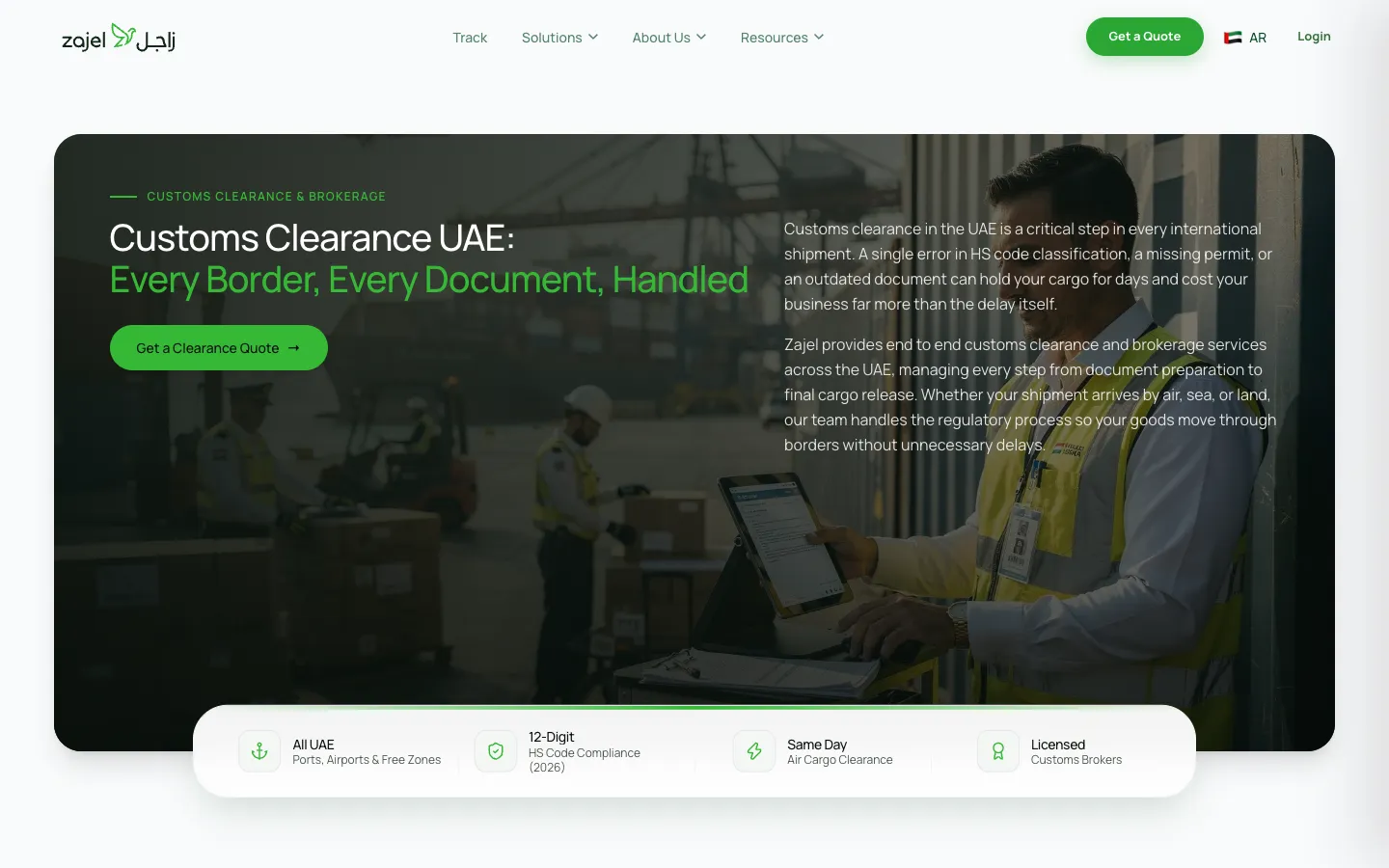
Client work should be described in the client's terms. For ZAJEL, a Dubai courier since 2008, we designed and built its new website, now live at zajel.com, and designed the portal its clients use for customs documents with Dubai Customs and the ZAJEL app. The ZAJEL case study says what we did and what we did not. Ask any company for the same split between "we designed", "we built" and "we supported".
What should a Dubai web design quote say about UAE rules?#
A UAE business website answers to federal rules that a generic quote may never mention. The quote should name each rule that applies to you and what will be built for it. These are the ones we checked.
The data law reaches an offshore web team that handles your customers' data too, so ask how its forms, analytics and ad tags collect consent. And a quote that says "e-commerce included" without the disclosures, invoices and complaints route is not yet a UAE quote.
For the payment gateway, ask which gateways the company has connected before, who holds the merchant account (you should), and whether card details stay on the gateway's own hosted page rather than passing through the website's server.
How we answer it: every UAE quote we send lists Arabic, VAT-inclusive dirham prices on your site, the checkout disclosures, consent and your gateway as separate lines, each with what we build for it. We build the features; compliance stays with your business and its advisers, so confirm the current text of each rule with them.
Who writes and checks the Arabic?#
This separates a bilingual site from an English site with a translate button. Ask three things.
- Who writes the Arabic? Ask for the writer's name or role and whether they are a native speaker.
- Who checks it, and when? A second reader should check the copy in the design, not in a spreadsheet.
- How is the Arabic site built? It should be a right-to-left layout with its own page addresses, linked to the English pages for search engines, with Arabic type chosen for the screen. Our Arabic and English website design guide covers it.
How we answer it: ZAJEL's website is in English today, and our Arabic client work so far is design. So an Arabic site is scoped with a native Arabic writer before we quote, and the quote names who writes it and who checks it.
Who will own the domain, hosting and code?#
Whoever holds the accounts controls the site. According to Morgan Lewis's guide to UAE domains (opens in a new tab) (October 2022, read 28 Oct 2026), .ae names are registered through an accredited registrar, not through the Domains Authority directly; the plain .ae space is unrestricted, open to local and foreign legal persons, while names under co.ae, net.ae, org.ae and the other restricted zones need a UAE-based accredited registrar and extra eligibility. Either way, the registrant can and should be your company.
How we answer it: the accounts are opened in your name, and hosting, domains and other usage are billed at cost, in your name. The admin logins are handed over at launch.
How do you judge speed, accessibility and SEO before you sign?#
Use public thresholds, not a company's adjectives.
Speed. Google's web.dev guide to Web Vitals (opens in a new tab) (read 28 Oct 2026) sets the good thresholds: Largest Contentful Paint within 2.5 seconds, Interaction to Next Paint of 200 milliseconds or less, and Cumulative Layout Shift of 0.1 or less, measured at the 75th percentile of page loads, segmented across mobile and desktop. Run two or three of the company's live sites through PageSpeed Insights and ask whether the quote commits to those thresholds for yours.
Accessibility. The W3C published WCAG 2.2 (opens in a new tab) as a Recommendation on 5 October 2023, and the standard itself (opens in a new tab) defines three levels of conformance: A, AA and AAA. Ask the quote to name a level; we would name AA. "Accessible" with no level commits to nothing.
SEO. Google publishes its own questions to ask before hiring an SEO (opens in a new tab) (last updated 5 June 2026, read 28 Oct 2026). They include asking for examples of previous work, whether the company follows Google Search Essentials, what results it expects and in what timeframe, its experience in your country or city, and whether it will share every change it makes to your site. The same page warns that no one can guarantee a number one ranking on Google, and that if someone guarantees first place, you should find someone else. Replacing an old site? Our redesign SEO checklist covers the redirects.
Does a web design company need an office in Dubai?#
No. It needs to be reachable in your hours and honest about where the work happens. An office lets you meet in person, but it does not by itself change who designs or codes your site.
One claim is worth checking. Google Business Profile's guidelines (opens in a new tab) (read 28 Oct 2026) say a business is eligible only if it has a physical location customers can visit or travels to customers, and that a rented mailing address the business does not operate from, a virtual office, is not eligible. An office in a co-working space counts only if it has clear signage, receives customers there during business hours and is staffed by the business's own people in those hours. So if a company shows a Dubai pin on Google Maps, it is fair to ask whether you could walk in and meet the team there.
How we answer it: our team is in Calicut, 90 minutes ahead of Dubai, and we have no UAE office, so we will not rent a Dubai address to look local. We work Monday to Saturday, 8 am to 5 pm UAE time, over WhatsApp and video calls. Our post on outsourcing development from the UAE to India covers how remote teams work with Gulf businesses.
What support should you expect after launch?#
A website needs updates, backups, security patches and small fixes after launch, and the quote should say who does them and at what cost. Ask for a care or maintenance plan in writing: what it covers, the monthly or yearly fee, the response time for something broken, and the rate for work outside the plan. Ask too what happens if you stop paying for it: you should keep the site, the code and every account.
How we answer it: our website care plan is from AED 500 a month, billed yearly, before VAT where it applies, and keeps updates, backups and fixes going after launch. Hosting and domains are billed at cost as well, in your name.
Where to go from here#
Send your one-page brief to two or three companies, ask each the questions above, and compare the answers before the prices. For bigger builds, our guide to choosing a software development company adds the wider questions. If you would like us to be one of them, our page on website development for Dubai and the UAE shows the UAE rules we quote for, the ZAJEL website and our concept builds, and how to reach us in your hours. We will answer every question on this list in writing.
Related services
Written by
Co-founder, Marketlube
Althameem Ali researched, edited and approved this post. Marketlube is a growth partner in Calicut building brands, websites, CRMs and campaigns for businesses across Kerala, India and the Gulf.