Websites for law firms
Precise words. A site to match. Law firm website design for advocates and legal consultants
Marketlube designs and builds websites for law firms, advocates and legal consultancies in Kerala and the Gulf. Our team works in Calicut, Kerala, and meets Gulf partners by video; we have no Gulf office. A law firm site has to explain the work without promising results, show who may act and in what capacity, and take an enquiry without collecting confidential detail too early. We build practice pages, lawyer profiles, a conflict-check enquiry form and an Arabic version where the clients need one. We have not built a site for a real law firm yet; the sample here is our Bunood Legal concept build, made for a fictional Doha practice.
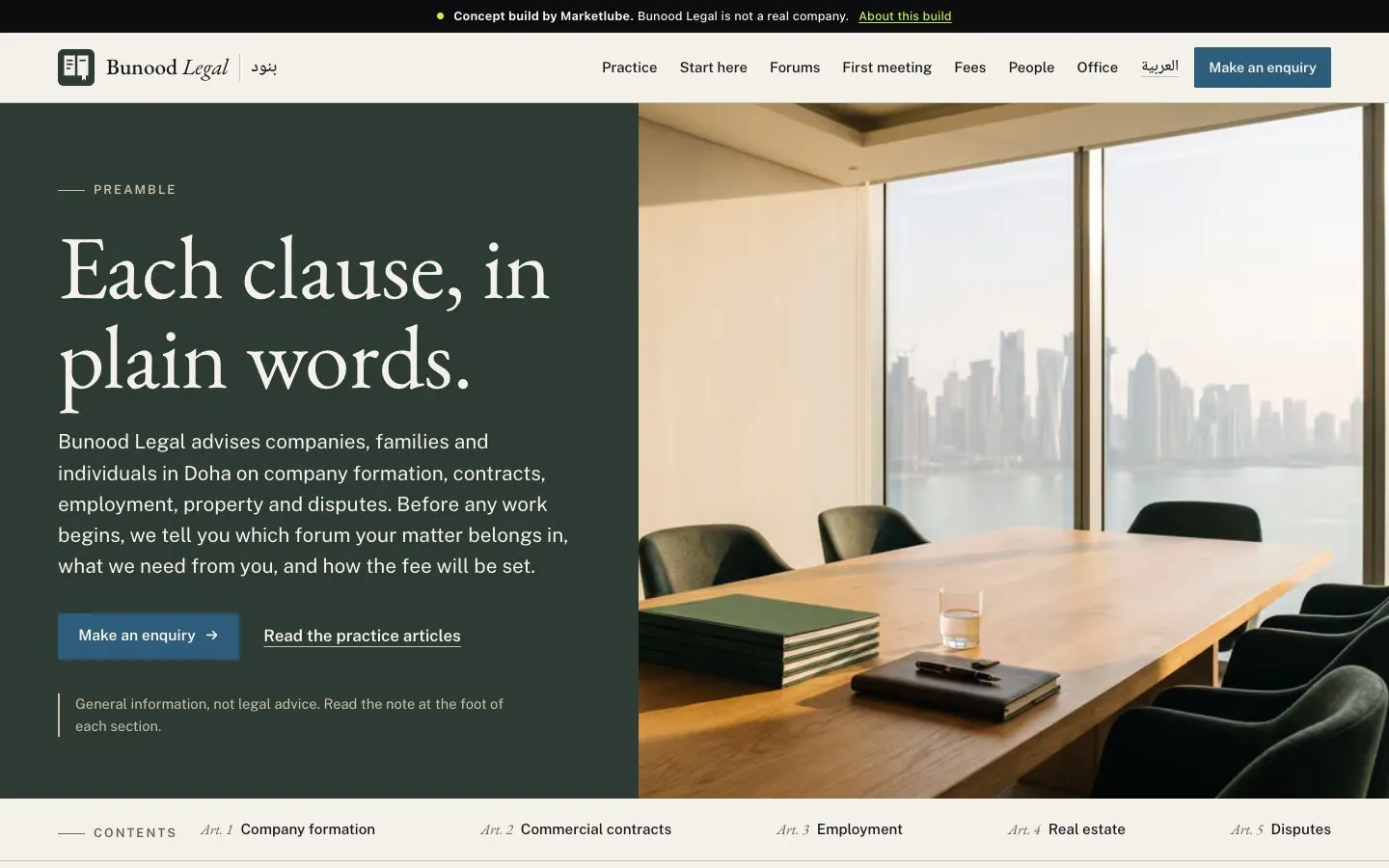
Concept build · Bunood Legal, a law firm website for Doha

Concept build · Bunood Legal, further down the homepage
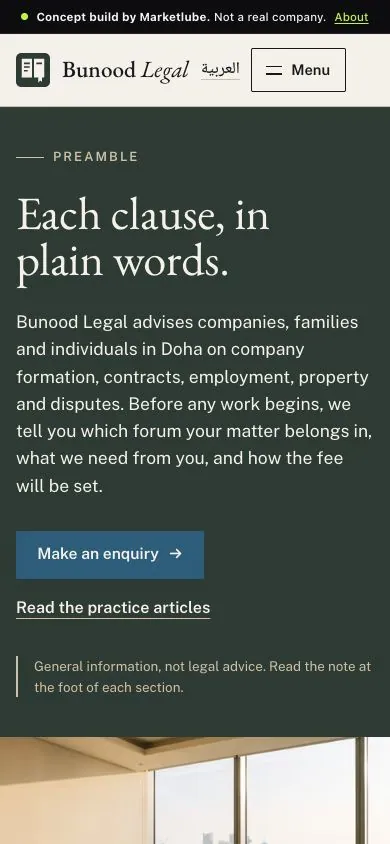
Concept build · Bunood Legal on a phone
Bunood Legal, a concept build
A law firm website is read before anyone calls.
Someone looking for a lawyer usually arrives with a problem and very little patience: a contract that has gone wrong, an employee who has left, a property deal stuck with a developer. They read practice pages to see whether the firm handles their kind of matter, look at the people to see who would take it, and then decide whether to send an enquiry. A site that lists twenty practice areas in a grid and a contact form at the bottom answers none of that.
The rules on what a lawyer may publish also change by country, and they are stricter than for most businesses. In India, the Bar Council of India's Rule 36 still restricts advertising by advocates and allows a website only within set limits. Qatar opened the door to promotion by electronic means in 2025, under rules from its admission committee. Saudi Arabia's 2021 code of conduct restricts advertising of legal services through electronic means. So a law firm site is designed around what the firm is allowed to say before it is designed around how it looks.
We build the features and the structure; the firm and its own lawyers decide the wording of disclaimers, profiles and claims. Nothing on this page is legal advice, and every rule below carries its source and the date we read it.
What the site must say, and what it must not.
Show who may act, and in what capacity
What we build: Lawyer profiles built on fields, not free text: role, admission or licence, languages, practice areas and the office each lawyer works from. In the UAE, Federal Law 34 of 2022 separates advocates, who have rights of audience before the UAE courts, from legal consultants, who may not appear in court, so a profile should never blur the two titles.
What you get (4)Show less
- A profile template with a fixed field for title and admission, filled from the firm's own records
- Practice areas on each profile that link both ways to the practice pages
- Languages each lawyer works in, so an Arabic or Malayalam speaker finds the right person
- Plainly marked empty slots for licence details until the firm confirms them
Source: Norton Rose Fulbright, New UAE and Dubai laws bring in tighter regulation of UAE legal professionals, read 28 Oct 2026
Explain practice areas without promising outcomes
What we build: A practice page per area, written around the matter rather than the firm: what this kind of matter usually involves, which forum or authority it tends to reach, what the first meeting needs and what the firm will tell the client before work starts. No win rates, case values or directory badges unless the firm's regulator allows them and the firm signs them off.
What you get (4)Show less
- One page per practice area with its own heading, summary and fold-out detail
- A short list of documents to bring, specific to that area
- A general-information note under every article, worded by the firm
- Links from each area to the lawyers who handle it
Take an enquiry without receiving confidences too early
What we build: An enquiry form designed for a conflict check: the client's name, the names of the other parties and a one-line summary, then the practice area and preferred language. It tells people not to send confidential documents until the firm confirms it can act, and asks them to confirm that an enquiry does not create a lawyer and client relationship. Under Qatar's data law guidelines, consent to direct marketing has to be explicit and affirmative, and pre-ticked boxes may no longer count, so newsletter consent sits apart from the enquiry.
What you get (5)Show less
- Fields for the other parties' names, so the conflict check can start before anyone reads the matter
- No file upload on the first form, by design
- An acknowledgement checkbox and a separate, unticked consent for updates
- Routing by practice area to the right lawyer's inbox
- A reply promise the firm sets: who answers and within how many working days
Source: Clyde & Co, New regulatory guidelines on the Qatar Personal Data Privacy Protection Law, read 28 Oct 2026
Help a client work out where their matter starts
What we build: A short matter triage: three questions on who the client is, what the matter concerns and how soon a date falls, answered in the browser with the lawyer who usually leads, what to prepare and a likely first step. The answer carries the matter type into the enquiry form. Every result ends with a line saying it is general information to help the client prepare, not a decision on their case.
What you get (4)Show less
- Three questions with plain answers, built and tested with the firm's partners
- A result that names a practice group, never a predicted outcome
- A printable checklist of what to bring to the first meeting
- The answers passed into the form, so the client does not type them twice
Carry the details a regulated profession must publish
What we build: A footer and legal notices page that hold the firm's registration and professional details in one place. Qatar's e-commerce law (Decree-Law No. 16 of 2010) asks a provider to keep its name, address, email and register details easily accessible, and Article 52 adds, for a regulated profession, the professional body it is registered with, its professional title and the country that granted it, and how to reach the professional rules that apply.
What you get (4)Show less
- A legal notices page with the firm's registration, licensing body and professional titles
- Links to the professional rules that apply, where the regulator publishes them
- The same details in the footer of every page, in each language
- Disclaimer, privacy and cookie notices placed where the firm's lawyers want them
Source: WIPO Lex, Qatar Decree-Law No. 16 of 2010 on Electronic Commerce and Transactions (unofficial English text), read 28 Oct 2026
Stay inside the Bar Council of India's limits
What we build: For an Indian practice, a site that keeps to what Rule 36 and its 2008 proviso allow: name, contact details, enrolment, qualifications and areas of practice, with no client lists, results or testimonials. The site also carries a disclaimer, and many Indian firms show it before the site opens, asking the visitor to confirm they are seeking information of their own accord; we build that as a light, accessible screen that remembers the answer.
What you get (4)Show less
- A disclaimer screen worded by the firm, shown once and remembered
- Profiles limited to the particulars the firm decides it may publish
- No testimonial, ratings or results blocks in the build at all
- Insight articles framed as general information on the law
Source: India Legal, Rule 36 at the crossroads (Supreme Court revisits rule banning advocates from self-promotion), read 28 Oct 2026
Arabic that says the same thing as the English
What we build: An Arabic version drafted for Arabic readers, laid out right to left with its own addresses, and linked to the English with hreflang. Legal terms rarely carry over word for word, so the Arabic text is written by a native writer and checked by one of the firm's Arabic-speaking lawyers before launch, so that both versions make the same promises and carry the same disclaimers.
What you get (4)Show less
- A mirrored right-to-left layout with Arabic type set properly, not a translate button
- Matching page names and numbering in both languages
- A review round reserved for the firm's lawyer to check the Arabic
- A language switch that opens the same page, not the home page
Set out fees and engagement before work begins
What we build: A fees and engagement page that explains how the firm charges, in words: fixed fees for defined work, hourly rates with stage estimates, or a monthly retainer, and what is paid at cost, such as court fees, translation and notarisation. It then walks through the steps from first message to engagement letter, so a client knows what will be agreed in writing.
What you get (4)Show less
- Fee bases explained without figures, unless the firm chooses to show them
- A numbered timeline from enquiry to conflict check, meeting and engagement letter
- A note on disbursements and the currency fees are quoted in
- First-meeting terms the firm confirms when a client books
Bunood Legal: a concept build to click through.
Bunood Legal is a concept build: a working homepage we designed and built for a fictional brand, so you can try the layout and its tools on your phone before we build yours. It is not a client. See every concept build.
Concept build · Legal · Doha
Bunood Legal
Bunood Legal is a made-up commercial and private-client firm set in West Bay, Doha, built in English and in Arabic to show what a law firm website for Qatar can do. It speaks to companies and employers, families and individuals, and investors arriving from abroad, most of whom want to know where their matter will be heard and what to prepare before they get in touch. Its lawyers are invented and the page offers no legal advice, but the matter triage, the forum guide, the first-meeting checklist and the switch between languages all respond in the browser.
A site map built around practices and people.
- HomeWho the firm acts for, its main practice areas and the way to start: the triage, the enquiry form or a call. Office hours for that country's working week sit in the first screen.
- Practice areasAn index of the areas the firm handles, grouped for companies and for individuals, each with a one-line description of the matters it covers.
- One page per practice areaCorporate, employment, property, disputes, family or whatever the firm does: what the matter involves, what to bring, the lawyers who lead it and a general-information note.
- PeopleA profile per lawyer with title, admission, languages and practice areas, plus a filter by area and language. Photographs only where each lawyer agrees.
- Start hereThe matter triage and the first-meeting checklist on one page, for visitors who do not yet know which practice area they need.
- Fees and engagementHow fees are set and the steps from first message to engagement letter, including what happens about conflicts of interest.
- InsightsDated articles on changes in the law, each with an author, the jurisdiction it covers and a reviewed-on date, so an old note is never read as current.
- CareersOpenings for associates, paralegals and interns or articled clerks, with what the firm looks for and how to apply.
- Contact and enquiryThe conflict-check form, the office address with parking or access notes, a map, and the hours in the local time.
- Arabic versionEvery page above in Arabic, right to left, for Gulf firms, or a Malayalam summary for Kerala practices whose clients prefer it.
- Legal noticesThe disclaimer, privacy notice, cookie notice and the firm's registration and professional details, in each language the site uses.
What changes in Qatar, the UAE, Saudi Arabia and Kerala.
Qatar
Law No. 19 of 2025 amended the Legal Profession Law (Law No. 23 of 2006) so that lawyers may promote their services through traditional and electronic means, under regulations set by the Attorneys' Admission Committee. That makes a fuller website possible, but the committee's regulations decide what goes on it, so we leave claims and badges out until the firm has checked them. Our Bunood Legal concept build is set in Doha, with an Arabic version and a forum guide for national courts, the QFC and arbitration.
Source: QNA, Ministry of Justice: amendments to Legal Profession Law, read 28 Oct 2026
The UAE
Federal Law 34 of 2022 on the advocacy and legal consultancy profession has applied since 2 January 2023, and in Dubai the Legal Affairs Department regulates lawyers, with its own conduct and violations committees. A Dubai firm's site therefore names each person's title as the regulator records it. Enquiry forms follow the federal data law, Decree-Law 45 of 2021, which covers processing inside or outside the country, so it still applies when the site is built from Calicut; the government's data law page lists the DIFC's own Data Protection Law (DIFC Law No. 5 of 2020) beside it, which a firm in that centre checks with its own lawyers.
Source: u.ae, Data protection laws, read 28 Oct 2026
Saudi Arabia
The Code of Conduct for Legal Professionals, announced on 4 September 2021, has a chapter that restricts the advertisement of legal services in the mass media and through electronic means, social media included. A Saudi firm's site is kept factual: practice areas, people and how to get in touch. Enquiry data falls under the PDPL, which has applied since 14 September 2023, reaches processing outside the Kingdom of data about its residents, and expects breaches to be reported to SDAIA within 72 hours.
Source: Clyde & Co, New rules of professional conduct for lawyers in the Kingdom of Saudi Arabia, read 28 Oct 2026
Kerala and India
Rule 36 of the Bar Council of India Rules bars advocates from soliciting work or advertising, and a proviso added in 2008 lets them publish website information set out in a schedule, under intimation to and as approved by the Bar Council of India, such as name, contact details, enrolment, qualifications and areas of practice; anything beyond the approved particulars can be treated as misconduct. India Legal reports that in 2026 the Supreme Court sought responses from state bar councils on a petition about advocates' online solicitation under the rule; there is no decision yet. A Kerala practice's site is built to the current limits, and its enquiry form is ready for the DPDP Rules, whose notice and consent duties apply from May 2027.
Source: itatonline, Advertisement by Advocates (BCI resolution amending Rule 36), read 28 Oct 2026
What a law firm website costs.
- Business websiteCustom design, up to 8 pages · 4 to 8 weeksfrom INR 60,000 · AED, QAR or SAR 8,000 · KWD 650 · OMR or BHD 800
- Next.js website with a CMSHeadless CMS, up to 15 pages · 8 to 14 weeksfrom INR 2,00,000 · AED, QAR or SAR 15,000 · KWD 1,250 · OMR 1,550 · BHD 1,500
- Website care planBilled yearly · starts within a weekfrom INR 3,000 · AED, QAR or SAR 500 · KWD 40 · OMR or BHD 50 a month
Figures are before GST in India and before VAT where it applies in the Gulf; Qatar has no VAT or sales tax in force. The written quote for a law firm lists the number of practice and profile pages, the Arabic or Malayalam version and who drafts and checks it, the triage questions, enquiry routing by practice area and any second office.
What the build includes
- A practice page per area, with documents to bring and the lawyers who lead it
- Lawyer profiles with title, admission, languages and practice areas as fixed fields
- A conflict-check enquiry form with acknowledgement, routing and separate marketing consent
- A matter triage and a printable first-meeting checklist
- A fees and engagement page explaining the firm's fee bases in words
- An Arabic right-to-left version linked with hreflang, for Gulf firms that need one
- A legal notices page and footer with the firm's registration and professional details
- An insights section with authors, jurisdictions and reviewed-on dates
- LegalService structured data for each office and Person markup on each lawyer's profile, so searches for a lawyer's name find the right page
Not included
- Writing the disclaimer, privacy notice or terms: the firm's own lawyers word them, and we place them
- Checking the site with the bar council or admission committee, or any notification it requires
- Certified legal translation; we arrange a native Arabic writer, and the firm's lawyer checks the text
- A secure client portal for sharing documents, which is quoted as separate software
- Photography of the lawyers and the office
Five steps. No surprises.
Every stage has an owner, a deliverable and a sign-off, all agreed with you before it starts.
Book a discovery callA call about what the firm may say
The first conversation is with the managing partner, not the marketing team. Before any design, we ask which bar or regulator each lawyer answers to, what the firm already publishes and what it will not publish, because that sets the limits for every page.
Practice and people inventory
You send the list of practice areas and lawyers, and we turn it into a site map and a profile field list. We agree the triage questions and the documents list for each area with the partners who handle that work.
Design, then both languages
We design the practice page, a profile and the enquiry form first, then the rest. The firm writes or approves every claim; where there is an Arabic version, the firm's Arabic-speaking lawyer checks it in its own review round.
Build and test the enquiry path
We build the site and test the path from triage to form to the right lawyer's inbox, on phones first. Test enquiries use made-up names, and nothing confidential goes into the system while we build.
Sign-off, launch and care
Nothing goes live until a partner has signed off every profile, practice page and notice in each language. After launch, the care plan covers the jobs a firm forgets: a new associate's profile, a lawyer who leaves, and a reviewed-on date on any insight that a change in the law has overtaken.
Law firm websites, answered.
The team is in Calicut, India
1414, 4th Floor, Phase 1, HiLITE Business ParkKozhikode, Kerala 673014Mon–Sat · 9:30 am to 6:30 pm
Can advocates in India have a website?
Yes, within limits. Rule 36 of the Bar Council of India Rules restricts advertising and soliciting work, but a proviso added in 2008 lets advocates publish website information set out in a schedule, such as name, contact details, enrolment, qualifications and areas of practice. Anything beyond the approved particulars can be treated as misconduct. In 2026 the Supreme Court sought responses from state bar councils on a petition about advocates' online solicitation under the rule; there is no decision yet. Check the current position with the Bar Council of India and your state bar council before launch; this is not legal advice.
Why do Indian law firm websites show a disclaimer before the home page?
Because of the Bar Council of India's restriction on advertising. Many firms ask the visitor to confirm that they are seeking information of their own accord and that nothing on the site is an invitation or legal advice, before the site opens. It is a firm's own precaution rather than a set wording, so the firm's lawyers write it and the site remembers the answer so it is not asked on every page.
What should a law firm's enquiry form ask for?
At first, only what a conflict check needs: the client's name, the names of the other parties and a one-line summary, plus the practice area and preferred language. Say that an enquiry does not create a lawyer and client relationship, ask people not to send confidential documents until the firm confirms it can act, and keep any newsletter consent as a separate, unticked box.
Can lawyers in Qatar advertise online?
Since Law No. 19 of 2025 amended the Legal Profession Law, lawyers in Qatar may promote their services through traditional and electronic means, under regulations set by the Attorneys' Admission Committee, and breaches can bring disciplinary action. A website is allowed; what it may claim depends on those regulations, so the firm should check its wording against them before launch.
Should a law firm website show case results and client testimonials?
Usually not. Indian advocates are limited to set particulars, Saudi Arabia's code of conduct restricts advertising through electronic means, and outcomes in legal work depend on facts that one result does not show. Practice pages that explain what a matter involves and what to prepare tend to help a reader more than a list of wins.
Should a UAE law firm publish its practice pages in Arabic as well as English?
No single rule requiring it was found when this page was written, but a firm with Arabic-speaking clients, or one that handles matters for Emirati companies and families, is read more easily with a full Arabic version. It should be drafted for Arabic readers rather than translated word for word, laid out right to left, and checked by one of the firm's own lawyers so both versions say the same thing.
Further reading
- Our Bunood Legal concept build, a law firm website for a fictional Doha firm
- Website development for Qatar
- Website development for Dubai and the UAE
- Website development for Saudi Arabia
- Designing a site in Arabic and English
- A DPDP compliance checklist for Indian businesses
- Web development
- Pricing
- All our projects and concept builds
Sources
- Norton Rose Fulbright, New UAE and Dubai laws bring in tighter regulation of UAE legal professionals, read 28 Oct 2026
- Clyde & Co, New regulatory guidelines on the Qatar Personal Data Privacy Protection Law, read 28 Oct 2026
- WIPO Lex, Qatar Decree-Law No. 16 of 2010 on Electronic Commerce and Transactions (unofficial English text), read 28 Oct 2026
- India Legal, Rule 36 at the crossroads (Supreme Court revisits rule banning advocates from self-promotion), read 28 Oct 2026
- QNA, Ministry of Justice: amendments to Legal Profession Law, read 28 Oct 2026
- u.ae, Data protection laws, read 28 Oct 2026
- Clyde & Co, New rules of professional conduct for lawyers in the Kingdom of Saudi Arabia, read 28 Oct 2026
- itatonline, Advertisement by Advocates (BCI resolution amending Rule 36), read 28 Oct 2026
- DLA Piper, Data Protection Laws of the World: Saudi Arabia, read 28 Oct 2026
- PwC Worldwide Tax Summaries, Qatar: other taxes (no VAT or sales tax in force), read 28 Oct 2026
- Mondaq, Digital Personal Data Protection Rules, 2025 notified, read 28 Oct 2026
Law firm websites
Let's build your website.
Tell us what the site has to do and who it is for. A strategist replies within one working day, from our team in Calicut.
Every rupee you spend with us has to earn its keep.