The AI video production process behind three films for Tagus Global in Saudi Arabia: script, cast, keyframes, animation, logo checks, voice and the edit.
- Published
- Reading time
- 9 minutes
Drafted with AI tools; researched, edited and approved by Althameem Ali. Our editorial policy
On this page · 8 sections
- What did the client ask for?
- How does an AI video production process work, step by step?
- How do you keep the same people and the brand's logo in every shot?
- What did the AI get wrong, and how did we catch it?
- What do the checks before delivery look at?
- How long does AI video production take, and what does it cost?
- When is AI video the wrong choice?
- Watch the films, then brief us
We make AI films for brands in Kerala, across India and in the Gulf as an AI video production team in Calicut. This post walks through one real job from start to finish: three films for Tagus Global, a freight and logistics group in Saudi Arabia whose relocation team moves homes, pets, vehicles and offices abroad. All three play in full, with sound, on our AI videos page.
The films are a 46-second vertical reel that follows a family from one enquiry to a new home, a 46-second cinematic version in 16:9 for YouTube and the website, and a 24-second reel built from the client's own storyboard about why stronger boxes matter. Each was made within a working day, and the last one went from storyboard to finished cut in under two hours of production time.
What did the client ask for?#
The first brief was a script for a high-energy vertical ad: fast cuts, an energetic American voice, good music and, in the founder's words when he passed it on, "the same exact logo" of Tagus on the videos. A day later came a second ask: a cinematic version in landscape, slow camera moves, professional sound, and the logo shown where a real company's logo would be, on moving boxes and vehicle livery rather than pasted over the footage.
The third brief was a storyboard: eight shots, laid out by the client's team. A crushed ordinary carton. A hand pressing on a Tagus box. A side-by-side of 3-ply and 5-ply board. A vase wrapped in bubble wrap, cushioned with packing paper, then a box sealed and labelled. The crew working through a villa, and the cartons going onto a Tagus truck at sunset. The message was simple: Tagus doesn't pack in regular boxes; it chooses its materials for strength.
How does an AI video production process work, step by step?#
These are the steps we ran for all three films. They're the same steps we follow for any AI film.
- Script or storyboard, approved. Every line of the voice-over and every shot is written down before anything is generated. For the packing reel, the storyboard set the shots and we wrote a nine-line voice-over that times to them.
- Cast and references. We fixed one Saudi family, one Saudi crew and the Tagus uniform as reference stills, and uploaded the logo artwork from the brand's guidelines. Every shot is generated from these, so faces, clothes and the brand stay the same from shot to shot.
- Keyframes. Each shot is generated first as a still image (we use Nano Banana Pro on Higgsfield), in the final format, 9:16 or 16:9. Stills are cheap to redo, so this is where we fix composition, casting and branding.
- Animation. Approved stills are animated into five-second clips (Kling 4.0 on Higgsfield), each with a written camera move: a slow push in, a crane down, a lateral slide.
- Voice and music. The voice-over is generated (ElevenLabs on Higgsfield) and the music composed for the film (Sonilo on Higgsfield), then a second ear checks the takes before we pick one.
- The edit. Cuts land on the beat and on the spoken word, titles and captions are added, the exact logo goes on the end card with the phone number and email, and sound effects are placed by hand.
- Checks. Every frame, every title and every transition is checked before delivery: more on that below.
- Delivery. An MP4 for Instagram and the ads, a preview copy, and a short credits note listing what was generated and with which tools.
How do you keep the same people and the brand's logo in every shot?#
By never asking the AI to invent them twice. Reference images do the work. The crew in the reel and the crew in the cinematic film are the same men, in the same deep green polos with the Tagus mark on the chest, because every keyframe was made from the same reference stills.
The cast itself was a decision, not a default. The client is in Saudi Arabia and so are its customers, so the families and the crew are Saudi. Some of the storyboard's sample frames showed a different crew, so we recast those shots from our Saudi reference cast before anything was animated. A film for a Gulf brand that looks like it was cast somewhere else loses trust in the first second.
Logos need two kinds of care. On cartons, uniforms and the truck, the logo is drawn into the scene by the image model from the real artwork, which is what makes it sit on the cardboard and the paint like real printing. Then we compare each one against the brand's vector logo, and anything that drifts is regenerated or fixed before animation. On the end card, the logo is the exact vector artwork, never a generated copy.
What did the AI get wrong, and how did we catch it?#
The most useful example is the board. The storyboard compares 3-ply and 5-ply cardboard, and the first images got the layers wrong: the "3-ply" sheet showed four rows of flutes, and the "5-ply" showed three. A 3-ply board is single wall, two flat liners with one fluted layer between them. A 5-ply board is double wall, three liners with two fluted layers. Three fluted layers would be 7-ply.
Image models are poor at counting. We regenerated both boards with the counts spelled out, tried two models side by side, and kept only the frames with the right construction. Anyone in the packaging trade would have spotted the mistake, and the film is about exactly that detail.
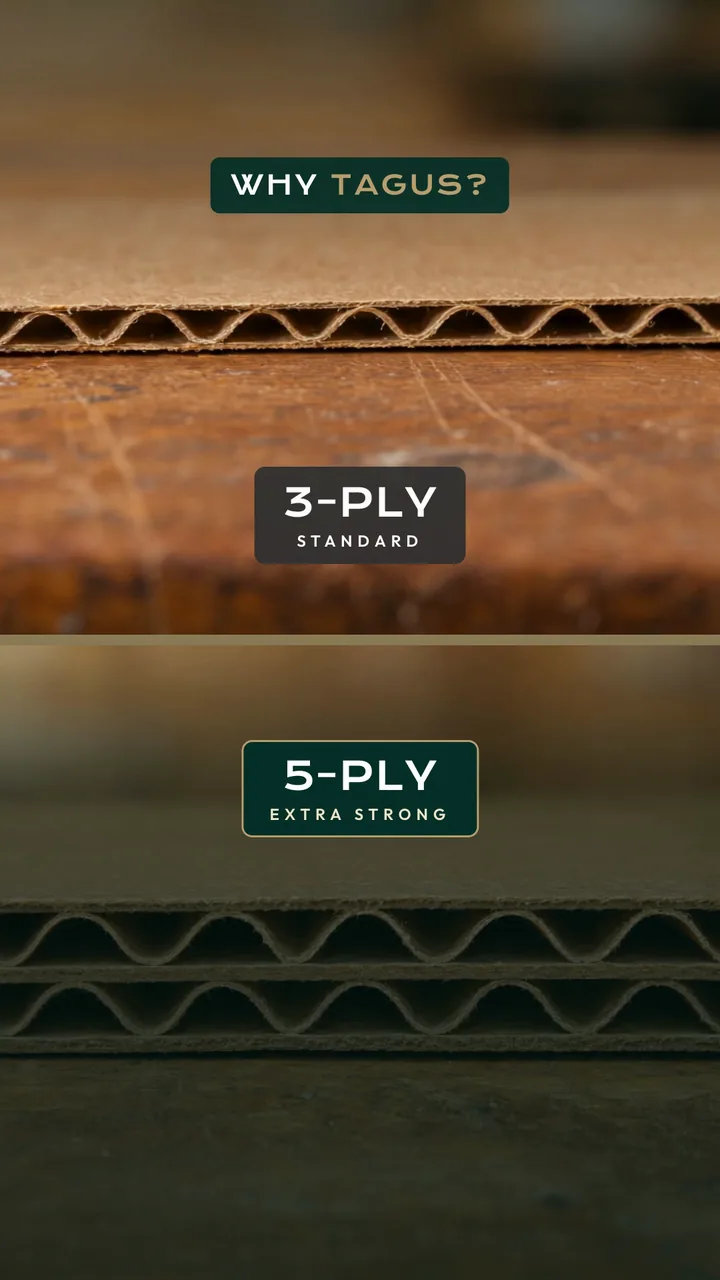 (opens the full-size image in a new tab)The split screen in the finished reel: 3-ply (one fluted layer) above, 5-ply (two fluted layers) below.
Two smaller catches came from the truck shot. The first version showed green cartons going into the truck, when every other shot had brown kraft boxes with green print, and the next version cut the logo on the truck's side off at the frame's edge. Both were regenerated before animation, because a slow push in would only have made them worse.
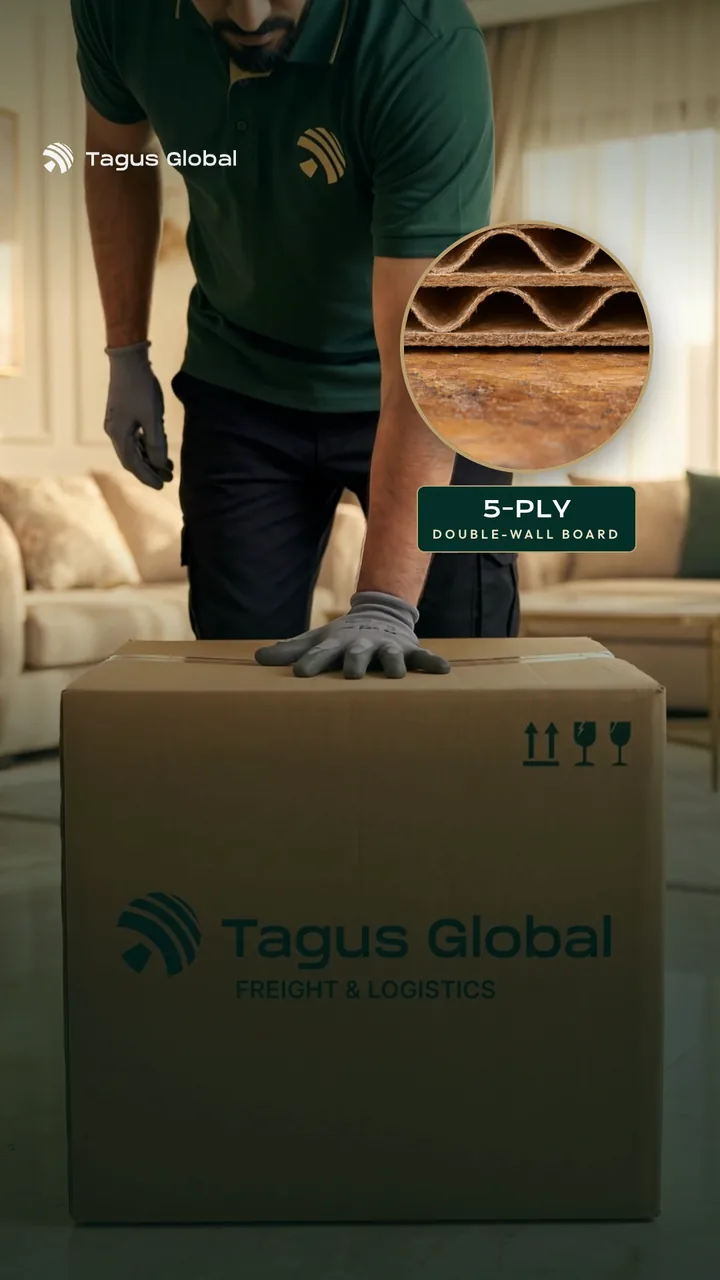 (opens the full-size image in a new tab)The press shot: the carton holds its shape, and the lens shows the double-wall board it is made of.
What do the checks before delivery look at?#
Most of the hours in an AI film go into checking, not generating. Before any of the three films went out, a person checked:
- Faces and hands in every shot, at the start, middle and end of each clip, because animation can drift.
- Logos and labels, on cartons, polos and the truck, against the brand's artwork, and the FRAGILE and THIS WAY UP labels for spelling.
- Facts, such as the board layers, the phone number and the email on the end card.
- Every title and caption, frame by frame, for anything cropped, hidden behind a person, too low in contrast or on screen too briefly to read. On the cinematic film, our founder spotted titles that flashed for a few frames before animating in; we fixed them and now run that check at every frame, not every tenth of a second.
- Every transition, for flicker: a dissolve needs both shots on screen for its whole length, or the black behind shows through.
- The sound, for clipped words, music masking the voice and loudness, set for social platforms.
Then our founder watched and listened to every film before it went to the client. No automated check replaces that.
How long does AI video production take, and what does it cost?#
For these three films, each one was made within a working day, and the packing reel took under two hours of production time from the storyboard to a finished cut, with revisions after review on top. A shoot with the same scenes (a villa, a crew, a truck at sunset, macro shots of board) would have needed locations, a crew and days.
The generation itself is a small part of the cost. The packing reel used about 130 Higgsfield credits, retries included. Most of the price is people: the script, the casting decisions, the checks and the edit. We price every AI film per brief, by its length, the number of scenes, the versions and formats and whether real footage goes in, and send a written quote before anything starts.
When is AI video the wrong choice?#
When the viewer needs to trust that what they see is real. For a mover, that means a testimonial, the real team on a real job, or the real trucks a customer will see on moving day; those should be filmed. AI is right for what these films do: show the promise and the process, at a quality and in places a small shoot couldn't reach. Our guide to AI video ads and a real shoot sets out how to decide, and our video production team films the cases where a camera wins.
Watch the films, then brief us#
All three Tagus films play whole, with sound, on our AI videos page, in their own row above the rest of our AI work. The brand behind them is on our Tagus Global brand study.
If you're a company in Saudi Arabia, the UAE or Kerala with a launch, a service to explain or a market to open, our AI-first agency page shows what else we build with AI, from agents to CRMs. Or send us the brief on our contact page: we'll come back with a script, style frames and an honest call on what to make with AI and what to film.
Related services
Written by
Co-founder, Marketlube
Althameem Ali researched, edited and approved this post. Marketlube is a growth partner in Calicut building brands, websites, CRMs and campaigns for businesses across Kerala, India and the Gulf.